Priorat, as it is known in the local Catalan (Priorato in Castilian), is named after the priory established here in the hills above Tarragona by Carthusians who arrived from Provence in the 12th century, possibly bringing Garnacha (Grenache) vines with them. Certainly Garnacha was the variety of choice in what were extensive vineyards until the phylloxera louse arrived at the beginning of the 20th century. Thousands of hectares of vineyards and a flourishing industry making mainly sacramental wine had become just 600 hectares in a rugged, depopulated landscape by 1979 when René Barbier, brought up in the wine business to the north east in Penedès, first arrived and saw the potential of the ancient vines growing here.
It took some skill to identify the most promising plots of ancient Garnacha vines. Post-phylloxera Carineña (Carignan in French) had been adopted as a much more productive variety. But by the late 1980s Barbier was joined by four fellow enthusiasts who applied modern winemaking techniques and small French oak barrels to the best local fruit. The first exponents of modern Priorat were a band of five, all operating from the same sun-scorched, barn-like winery sunk into the rock in the hardly-village of Gratallops, fashioning wine from their own carefully selected vines and selling them under five remarkably similar-looking labels, all beginning with the word Clos.
Clos Mogador was Barbier's own label. Clos Martinet belonged to José Luis Pérez, another far-sighted pioneer who now has his own bodega, Mas Martinet, towards the nearby town of Falset. Clos de l'Obac belonged to the local mayor whose wine company is now Costers del Siurana, while Clos Erasmus is the creation of Daphne Glorian and is seen almost exclusively in the US where her husband is wine importer Eric Solomon. The fifth Clos was Clos Dofi, renamed Finca Dofi in 1994, and the creation of Alvaro Palacios, the public face of Priorat and maker of Spain's most famous wine, L'Ermita. L'Ermita,is imported into the UK by Corney & Barrow who say of it ominously in their new price list 'Price on Application'. US importer is the Rare Wine Company (www.rarewineco.com) which can offer a wide range of vintages of all three of Palacios's Priorat – as well as his exciting new Bierzo.
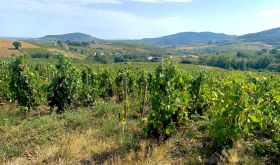
Palacios was brought up in a family wine business in Rioja Baja, Palacios Remondo, but fell for the extraordinary natural environment of Priorat. It looks impressively distinctive to the most casual visitor (of which there are, still, relatively few – the infrastructure is still embryonic). But to a young man who had just fallen in love with great wine, conscious that Spain was still regarded as a second class wine producer at best, the vertiginous hillsides of Priorat must have looked like El Dorado. The most important natural element of Priorat is a very particular sort of schist, called llicorella locally, which really does sparkle in the sunshine. Dark brown, heavily striated and pimpled, it looks not unlike a burnt paper wrapper of an amaretti [biscuit]. It is a relatively soft rock which has the great attribute of being both cool and damp enough to nourish deep-rooted vines in the particularly dry, mediterrean summers of Priorat.
The best vineyards tend to be on infertile hillsides facing north and east to avoid sunburn and catch breezes from the Mediterranean at middle altitudes around 500 m. Much higher and the soils are not schistous enough; too low and the soils are too fertile and warm to make wines of sophistication. L'Ermita, all 4,000 bottles of it, comes from a 60 degree slope of llicorella on which vineyard workers (mainly from the Ivory Coast when I visited in 2000) really ought to be roped and issued with a few crampons.
In fact tasting my way through this fascinating and extremely varied collection of Priorat 2001s I found the most common fault was a certain facile overripeness without any of the excitingly mineral tingle associated with llicorella. Presumably this was a reflection of the many new vineyards planted on much less suitable terrain. The region now has more than 1,500 hectares of vineyard in production (much of it on remodelled terraces which Alvaro Palacios believes will never produce truly great Priorat), which must also mean a high proportion of young vines and therefore less subtle fruit.
The finest Priorat vines are old, with yields as low as one bottle per fist of a bushvine, and, typically, Garnacha. In these soils and at these low yields, Garnacha is well capable of producing very fine, concentrated, densely fruity wine. It is remarkable, incidentally, that the pre-eminence of L'Ermita, 80 per cent Garnacha with a bit of Cabernet Sauvignon – and a tiny bit of old Carignan and Garnacha Blanca, according to Alvaro Palacios in 2000 – has not managed to upgrade the lamentably low reputation of Garnacha elsewhere in Spain where the Tempranillo grape reigns supreme. (If vines as early-maturing as Tempranillo and Pinot Noir were planted in Priorat, they would have to be picked in mid August apparently.)
I have long thought that a good Priorat is one of the most obviously terroir-driven wines in the world. Drinking young Priorat, like wines from the Wachau's Achleiten vineyard in Austria, can be remarkably like sucking a stone, in the nicest possible way of course. The wines I tasted divided pretty obviously into those which displayed the fine, grainy tannins of old vines grown on steep schist and those which may have been perfectly well-made, ripe, juicy reds but could plausibly have come from anywhere.
Old vines in Priorat are either Garnacha or Carignan. Seriously old Carignan can produce interesting wine, and producers such as Cims de Porrera base as much as 85 per cent of their Classic bottling on this variety, whose wine can often taste hard and tart if the vines are less than 15 years old. No-one is wasting the precious vineyard land planting Carignan. Much more likely candidates are either Garnacha or Cabernet Sauvignon, Merlot and Syrah which are all permitted ingredients by the local regulations, although Merlot does not tend to shine here. All sorts of varietal assemblages are sold as red Priorat today (and full bodied, almost flabby, white versions exist too) but old-vine Garnacha is the mainstay of most of my favourites.
Since the region is so young, in its highly successful modern idiom anyway, it is difficult to work out how well these wines, often very high in tannin, will age. A handful of Clos wines from the early 1990s tasted recently hardly yielded a pattern. Clos Martinet 1992 tasted like nothing more than a lovely mature Pomerol from a soft vintage such as 1990 while others of the same age seemed years off being ready. But perhaps this was the result of early winemaking techniques and their more rustic tannins. The Priorat winemaker of today is clearly tinkering away like mad with his extraction techniques and fermentation in barrel ( René Barbier's newish Clos Manyetes bottling being a fine example).
Only in the last five minutes have I examined my detailed tasting notes and realised, as shown in the box, that four of my six favourite 2001s were made by the original Clos pioneers.
My favourite 2001 Priorats
L' Ermita 2001 Álvaro Palacios
(Clos Dofi 2001 not tasted)
Clos Erasmus 2001 Daphne Glorian
Clos Fontá 2001 Mas D'en Gil
Clos Mogador 2001 René Barbier
Clos de L´Obac 2001 Costers del Siurana
Lo Givot 2001 Celler del Pont
Clos Martinet 2001 Mas Martinet
See also tasting notes in purple pages for full details and scores on many more Priorats.
PS I have been reminded that South African Eben Sadie's Dites del Terra 2001 Priorat is particularly fine too. Much more refined than most.