Last time I wrote about the emerging 2020 vintage I was branded ‘a denier’, ‘a dinosaur’ and ‘an angry old white man with a tin ear’, among other compliments. Let me begin this final version with a disclaimer: A hotter and drier future cannot be denied or avoided and each of us can and should do our utmost to mitigate that.
So, to the weather. A normal and even budburst occurred in early September 2019 in cool, dry conditions in our three vineyards, The Tiers in the Piccadilly Valley, Foggy Hill on the Fleurieu Peninsula and Whalebone at Wrattonbully just north of Coonawarra. Little did I know then, budburst would be the only ‘normal’ interaction of weather and vine from then until February.
At that time the Australian Bureau of Meteorology (BOM) was issuing warnings of impending very hot, dry and windy conditions because of the dramatic escalation of the Indian Ocean Dipole (IOD) index to near record levels. They were also warning that the Antarctic vortex had warmed and weakened dramatically and wandered away from its polar home, out over the Great Southern Ocean, and that this implied acceleration of the trans-Australian westerly winds that were already searing hot and dry from the IOD effect. This implied the fire season was likely to begin early and potentially catastrophically. How right they were!
We experienced the first weather surprise of the 2019/2020 season on 17 September when a record low-temperature air mass slipped off the back of Mount Lofty two kilometres to the west and, during the day, stalled on top of the venerable Tiers Vineyard, destroying 90% of the barely emerging shoots of the primary buds. If there was a silver lining, it was that the frost was early enough in the season to allow the (albeit much less fecund) secondary buds to develop mature shoots and ripen their crop. After the very small Tiers crop of 2019, the frost was a ‘shrug the shoulders, whatever’ moment in the constant mental dialogue between vigneron and the weather gods. [See also Sam Cole-Johnson's reference to this frost in the first instalment of her Barossa 2020 harvest diary – JR]
October was warm and shoot growth accelerated, only to be halted prematurely by a very cold November. With the heat to follow in December contributing, the vines struggled to grow an adequate canopy in 2020 and only just staggered to the harvest finish line in March.
The cold of November persisted through flowering in each of our vineyards, interrupting the fruit-set process, which especially shrank the potential Cabernet Sauvignon crop in Wrattonbully but also affected Chardonnay set in the Piccadilly Valley. The Pinot Noir at Foggy Hill set a normal crop because of the moderating effect of the adjacent Great Southern Ocean. So far, with one out of three vineyards in the normal zone, who would have thought worse was to follow?
Then in December, consistent with BOM’s predictions, all hell broke loose! Fires throughout New South Wales and north-east Victoria, some burning since August, exploded and burnt to the coast with an unstoppable ferocity televised live to the world. These were largely driven by the twin weather demons, the IOD and the Antarctic vortex.
.
South Australia first suspected it too would fall victim at some point when in late November, the inhabitants of Yorktown on the foot of the York Peninsula were forced by bushfires to retreat to the shoreline in scenes later repeated on the east coast on a much larger scale of suffering and loss.
With a name like Cudlee Creek, this little Adelaide Hills hamlet and its adjacent forest would seem an unlikely serial contributor to fire in the Adelaide Hills, but following a bit part in the 2015 Sampson Flat fire, Cudlee Creek became the source of the 20 December 2019 fire that ravaged the northern 20% of the Adelaide Hills region’s vines. About half of the vines in these vineyards were directly affected, so 10% of the Adelaide Hills GI’s vines were damaged.
The extent of smoke damage to fruit extends beyond the direct fire zone but will become quantifiable only when the 2020 vintage is fully documented. It is likely the November failure of fruit set had a greater impact on Adelaide Hills yields than either the fire or the smoke. That does not diminish the loss and anguish of those affected by the fire, among them my dear friend Geoffrey Weaver. He has already bounced back, rebuilt his infrastructure and his vineyard is well on the road to recovery.
The Adelaide Hills fire was barely contained when on 3 January Kangaroo Island lit up and the fire was not controlled until the western half of the island had been razed. Among others, my friend Jacques Lurton lost his pioneering Islander vineyards and winery. He too will bounce back.
Just to summarise Australia’s fire misery: in the 2019/2020 fire season, 18.7 million hectares were burnt, largely in five states. A total of 23,000 ha (56,835 acres) were burnt in the Adelaide Hills and 170,000 ha (420,000 acres) on Kangaroo Island. Not that fires of this dimension are unprecedented. In the 1974/75 fire season 117 million ha (289 million acres), or 15% of Australia’s land surface, burnt.
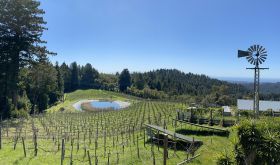
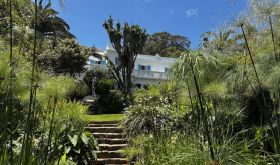
After a December and January of searing heat and fickle winds, autumn arrived early in early February. The IOD disappeared quicker than it had appeared, again as predicted by the BOM. Significantly below-average temperatures yet still-sunny days have prevailed for the past two and a half months. As I write this on 14 April, I am looking out on a golden Tiers Vineyard basking in the cool autumn sunshine having yielded up its meagre crop on 1 April (see picture above).
The critical late-summer/autumn ripening period has been perfect for eliciting the best qualities from each of our vineyards, resulting in lovely acids and the intricate flavours of cool-grown fruit, harvested a week later than normal.
‘Good things come in small parcels’ and that is certainly true of 2020 vintage for Tapanappa. Tiers yielded a third of a normal crop, Foggy Hill two-thirds and Whalebone just 20%.
In summary:
- Tiers to 31 March had a six-month heat summation of 1137 °C days versus the average of 976 °C days (Burgundy for the same period is 1136 °C days) [see the Oxford Companion entry on climate classification for an explanation of degree days]
- Foggy Hill racked up 1167 °C days versus the average of 1189 °C days
- Whalebone 1,365 °C day versus the average of 1,350 °C days (Bordeaux for the same period is 1367 °C days)
The cool autumnal conditions of February and March have erased the excess heat accumulated in December and January and restored 2020 to an average-temperature harvest but the memories of destruction and human misery of the fires remain.
Oh, and I almost forgot the coronavirus pandemic.
Fortunately, we have been allowed to harvest our fruit and process it in the winery despite the self-isolation and social-distancing measures being successfully enforced in South Australia. I abandoned the winery to younger people from the middle of March, going down to review the previous day’s work, leaving detailed plans and doing my microbiological work before one of the two non-overlapping vintage crews arrived for work at 7 am. These arrangements have worked and we are now pressing reds and barrelling down, having taken the last fruit from Wrattonbully on 9 April.
My 51st vintage has been unforgettable, but the wines will be worthy of contemplation into the next decade – and what memories they will evoke!