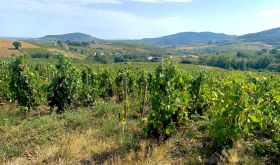

So, here we are. In the middle of 2025. A year – a milestone – I’ve been thinking about for almost three decades.
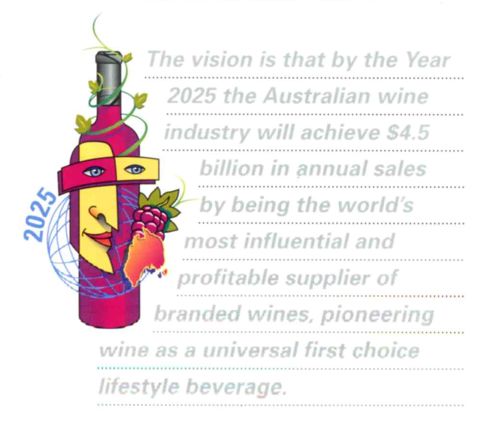
In 1996, the Winemakers Federation of Australia launched a glossy document called Strategy 2025, a rallying call to the nation’s grape-growers and winemakers to unite in the pursuit of an ambitious vision:
‘... that by the Year 2025 the Australian wine industry will achieve $4.5 billion in annual sales by being the world’s most influential and profitable supplier of branded wines, pioneering wine as a universal first choice lifestyle beverage.’
The vision captured the ebullient spirit of the times. The Australian wine industry I was reporting on in the mid 1990s (I was there at the launch of the document) was in a very different position to the one it finds itself in today.
Consumer demand – especially from the recently booming export market – outstripped supply. There weren’t enough grapes to go round. New wineries were opening at a breathless rate – more than 100 a year. The only way, it seemed, was up, and Strategy 2025 reflected this mood, calling for 40,000 ha (98,842 acres) of new vineyards and over a billion litres of new processing and storage capacity to be established over the next three decades.
The industry responded with gusto, planting new vineyards at an unprecedented rate, meeting and exceeding the required acreage in just a few years. Much of the cash for these new plantings came from outside the industry, driven by tax-incentivised managed investment schemes. But it wasn’t long after the launch of the big, bold vision that it all began to feel like it was way too much, way too fast.
As I was digging around in my filing cabinet for my old copy of the Strategy 2025 document, I came across an article I wrote in 1998, for The Weekend Australian, called ‘Put a cork in it: as newcomers rush to invest in the wine industry, old-timers are urging a little caution’. It contains a few choice quotes that sum up the impact the ‘vision’ had on the industry at the time, and the unease many were feeling following its release.
‘The pace of development has been so extraordinary that the goals we set out in the 2025 plan were pretty much obsolete within six months of it being launched’, said Winemakers’ Federation of Australia CEO Ian Sutton, one of the plan’s architects. ‘[But] There’s no doubt that there’s a lot of hot money being directed into this area, and we would question why.’
‘I’m concerned’, said respected viticulturist Di Davidson. ‘It’s time to settle down and think about where we’re going. Too many people are coming into the industry with not enough experience. And nothing is worse than an abandoned vineyard.’
‘All the projections have the sales on a steady upward line’, said one unnamed winemaker, adding, presciently, ‘But what happens if wine falls out of favour as the “universal, first-choice lifestyle beverage”? There is no defence mechanism in place in case Strategy 2025 doesn’t work.’
As the late Dr Richard Smart argued in an article for Australia’s Wine Business Magazine last year (entitled – in typically provocative style – ‘Did the Australian wine industry begin to implode in 1996?’), the frenzy of growth witnessed in that era, accelerated by Strategy 2025, is the origin of the structural oversupply that the industry is still dealing with today.
From theory to reality: fast forward to 2025
I recently talked to a few finalists and winners of the fifth annual Young Gun of Wine Vineyard of the Year Awards, an initiative I’ve been involved with since its inception, about what they thought of Strategy 2025, and what it’s like growing and making and selling wine in Australia in actual 2025.
Brett Grocke, 50, Eperosa, Barossa Valley
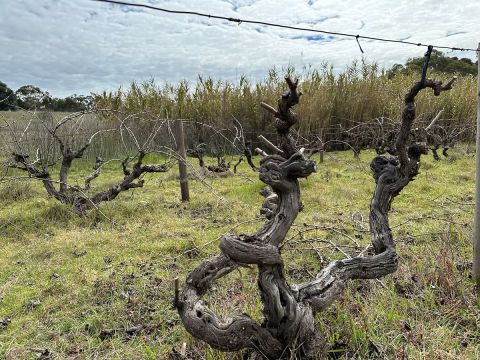
Brett Grocke won this year’s Old Vineyard award for his Magnolia block, a precious parcel of Barossa Valley viticultural history boasting Shiraz vines dating back to the 1890s and Semillon back to the 1940s.
‘I’m old enough to be aware of Strategy 2025’, says Grocke. ‘But my main memory is, having graduated [from wine school] in 2000, working with a local contractor at the time putting in huge, 100-hectare vineyards across the Barossa, working flat-out, block after block, punching in vineyard posts, irrigation, and thinking, this was a long-term recipe for disaster.’
Rather than follow that lead, Grocke ended up establishing a small label, Eperosa, with his own winery and cellar door on Krondorf Road, near well-established Charlie Melton and Rockford wineries.
‘It’s a solid, long-term investment’, he says. ‘I’m there every weekend. You have to work twice as hard to make the same amount these days. You just have to keep turning up. But it’s what customers want: making that connection.’
Dan Berrigan, 42, Berrigan Wines, Adelaide Hills
Dan Berrigan graduated just after the late 1990s boom, in 2003, and says he doesn’t feel the industry has ever been ‘going great’ throughout his career. That hasn’t stopped him persisting, though, working for other wineries and then establishing his eponymous label in 2016.
In 2020 he bought the 15-ha (37 acre) Shining Rock vineyard in the Adelaide Hills, a site first planted by Brian Croser’s Petaluma in 1999 at the height of the boom.
‘With COVID and then the China tariffs in 2020 I knew exactly what I was getting into’, says Berrigan. ‘But I thought: if I can make it through this, I’ll be able to make it through anything. Trying to hold on in the current market is the hardest part.’

Since taking over the vineyard, Berrigan has changed the varietal mix to reflect the changing market: Shining Rock was two-thirds Shiraz; now it’s less than half, replaced by the much more saleable Sangiovese, Chardonnay, Grüner Veltliner, Prosecco and even Sauvignon Blanc.
‘When I started out in the industry, the dream was to build a big brand’, he says. ‘These days I’m happy with just the one vineyard, one brand. You see well-established small brands that sell out, just on the mailing list, that’s the dream. Focus on core varieties, be the best we can off that site.’
Troy Walsh, 54, Attwoods Wine, Ballarat, Western Victoria
Troy Walsh and his wife Jane have been making wine under their own label for 15 years, from their own young vines, leased vineyards and bought-in fruit. Walsh was working as a sommelier in London at top restaurants such as The Square when Australia’s wine industry was booming post-Strategy 2025, returning to Australia in the early 2000s and shifting to winemaking. Despite the difficulties facing everyone in the industry, he feels optimistic about the future for boutique, quality-oriented producers of cool-climate Chardonnay and Pinot.
‘We’re still relatively small’, he says. ‘We crush 40 tonnes across the range. But we want to get to 70 or so. I think people will always want to buy wine; they’ll just want better quality and a connection to the producer. Especially in the Pinot and Chardonnay space: as burgundy becomes more out of reach there’s more room for us to fill that gap.’
Walsh says that he sees a lot of young people through the cellar door who want to know more about wine, who might not be drinking every day but are drinking better once or twice a week. As a result, he sells more AU$70 Pinot Noir than AU$35 Pinot.
‘My wife says I’m an eternal optimist and a dreamer’, he says. ‘Not great for a businessman, perhaps, but great for a winemaker. You have to be optimistic. What’s the alternative?’
Turon White, 37, Turon Wines, Adelaide Hills
Turon White was at primary school when Strategy 2025 was launched, so has no direct memories of it, but has kept up with more recent industry issues and politics. He says the problem with any catch-all vision – whether it be Strategy 2025 or last year’s One Grape & Wine Sector Plan – is that the Australian wine industry is really two industries: shareholder-driven, mostly larger corporate businesses and smaller owner-operators.
‘Each has different priorities’, he says. ‘Each has very different decision-making processes. Trying to do a single vision that suits everyone is not fair to anyone. For me, as an owner-operator, the only way forward is the long-term vision.’
White has invested in his long-term vision by purchasing a property at Lenswood, building a winery and establishing, one hectare at a time, a vineyard, as well as buying from other growers in the Hills and making wine under contract for eight other brands.
‘I don’t view what we’re going through as doom and gloom’, he says. ‘Yes, it’s a turbulent time, but in turbulent times there is also opportunity. There will be good times again.’
Matthias Utzinger, 40, Utzinger Wines, Tamar Valley, Tasmania

Swiss-born Matthias Utzinger didn’t move to Australia until a decade ago, so can be forgiven for having never heard of Strategy 2025 when I ask him about it. The winner of the Young Gun New Vineyard award can, however, see parallels between what happened in the late 1990s and what is happening in Tasmania today, a region that, until this year, was bucking Australia’s wine downturn trend, and seemed to be buoyant.
‘There are signs here of oversupply’, he says. ‘The 2025 vintage was massive; not all the fruit was harvested; wineries are full. A lot of vineyards have been going in where they shouldn’t have been put in. It’s a worrisome tendency. I feel Tassie is making the same mistakes as happened elsewhere: a goldrush mentality.’
Utzinger is struck by how quickly this has happened. He and his wife Lauren planted their own vineyard in 2018 because they couldn’t buy the grapes they wanted to establish their brand. Seven years later, they’re fielding phone calls every day from other growers desperate to sell grapes, some even offering fruit for free.
Despite how tough the market is now, though, like every other winemaker here Utzinger is optimistic about the future.
‘Maybe the whole thing has to bust open to reveal a different scenario’, he says. ‘More and more customers are asking where their wine comes from, how it has been grown. I feel confident that an operation like ours is moving more towards that.’
Click here to read my reviews of wines recently tasted from these producers, all of whom deserve to become very well-known indeed.
Images of the Strategy 2025 document are the author’s own.