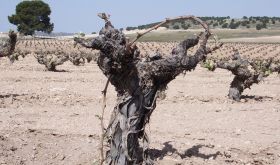
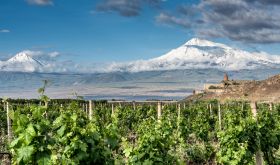
21 December 2020 Climate is a major factor in terroir. But what happens when the climate is so obviously changing, asks Dr Richard Smart. The yellowed leaves in this top vineyard on the plateau of Pomerol, which received just 45 mm (1.8 in) of rain mid June to mid September 2020, less than a third of the average, are symptoms of heat and water stress (photo by Gavin Quinney, 21 September 2020).
Have the best bordeaux wines been consumed already? Or are they in your cellar? Or maybe not yet?
You may think it strange to ask whether the best wines of Bordeaux were made some time in the past, are being made now, or will be made some time in the future. With all of this talk about climate change, which period had or has the best climate to make the best wines of Bordeaux? Was it in the years leading up to the famous classification of 1855? Or, perhaps as the climate in Bordeaux has been warming up recently, the best wine is yet to be made?
I write this article 12 months after my last article, in which I discussed the carbon footprint of wine. I continue to raise these concerns with producers and consumers alike, and to receive little response.
For example, I am yet to hear producers express concern about the continuing use of glass wine bottles, despite the costs listed in that earlier article, and I have heard of no new winery development to capture fermentation CO2 in the northern hemisphere, where grape harvest is now complete. Winemakers continue their environmental vandalism, with no censure from the authorities or from wine consumers.
Most informed wine consumers will be aware that the varying reputation of regional quality from vintage to vintage is climate-dependent. Added to this is the spatial variation from estate to estate, and even vineyard to vineyard. The climate parameters which affect wine quality have been observed for many years and are the stuff of local folklore. More recently this has been an area of scientific study, not only in Bordeaux but in wine regions around the world. Two noted Bordeaux University researchers Dr Kees van Leeuwen and Dr Philippe Darriet in 2016 published a study of factors affecting wine quality, especially in Bordeaux: ‘The impact of climate change on viticulture and wine quality’ (1).
With warmer spring and summer temperatures, the growth cycle of grapevines is completed more quickly, so the ripening and harvest period moves away from cooler autumn towards the hotter summer. This allows growers to harvest grapes at higher ripeness levels, causing an increase of some 2% alcohol by volume in the last 30 years. These authors claim that until the early 1980s, ripening was less complete and alcohol levels were too low. And so wine quality was improved by recent warming.
However, the temperature situation is not simple and clear-cut. Increasing temperatures also affect wine aromas, with potential positive and negative effects on quality. For the Bordeaux region, there is one frequent climate effect: a water deficit during the ripening period. Mild water stress as the grapes commence ripening and change colour (known as veraison) encourages rapid and uniform ripening, and improved wine quality. This phenomenon is well known and understood in the Bordeaux region, and is supported by classic terroir studies at the University of Bordeaux over several decades.
The relationship between water deficit and independent wine-quality assessment is highly significant. The frequency of water deficit is increasing with present climate change. Among the 20 driest vintages in 61 years, 10 have occurred in the period 2000 to 2012, confirming the recent drying trend in Bordeaux.
Another climate-change trend which is less frequently subject to comment is increases in ultraviolet-B sunlight (UV-B), suggested as 1–2% per decade. This radiation band enhances colour, flavonol and tannin synthesis in berries, directly affecting wine quality.
A study published in 2020 (2) took a more ambitious goal of predicting vintage quality ratings for four famous French wine regions (Alsace, Bordeaux, Burgundy and Champagne) using climate data for a 40-year period (1970–2010), and a mind-boggling 22 climate factors, rather than simply temperature, and using very sophisticated statistical analyses capable of dealing with enormous amounts of data.
The goal of this study was to use climate data as a basis for a reliable investment strategy in wine, and the authors conclude that ‘the wine quality of each region can be reliably predicted, which provides a reliable reference for wine investment’.
Bordeaux was found to have a more complex climate pattern than the other regions but could still be analysed. As well as confirming that climate is indeed dominant in affecting regional wine quality, the study indicates tantalising commercial benefits of using growing-season climate measurements to predict wine quality before bottling and sale. Tantalising indeed.
What of the future, and wine, and climate change?
Climate change has been shown to be caused by increases in atmospheric greenhouse-gas concentrations, especially of carbon dioxide. The Industrial Revolution that started in the early 1800s marked the beginning of societies’ dependence on fossil fuels. However, it was not until the early 1950s that the levels of atmospheric greenhouse gases began to rise substantially, accompanied by increases in global temperatures, and increasing climate instability. Climate change since 2000 or so is now very well established, and many wine regions worldwide are reporting earlier vintages (see this recent article about Burgundy, for example) and/or higher sugar content in harvested grapes.
The world wine map showing which varieties are grown where indicates that the interaction between climate and grape variety is predominant in affecting wine quality. In this context I am assuming the word ‘climate’ to mean regional climate. If the climate changes, then the variety needs change to a better heat-adapted one.
Here then is the dilemma which will face Bordeaux châteaux in the next 20 to 50 years. Might they move to a cooler region and plant their present famous varieties, Cabernets Sauvignon and Franc and Merlot, or, perhaps stay put in Bordeaux and grow more heat-tolerant varieties such as Syrah and Grenache? Alternatively they may resort to more PR spin to convince consumers that the wines are as fine as ever, even if they taste like wines grown in hotter regions.
The fact is that, like it or not, the famous Bordeaux terroir is changing – not the soil, but the all-important climate component. For presently cooler regions, such as Burgundy, or Central Otago in New Zealand, it is still possible to choose more adapted varieties as warming occurs (although in much of Europe local wine regulations would have to be adapted). However, for regions already enjoying quality reputations with more heat-tolerant varieties, such as Australia’s Barossa Valley with Shiraz, the situation is much more difficult as there are few well-known varieties adapted to hotter climates.
The world’s climate scientists are urging governments to agree to limiting greenhouse-gas emissions so that temperature increases are restricted to 1.5 ⁰C by 2050; current emission rates will exceed this figure, perhaps double it. I invest much time encouraging the grape and wine sector to be more carbon neutral, to make their contribution to this mitigation effort.
Conclusion
One year since my previous article, 29 more to go before 2050, and little progress to show. Which group will lead the way, producers or consumers? Right now my hope is with consumers demanding that their favourite beverage fall into line with other industries such as transport.
As to the questions posed at the top of this article, and being aware of the more substantial temperature increases recorded over the last decade, my tip is to begin cellaring about now (and keep your eye on the weather in Bordeaux, especially temperature and rainfall).
New Zealand’s then Australia’s wine industry have pledged to be carbon neutral by 2050; when might some others join them?
References
1 C van Leeuwen, P Darriet, ‘The Impact of Climate Change on Viticulture and Wine Quality’, Journal of Wine Economics 11 (2016), 150–67; https://doi.org/10.1017/jwe.2015.21
2 Ya-Lun S Tsai, Shih-Yuan Lin, ‘Big climate data assessment of viticultural conditions for wine quality determination in France’, Oeno One, October 2020; https://doi.org/10.20870/oeno-one.2020.54.4.3563