Andrew Neather is a freelance British wine journalist. A former academic historian, environmental campaigner, political speechwriter and newspaper journalist, he was the London Evening Standard’s wine critic, 2005-15. He now blogs weekly on wine and food at https://aviewfrommytable.substack.com/ and writes a regular column for Tim Atkin MW’s website. His book co-written with Jane Masters MW, Rooted in Change: The Stories Behind Sustainable Wine, is published this October by the Academie du Vin Library.
Xinomavro
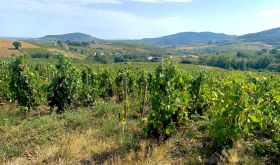
From a distance, you could almost miss the tiny vineyard. Low, knarled, each bush surrounded by a profusion of weeds and yellow flowers, no sign yet of spring’s approach on their twisted, woody arms. We are 800 metres up in a lonely corner of north-west Greece, in mid-April, in a wide valley formed by high, empty hills just turning green. There will be no more frosts this year, yet these 95 year-old Xinomavro vines haven’t yet come back to life. Dimitris Diamantis’s father nursed a dream of reviving old vines like these, and planted new ones; when he died, Diamantis carried on the task.
There are many reasons to love Xinomavro, Greece’s greatest red grape: its fragrance, complexity, ageworthiness. But its significance for me is the way it expresses the harshness of this land and the patience of the growers who each year coax magic from these stony hillsides.
Xinomavro has a reputation for being difficult: “capricious”, Yiannis Karakasis MW calls it. It’s there even in its name, Ξινό/μαυρο – “sour/black”. It brims with robust acidity and earthy tannins yet its fragrance and bright fruit shine through: Nebbiolo in a Greek shepherd’s waistcoat. Sipping Diamantis’s Xinomavro 2020 with him and his son, I marvel at its fragrance, elegance, structure.
Not all the 2,000-plus hectares of the grape in Greece are planted in places as forbidding as Diamantis’s near-centenarians in the wilds of western Macedonia. Xinomavro’s Naoussa heartland, 75km east towards Thessaloniki, is not so inhospitable – even though last year they had snow in early December. And a couple of days after Siatista, I looked out over Babis Bekris’s vines at Akrathos, further east still in the Chalkidiki, and could imagine summer’s arrival: spring sunshine over Mount Athos and the blue of the Aegean in the distance.
Both Naoussa and Siatista were known for their wines in the nineteenth century. Domaine Dalamara has been making wine in Naoussa since 1840. And Stelios Boutaris, owner of leading producer Kir-Yianni, showed me a bottle of his family’s wine from 1906. Its Greek label also bore Hebrew script (for the Ladino-speaking Jews of Thessaloniki) and Ottoman Turkish: the region was part of that empire until 1912.
Yet soon after, Xinomavro came close to extinction. Phylloxera, first detected in northern Greece in 1898, spread from 1918 and in later waves. Greece suffered a gruelling mid-twentieth century. The trauma of the population exchanges with Turkey in the 1920s – over 600,000 refugees settled in Macedonia – was followed by World War II, a brutal occupation, civil war and dictatorship. “In the sixties it was mostly peaches here, after phylloxera in the fifties,” says Boutaris. By 1962, there were just 50 hectares of vines left in Naoussa. Even today, Xinomavro vines face competition from peaches and other fruit trees which pay better than grapes.
But Boutaris’s father, Yiannis, believed in Xinomavro. In 1968 he began to re-plant cuttings. He encouraged growers to replant and move away from field blends to Xinomavro. He bought their harvests. He fought the authorities for official recognition of the grape in Naoussa, Amyndeon and Goumenissa: Naoussa became a PDO in 1971. So it was that growers like Apostolos and Stergios Thymiopoulos rebuilt their Xinomavro vineyards, patiently grafting their vines on to American rootstocks.
By the dawn of the new century, international critics were waking up to Xinomavro’s charms. Yiannis Boutaris had parted company with the family firm, setting up Kir-Yianni in 1997. Meanwhile a new generation of winemakers, many trained abroad, were rising to prominence, none less so than Apostolos Thymiopoulos, son of Sergios and grandson of his namesake. His Earth and Sky (Γη και ουρανός), launched in 2005, established a new, more modern style of Xinomavro, its tannins requiring fewer years to tame.
Yet in the vineyard, while Thymiopoulos embraced biodynamics, as with many Greek growers such approaches seem more a kind of old-fashioned low-intervention farming than new-fangled ideas. “Lots of producers tried foreign methods and it was a big mistake,” says Diamantis. “Now they’re going back to their grandfathers’ way of working – it’s more sustainable.” Indeed the day I visited, Diamantis’s neighbours were hoeing their plot by hand.
As such toil suggests, Xinomavro and its landscapes demand a special kind of belief. Diamantis keeps his father’s dream alive despite poor soil, an unforgiving climate and the depredations of grape-loving wild boar and bears. I travelled on from Magoutes to Amyndeon, where Kir-Yianni’s western vineyards huddled beneath lowering clouds, distant mountains black against the sky and a chilly wind whipping off the grey expanse of Lake Vegoritida. A few kilometres away, just in sight of the lake, Laurens Hartman ploughs a quixotic furrow – using two mules and a horse – to produce Greece’s finest sparkling wine from biodynamic Xinomavro at Domaine Karanika. He makes a beautiful red too, in the characteristically lighter style of the area. Dutch-Greek, he came to this windswept spot because of the climate and this grape: “You can do everything with Xinomavro, from red to sparkling. And Amyndeon is the only really climate-resistant place.”
In these landscapes, it is no surprise that winemakers might appeal to divine intervention. In the village of Kilkis, in Goumenissa, a chapel is dedicated to St Tryphon; his veneration was brought to Macedonia by refugees from Asia Minor in the 1920s. His feast day, 1 February, falls in pruning season: in one icon in the Kilkis chapel he holds the local svanas pruning knife. And on a previous visit to Kir-Yianni during harvest, I joined grape-pickers gathered in the winery around a makeshift altar for a blessing: a Greek Orthodox priest sprinkled us with holy water from a bunch of basil.
A glass of Xinomavro transports me back to that altar and those hillsides. I opened a bottle of Kostis Dalmaras’s 2018 while writing this and got lost in its subtleties, hints of tomato leaf and black olive. Greece’s noblest red grape demands dedication from its growers; it rewards them and us with its story of beauty in a hard land.
The photo is the author's own. Caption: 'Dimitris Diamantis, left, and son in an old-vine Xinomavro plot, Siatista, Greece'.