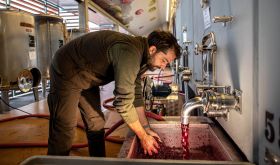
The beauty of wine is supposed to be that, unlike so much of the food and drink we eat today, it is so ‘natural’. To produce wine, as all of us wine students have been taught, all you need are grapes. Once the grape skin is broken, the yeasts that are naturally present in the atmosphere get to work on the fermentable sugars in the grape pulp and transform them into alcohol, as part of the 'natural' fermentation process shown in this Mick Rock photograph (see his invaluable resource at www.cephas.com).
That is the nice theory, and there is even a chemical equation that neatly sums it up. But in fact this is very far from modern practice. The overwhelming majority of wine on sale today was fermented using commercially available strains of yeast, yeasts specially chosen for their particular and powerful attributes.
Just about the worst thing that can happen to a winemaker is a ‘stuck’ fermentation, one that will not complete the process of turning sugar into alcohol. What’s left is semi-sweet, low-alcohol grape juice that is dangerously vulnerable to harmful bacteria and completely unsaleable. The yeast attribute therefore prized above all others by the majority of winemakers is efficiency. So, especially in our current era of very ripe grapes, winemakers increasingly choose yeasts that have been specially designed to act in high-alcohol environments. The last thing they want is puny little yeasts with weak heads for alcohol that might be stunned into inaction before the job is done.
As a fan of efficiency myself, I can sympathise with this view. But what worries me is how powerfully modern selected yeasts are now able to influence the style and even flavour of a wine. One prominent New Zealand winemaker claims, for example, that he can make any required style of Sauvignon Blanc from exactly the same grapes, provided he can choose the yeast.
The following thoughts have been inspired, not by the rather sensationalist Dispatches documentary about wine and additives shown on the UK’s Channel 4 last Monday night, but by Chardonnays that taste like Sauvignon Blancs, a raft of indistinguishable New World Syrahs, and my sense that the flavour spectrum of wines today seems narrower than it has ever been.
Lallemand is one of the most important suppliers of commercial yeasts to the wine industry. A look at their catalogue may be reassuring to a nervous winemaker but as a wine drinker who savours the idea that a wine communicates the unique characteristics of where it was grown, I find it deeply depressing.
Enoferm BGY®, for example, has listed as its product positioning (sic), ‘Used in red, particularly Pinot Noir’, while Enoferm Assmannshausen® has the even more specific ‘For making Pinot Noir and Zinfandel.' It is considered a color friendly strain that enhances spicy (clove, nutmeg) and fruity flavours and aromas.’ And I feel as though I have tasted many a wine made with Enoferm Syrah® with its ‘High glycerol and offers good mouthfeel and stable color extraction. Typical aromas include violets, raspberries, cassis, strawberries, black pepper’. So that’s where they get all those descriptors on the back labels!
For those oenologists wishing to influence how their white wines will taste, Lalvin CY3079® is designed ‘For barrel fermented Chardonnay and ageing on lees. Gives rich, full mouthfeel and aromas’ while Uvaferm SVG® is designed ‘to enhance typical Sauvignon character, diminished acidity and with good fermentation kinetics’. This would explain the growing number of wines I have tasted over the past two or three years, while the fashion for leaner Chardonnays has been growing, that say Chardonnay on the label but taste eerily like aromatic, crisp Sauvignon Blanc.
Like many observers of the wine scene I have been dimly aware of how the wines of the world are starting to taste much more similar, despite the fact that they come from a wider range of geographical sources than ever before. Powerful wine critics such as the American Robert Parker have been blamed for this phenomenon. Improved communications between winemakers around the world who tend to share their secrets and techniques have almost certainly played a part, as has the near universality of French oak barrels. But I strongly suspect that the widespread use of a relatively narrow range of commercial yeasts has accentuated this phenomenon.
Admittedly it takes time to build up in vineyards and wineries a population of ambient yeasts that is powerful enough to ferment grapes safely and efficiently. So the many winemakers in areas new to wine have no choice but to import yeasts from elsewhere, at least in the beginning.
Similarly, at the beginning of harvest, when the first grapes come into the winery, the yeast population is at its feeblest and may need encouragement. Even those winemakers most determined to rely only on ambient yeasts tend to keep a small culture of them in a refrigerator from one year to the next so that they can add a starter culture to get the first fermentation going.
Arguably white wines are more transparent when it comes to betraying the influence of the yeast used. In Germany and Austria where the great majority of wine produced is white and unmasked by any oak, wines tend to wear the yeast choice that made them on their sleeve. Conflict between those who believe in, respectively, ambient and commercial yeasts is currently showing every sign of escalating into a holy war. It would be fair to say that the great majority of the most ambitious artisan German and Austrian winemakers try to make their best wines using ambient yeasts only. As Franz-Josef Gansberger of the promising new Weingut Stift Göttweig in Austria’s Kremstal put it to me last week, he may use commercial yeasts for his less expensive bottlings made from the grapes which are picked earliest, but wouldn’t dream of using anything other than ambient yeasts for the single-vineyard wines in which he wants to emphasize their inherent individuality as much as possible. Believers in ambient yeasts see the local yeast population as an inherent ingredient in local terroir.
Some producers who choose the road less travelled and depend not at all on the likes of Lallemand, particularly in New World regions where commercial yeasts rule, tend to brag about it on the label. The phrase Native Yeast may be used, and Errazuriz of Chile, Yalumba of South Australia and Craggy Range of New Zealand are just three of the more prominent producers selling wines whose official brand names include the words Wild Ferment. This phrase may be evocative, conjuring up the image of an impetuously untameable Carmen of a wine that is constantly threatening to bolt out of the winery door, but it is slightly misleading.
Those who sell and use commercial yeasts would be the first to point out that what they sell or use were ‘wild yeasts’ at one point in their history. Their attribute is that they have supposedly been carefully selected to behave predictably – except that even that is debatable. Languedoc consultant oenologist Claude Gros, about whom I wrote here a couple of weeks ago, got quite incensed on the subject of the variability of commercial yeasts. “They launched a yeast called Brunello di Montalcino 45. In the first year it was great. In the second it was awful – quite different – and resulted in stuck fermentations all over the place.”
So, there you have it. Remember that your next glass of wine may owe its character to something unacknowledged that can be every bit as influential as the grapes.