Although I have had the highest admiration for Yotam Ottolenghi since he opened the first of what are now four cafés and delicatessens around London in 2002, my initial conversation with him ended in disappointment.
It was at the reception for the André Simon Award for the best food and drink book of 2008, for which Ottolenghi The Cookbook (Ebury £25) was justifiably shortlisted. I asked him whether he planned to open any more establishments. 'No', he said quite firmly. 'I spend every morning travelling from one to another to ensure what the chefs are preparing is as good as I want it to be. I couldn’t fit any more stops in.' My hopes that he would open closer to me were immediately dashed.
This comment goes to the heart of why it is so difficult to expand artisanal food businesses. There are limited opportunities for any economies of scale; food does not travel very well; and when it is transported from what is unromantically referred to in the business as a CPU or Central Production Unit to the various outlets, it has to be refrigerated, which affects flavour.
Ottolenghi’s response, along with that of his partner Sami Tamimi, is to make almost everything in what I was to see are quite cramped kitchens under the cafés. The only exceptions to this rule are their croissants and breads, which they produce in a central bakery but then prove and bake in each location. This allows him to keep refrigeration to a minimum because, as he writes in his introduction to the book, ‘it is a chilling experience to eat a cold sandwich’. This strategy also maximises the aromas of good cooking . 'When we renovated our delicatessen in Notting Hill, we made sure that we left a few small holes in the floor so that the customers could always smell what was being prepared downstairs', he told me intriguingly.
If Ottolenghi was not going to open near me, the least he could do would be to allow me to accompany him on his morning tour, I felt. He readily agreed.
As I arrived at what was his first outpost in Notting Hill Gate at 10, the window already looked distinctly colourful with large trays of croissants, lemon meringue tarts and cinnamon and hazelnut meringues on display ringed by a row of unwaxed Sicilian lemons. Several people were running in to grab a coffee and something to eat while Ottolenghi stood calmly talking to his chef. He waved me in, took me past the counter stacked with more food, pointed out the macadamia and coconut fudge wrapped in multi-coloured paper that they had just made for the first time that day, and ushered me into the cubbyhole that passes for an office, flanked by their coffee machine.
While his business and reputation have expanded considerably out of this original site, two principles have not changed. The first was his designer’s advice that the interior and furniture should be entirely white to accentuate the colour of the food on display and the second is the name of the business. 'I was very reluctant to put my name above the front door but my friends urged me to do so. I’m Israeli, it does sound exotic and mirrors the food we serve but I do feel as though I’ve lost my family name because the first thing people think of when they hear the word Ottolenghi is the company.'
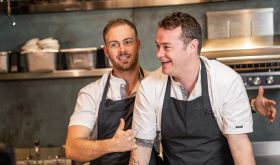
But the past seven years have certainly not dimmed his fascination with cooking. We dashed down a set of steep steps, not for the last time that morning, past shelves stuffed with dried goods, plates, uniforms and large platters and burst into a bustling kitchen whose members Ottolenghi greeted with the phrase ‘Hi guys’ that I was to hear whenever he walked into one of his cafés or kitchens.
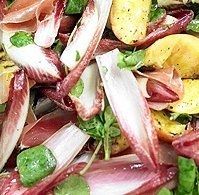
Facing us was a large range on which one chef was gently loading the ingredients for what Ottolenghi described as a ‘Middle Eastern ratatouille with lots of coriander’ on to an equally colourful plate in front of two pastry chefs hard at work. The 90 minutes from 10 am are hectic in these kitchens because that is when the chefs prepare the large plates of food that form the basis of not just the café menu but the equally crucial takeaway business.
And these dishes have to fulfil one important criterion. 'It’s become a bit of a joke by now but whenever I walk into one of my places the first thing I ask myself is, "Is the food smiling?" If it is, then I’m happy, too, and I know my customers will be.' This was the mantra Ottolenghi kept repeating on his travels as he occasionally found fault with a few of the dishes we tasted. On one occasion he wanted the okra fritters cut smaller; on another he wanted purple sprouting broccoli mixed in with the green variety in one of their most popular dishes; and in a third he told the chef that he thought his kitchen was ‘a bit messy’.
Half an hour later we headed off in his car for the tiny Kensington outpost. As we passed Kensington Place restaurant, Ottolenghi explained how, when my colleague Rowley Leigh had been the chef there, he had rescued his culinary career.
'I came here from Israel in 1997 determined to become a chef although I was almost 30. Very foolishly I thought that working in the kitchen of a Michelin starred restaurant was the way to do this. I was very much mistaken as I, and I’m sure I wasn’t the only one, was made to work very long hours and any creativity was squashed. Rowley took me on, initially to make ice-creams and then in the pastry section. But for him, I think I may have abandoned my dream.'
This experience Ottolenghi has now turned into an effective management tool. While his four outposts share the same approach to food, they are quite different in scope. The Notting Hill and Belgravia branches both have large, communal café tables while the one just off High Street Kensington is purely a delicatessen. Islington is by far the biggest with an informal restaurant that takes bookings and serves deliciously fresh food.
Our dinner there included spicy, smoked aubergine; fried calamari with Szechuan pepper; ginger beer battered monkfish with chorizo and mango and chilli relish; courgette flowers stuffed with ricotta and basil; and some great desserts.
As a result, he has come to realise that he has as much to learn from his chefs as they do from him. So while his daily tours of their kitchens are vital, once every three weeks they all come to his kitchen and prepare a series of dishes on a common theme that will be incorporated into future menus.
As we sat in yet another traffic jam, Ottolenghi let slip two other aspects of his business which will continue to drive him to improve even further. The first is the continual search for the right kind of hard-wearing but eye-catching crockery of all sizes that will make the food his chefs prepare smile even more broadly.
The second is to emulate his father. Although he dreamt of becoming a chef at an early age, this was not a profession that was looked on with any enthusiasm in those days and certainly not by middle-class parents. His success today has won his parents round but his father cooks with a deftness of touch which Ottolenghi feels he still cannot match. 'He’s a professor of chemistry and somehow he has this intuitive understanding of what should be in a dish and what shouldn’t. That’s what I want to achieve.'