Wine is one of the most sensitive measures of climate change. A rise in temperature during the growing season can easily result – indeed has resulted – in riper grapes and fuller-bodied wines. Drought in areas such as much of Europe where irrigation is banned can leave grapes shrivelled and more like raisins, the resulting wine extremely dry and chewy with a distinct shortage of juice. The exceptional heatwave summer of 2003 provided European wine growers with their wake-up call but in many regions 2005 and 2009 were not so dissimilar.
Higher temperatures and generally lower rainfall are having a particularly profound effect on the wine industry of Australia, where the economics of wine production in the vast irrigated inland wine regions that once churned out inexpensive wine labelled South Eastern Australia make less and less sense now that water rights cost so much. The total area of Australia under vine has shrunk, from 172,676 ha in 2008 to 148,509 ha last year.
But climate change can help some wine growers. The quality of wine produced in Canada, England and Germany has improved immeasurably over the last decade. As acid levels plummet to sometimes dangerously low levels in Champagne (tart wine is a prerequisite for fine fizz), in England and Wales they have fallen to just about acceptable levels (although last year was a bit of a challenge for many European vine growers and especially those somewhere as far north as the British Isles).
Even within established fine-wine regions, the overall rise in temperatures is changing reality and then, more slowly, reputations. In Bordeaux, for example, in years as warm as 2009, the supposedly lean, mean Médoc appellations Listrac and Moulis can produce some really very attractive, almost fleshy wines. And this is with a palette of grape varieties as sturdy as Cabernet Sauvignon and Merlot.
The Pinot Noir of Burgundy's heartland the Côte d'Or is even more sensitive, so it is hardly surprising that things have been changing in the rarefied world of red burgundy production. The best (for which read oldest) vines in the most hallowed vineyards (for which read grand cru and the best premiers crus) have deep enough roots and small enough crops to ensure that in even the driest, hottest of years they can yield top-quality grapes. But some other Pinot vines on the Côte d'Or have suffered in recent hot vintages, and there are few drinks less appetising than soupy Pinot.
For decades the pretty wooded hills to the west of the famous limestone escarpment that is the Côte d'Or were regarded as a fine source for blackcurrants for the cassis needed in a kir but beyond the pale by fine-wine lovers. They were originally known as the Arrières Côtes until the locals pushed through a smarter-sounding name, the Hautes-Côtes, divided into the Hautes-Côtes de Nuits in the north, behind the Côte de Nuits, and the Hautes-Côtes de Beaune, to the west of the wine town of Beaune.
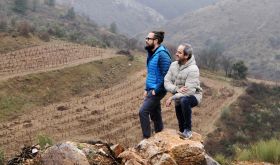
Until recently most of the wine grown in the Hautes-Côtes was pretty thin stuff but this is changing – partly because summers are getting warmer, and partly because of people such as Olivier Jouan (pictured), a vigneron in the Hautes-Côtes village of Arcenant who, perhaps on the Avis principle of trying harder, seems even more determined to make great wine than his counterparts downhill on the Côte d'Or.
Arcenant is typical of the villages of the Hautes-Côtes. Unlike the prosperous, carefully maintained villages of the Côte d'Or, where every ancient stone seems to have been polished and regrouted, Arcenant sprawls in an undisciplined, unsignposted fashion with something even approaching a housing estate above the somewhat forbidding church. I'd been warned by the British importer Roy Richards that there was no mobile phone signal in Arcenant and it took me a good 15 minutes and enquiries at several unpromising-looking front doors before I eventually found the workmanlike courtyard of Olivier Jouan, who has been making wine here since 1999. The son of a director of Smurfit packaging, he chose to establish himself in the keenly priced Hautes-Côtes on taking over from other family members a total of three hectares of vineyard in the Côte de Nuits, including some excellent vines in La Riotte in Morey-St-Denis planted in 1925. 'There is still a Jouan Henri in Morey-St-Denis', he told me, in his almost unintelligible but heartfelt gabble. His mother's Italian genes are obvious in his opera singer looks.
He took the deliberate decision to vinify all his wines in Arcenant and to add 5.5 hectares of rented Hautes-Côtes vineyard. He admits that at this altitude his cellar is so cold that it can be difficult to complete the second, softening, malolactic fermentations. They were still proceeding at a painfully stately pace on his 2011s when I visited at the end of November last year. He exports eight in every 10 bottles he fills, to the likes of Raeburn in Edinburgh, Jeff Welburn in Los Angeles and various Asian importers, but admits that it is difficult being so far off the established routes for the container lorries that are so familiar in the backstreets of Gevrey-Chambertin and Vosne-Romanée.
But he is convinced that the future is rosy. 'I really think that some of our Hautes-Côtes wines can be confused with Côte d'Or wines blind.' He is encouraged by the fact that many of the vines that were planted here in the 1960s when blackcurrants and raspberries were challenged by cheaper imports from Poland are now fully mature. Set against this is what he sees as a very different mentality in the Hautes-Côtes, where most vignerons are mixed farmers and, typically, deliver their grapes to the local co-op.
He believes that eventually there will be individual village appellations for the likes of Arcenant, Echevronne and Bevy rather than the much less geographically precise Hautes-Côtes appellations. For the moment he has just one permanent employee on his payroll and does most of the work himself, although he hopes that eventually his wife will join him. He is helped by the fact that he picks relatively late so that he can sometimes hire pickers who have already done the vintage elsewhere.
To judge from the wines listed below, I too am optimistic about the Hautes-Côtes, perhaps even more for the lively whites than for the reds.
HIGH-ACHIEVING HAUTES-CÔTES
Whites
Anne Gros, Cuvée Marine
Olivier Jouan
Méo-Camuzet, St-Philibert
Recrue des Sens
Reds
Jean-Claude Boisset, Dames Huguettes
Jayer-Gilles
A F Gros
Olivier Jouan
Thibault Liger-Belair, La Corvée de Villy
Laurent Roumier
Mongeard-Mugneret, La Croix