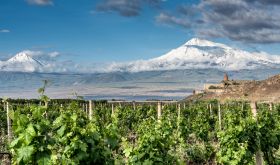
13 December 2021 Katia Nussbaum attended an awe-inspiring, mind-bending virtual conference which you too can access. Above, a favourite view of hers of an autumn morning over the Helichrysum vineyard at her San Polino estate in Montalcino.
I salute a tour de force from the team at RAW and in particular Isabelle Legeron MW, organisers of natural-wine fairs and now Alive! 2021. This virtual conference earlier this month with its theme ‘ideas for the world of wines inspired by nature’ was the first of its kind in the wine world. It was a truly exceptional event, like happening upon an Aladdin’s cave full to bursting with glorious ideas, questions and extraordinarily gifted people. It was all enough to make me feel quite high on various thoughts over the following days, and very much Alive!
I don’t know if it was just me, but I had the sensation of being in the midst of a moment of epistemic change. All of us participants were there for the same reason: to make a new sense of the workings of our fragile yet exquisite world, to reposition our place in it as human beings and try to see how we can be a part of its regeneration, whether as speakers, wine professionals, wine drinkers, scientists or as simple happy people.
I am not going to list the extraordinarily heterogenous panel of speakers name by name, or give a detailed account of what they said. That you can hear for yourselves. (See below for how to get a ticket to view the conference.) Take it from me though that the cumulative 32 hours of talks on five stages over two days, to be selected as you please, were smooth in their execution, really well prepared, understandable and mind-bendingly innovative while being based in indisputable science from international university faculties.
The conference was divided into three categories:
Big ideas ‘thought-provoking discussions with leaders in their fields … about topics with far-reaching implications’
Stories from the field ‘for talks that dig deeper into the world of wine, by daily practitioners from the country – wonderful wine growers and makers…’
We dig wine ‘conversations between personalities from the wine and food world and the growers and makers of their favourite tipple’
My personal preference was to choose from the ‘big ideas’ category. As a winemaker interested in such themes I wanted to come to the conference prepared, so I decided to look at some of the speakers’ work in advance. My heart skipped a beat as I read about plants possessing primitive eyes in their leaf cells and I wondered whether we should feel embarrassed for all that we’ve ever done under trees. I realised I was hooked!
Certain themes stand out from these two days.
- The constant reference to Darwin and his understanding of nature not as a place of nasty, brutal competition, but as an ecological whole of synergies and symbioses.
- The notion of the ‘cascade’ and of how even small disturbances in an environment can produce domino effects of chaotic and unpredictable change.
The message? The destructive power of ignorance. It would be highly advisable to keep a close watch on our prejudices and those dangerous a priori notions: we must tread carefully. There will be no forgiveness even if we know not what we do. In any case, the excuse of ignorance becomes less tenable after a conference of this scope and breadth.
It seems plants have developed methods to navigate their worlds, methods as good and intelligent as ours. And guess what? Perhaps even better than ours. We are the ones facing extinction, not plants.
As Alessandra Viola (science journalist and author) points out, we have historically suffered from ‘plant blindness’ and would do well to take off our blinkers to recognise their complexity, their powers of adaptability and capacity of interaction with their surrounding environments. Slower than us maybe, but sturdy, focused and ultimately ‘intelligent, sentient’.
Following on from this, Elizabeth Van Volkenburgh (biologist and plant neurobiologist) stresses the need to protect biological gene diversity in plants to keep a healthy ecology and to keep the plants clever.
The voice of Paco Calvo (plant neurobiologist) echoes in my ears as he emphasises, ‘we are not so special, we are not so special, we are not so special…’. It may not be wise to measure the world according to the standards of Homo sapiens. We have a brain but it seems that maybe plants just are a brain. So please remember, we are not so special!
In her talk, forest-ecologist Suzanne Simard shows us how much we can learn from forests. It would be wise to heed these many valuable lessons about co-operation, kinship and mutual aid if we wish to regenerate a functional society.
‘Biomimicry’ is a word that regularly pops up in these talks and in associated literature. This is the search for solutions to practical human problems through examination of the natural world to see how, over billions of years of trial and error, evolution has successfully managed similar problems.
Alive! is also and primarily a conference related to the world of wine, and so we are presented with the approaches used by many extraordinary winemakers from Austria, Chile, South Africa, France, Germany, Slovenia and Italy, all attempting to minimise the potential damage of agriculture to environmental ecosystems. Even more, these natural winemakers would like to see themselves in the position of enhancing these balances and regenerating nature.
These stories are inspiring, whimsical, inventive and joyful. The two common denominators are the desire to produce wines with as little negative environmental impact as possible, ideally none, and secondly to produce wines reflective of their terroir. Via the conference we learn this means a complex of vine variety, soil, micro-organic community, bedrock and other mineral complexity, climate, exposition, locality, winery, viticulturist and winemaker personality. The world-famous consultant Pedro Parra is interested in geology, the minerality of wines in relation to bedrock, vine type and climate, while Claude and Lydia Bourguignon (microbiologists) give a wonderfully informative talk on location, soil, microbes and suitability for vines.
A further understanding we gain from the conference is that while agriculture by definition disrupts natural environments, clever ecological assessment can help mitigate and potentially redress the worst damage. Disturbed ecologies, whether as vineyards or not, need to be given the chance to regenerate and keep healthy, for ourselves and for generations to come, with ourselves not as outsiders but as insiders intimately associated with the natural world.
Perhaps we could take some lessons from mycorrhizal fungi. The work of Merlin Sheldrake (mycologist and author of Entangled Life) illustrates the enormous role fungi have played as prime ecological connectors, influencing our evolutionary and cultural history, without which life on this planet would not have been possible. It means rethinking the idea of ‘survival of the fittest’; inter-species co-operation, symbiosis and synergy become the ultimate survival tool.
This somehow turns our world upside down. We were not taught that at school.
A further important thought that comes to me from this interdisciplinary conference is that while each and every detail is important in itself, the truly fundamental issues are still greater as a whole.
In any healthy ecosystem all individual organisms are indispensable while being at the same time wholly dispensable. An organism may be parasitised out of its niche and another with the same function may take its place. An organism may simply become obsolete because of changes to some other aspect of the ecosystem and no longer be of use, maybe to return at some other time or not.
So it is that changes in micro-ecosystems keep the larger system semi-stable: thus we find stability is dependent on instability.
Perhaps Fukuoka’s ‘nothingness’ can be found somewhere in this paradox and we could find much to learn in this, to re-cognise and re-learn the importance of intuitive observation and flexibility.
All the speakers seemed to agree that biological diversity is essential for the smooth running of nature. Nicolas Joly (of Coulée de Serrant and founder of Renaissance des Appellations) spoke out for flexibility in approach, even in the semi-sacred area of biodynamics. To be human is to be free, he said, and ‘biodynamics shouldn’t be a jail … [winemakers can] make their own experiments’. These were magnanimous words, indicating (to me) that a world in change requires new categories for thought and new approaches for action governed by the astuteness of science, intuitive observation, and openness to new concepts. [See Katia’s much earlier article Biodynamics – new approach needed?]
This was an extraordinary waltz through the kaleidoscopic meeting of minds: from theory and science to practice on the ground via the multi-faceted world of wine. Tasters, producers, scientists, philosophers, all had their own concerns united in the zest to place more pieces in the complicated dynamic puzzle that makes our world. We probably will never completely understand it, firstly because the puzzle is constantly changing so our pieces will never be enough, and secondly because with our blind spots we will no doubt always lack the intellectual tools to ask or answer the simplest of questions. In any case, as we know, questions beget questions.
But let us remember: all the conference speakers agreed that a healthy nature needs biological diversity and that great wines come from biologically diverse terroirs. It seems that our very survival depends on us making an ally of nature.
Our actions have great value, so let’s get inspired, active and Alive!
You can save £10/$10 on the $55 cost of a ticket to view the Alive! virtual conference that took place on 5 and 6 December using the discount code JancisRobinson10. That works out at $1.40 an hour. The intention is that the talks will be available to view for the next six months.