Just as the news Australian vine growers dreaded was announced – that irrigation will be switched off in the all-important Murray-Darling basin unless it rains in the next eight weeks (see members’ forum for more details) – the Australian Wine and Brandy Corporation has issued its initial report on the 2007 grape crop, confirming that is it the smallest in seven years, with yields the lowest for 30 years.
The 2007 harvest of 1.34 million tonnes is 29% lower than the 2006 crush and the smallest since 2000 according to estimates based on a survey of wine companies representing approximately 85% of the industry’s volumes. Because Australia’s total vineyard area has increased so markedly, the unprecedented run of meteorological disasters in the last growing season, as already reported here, in fact cut yields in tonnes per hectare to a 30-year low. The season was subjected to drought, frost, bushfire taint and what the Corporation calls “a widespread rain episode” in mid-January.
The white crush is estimated to have fallen by 17% to 702,000 tonnes, 52% of the total crush, while the total of red wine produced was even harder hit, with the red wine crush falling 39% to 639,000 tonnes. The red share of the total crush, 48%, is the lowest since 1999.
This year’s reduction in yields is only marginally offset by this year’s small expected increase in total area of productive vineyard of around 2%. This follows at least five years of much less frenetic planting in Australia than in the late 1990s.
A number of factors contributed to the greater reduction in red yields, the Corporation points out. “Firstly, cooler-climate regions have a higher proportion of reds than the warm-inland districts (accounting for nearly two-thirds of the total red bearing area) and yields in the cooler regions were more affected than those in the warm-inland districts. Yields in the cooler regions were more affected than those in the warm-inland districts because the incidence of frost was greater in the former, compounding the effects of drought felt across all regions.
“Secondly, adverse weather conditions, mainly the drought, appear to have had a bigger impact on reds – most likely because they had a greater exposure, being generally later-ripening varieties. Winemakers report that while in many red varieties bunch numbers were near average, there were fewer berries per bunch than usual, and berries were small.
“Thirdly, particularly early in the season, some growers made a commercial decision to divert limited water supplies to the whites that in the current operating environment are relatively higher-earning compared to reds.”
It seems that Australia’s infamous grape glut is well and truly over. For now. And, perhaps more worryingly for consumers, we are back to the days in which table and drying grapes end up being fermented into (particularly white) wine.
“While the past two seasons have seen grapes left on the vine or dropped at harvest (an estimated 55,000 tonnes in 2005 and 130,000 tonnes in 2006), it is unlikely that any of the 2007 crop will be left on the vine. The exception will be for rare batches of fruit that are diseased, damaged, or where it is uneconomical to harvest. In contrast to fruit being left on the vine, it is understood that some table and drying grapes were diverted to the crushing for wine.
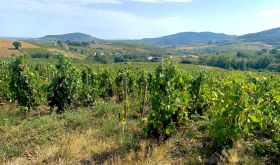
“The major seasonal influence on the 2007 crop was the severe drought conditions experienced across much of the country. In both warm-inland and cooler-climate regions, both rainfall and the number of rain days were well below average while temperatures were above average for most of the season.
“A dry winter followed by a dry and significantly warmer than average spring resulted in moisture deficient soil profiles, placing early-season stress on vines. Many regions were forced to irrigate early resulting in less water being available later in the season, during the ripening period. Also, the dry conditions towards the end of 2006 increased the severity of frost events, most particularly in some cooler-climate regions in South East South Australia, Victoria and Tasmania. An episode of rain in mid-January improved the situation for many growers by refreshing the vines but on the other hand, the warm inland regions received further cuts in their water allocations.
“The exceptional weather conditions and variable access to water across regions during the season make it difficult to determine the overall quality of the 2007 harvest. However, quality is thought to be generally good-to-excellent [but isn’t it always? – JR]. Absence of disease is a primary factor in this outcome. Conditions appear to be more favourable for reds with smaller red berry size traditionally associated with
higher quality through intensification of flavour and colour. In the case of whites where flavours and colour are not as critical [!!!], watering had been maintained in many regions.”
Love the idea that flavour is not as critical to white wines as to reds. All we white wine drinkers need is something wet and vaguely alcoholic – right? I should not be so flippant though. Things are clearly going to be horribly tough for many of Australia’s grape growers.
“The severe 2007 conditions are likely to have carryover effects for the 2008 harvest by virtue of poor development this year of primordial buds (next year’s fruiting buds that sit behind those that flower and bear fruit this year). This, together with expectations of reduced amounts of water available for irrigation in the warm-inland districts, because current low water stores are unlikely to be significantly improved, means the industry anticipates yields will be below average again in 2008.
“Drought and frost have caused hardship for many individual operators and communities this season. For operators receiving low prices in recent years, a low or lost crop in 2007 is likely to place further pressure on income streams [an expression more appropriate for the tax break corporations who planted so enthusiastically than for the poor little individual farmer]. Nevertheless, for the industry as a whole, this season is in some sense a compensator for three successive up-seasons immediately preceding it. The reduced crop this season will allow existing excess wine stocks to be considerably reduced and to accelerate a return to more sustainable operating conditions. “
This useful overview is the work of Peter Carmalt and Peter Bailey of the Australian Wine and Brandy Corporation in Adelaide.