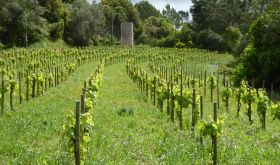
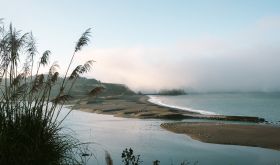
After a misty start on the Monday morning (as seen here at Vieux Château Certan), last week was sunny in Bordeaux, and so were both tasters and producers of the latest vintage en primeur. The majority of wines were a pleasure to taste and some were quite outstanding, but 2016 certainly didn’t seem blessed during the growing season.
According to Baptiste Guinaudeau of Ch Lafleur in Pomerol, he and his winemaker wife Julie didn’t realise they had something special on their hands until after Christmas, more than two months after the last grape had been picked. All they could think about before this period of reflection were the hoops that 2016 made them jump through.
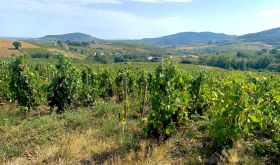
Last year was pretty much of a nightmare for most French vignerons, with the 2016 vintage shrunk variously by frost and hail, especially in greater Burgundy and the Loire. In Bordeaux they had their own worries. The wettest spring and early summer for many a year may have replenished the water table but left the threat of downy mildew horribly present under damp grey skies. Repeated spraying (with protective clothing now de rigueur) was a necessity for 2016 survival. Yo-yoing temperatures did nothing to reduce the mildew threat and slowed the vines’ annual growth, reminding many a vine grower of the annus horribilis of 2013 when the grapes struggled to ripen.
This became an even greater threat on the right bank of the Gironde (St-Émilion and Pomerol most importantly) when, after a rather miraculously successful flowering that promised a good quantity of grapes, summer suddenly arrived with a vengeance on Brexit day, 23 June. Bordeaux was to experience its longest drought ever with no real rainfall until 13 September.
As the Thienponts of Le Pin observed, there was little work to be done in the vineyards over the summer because, in most right-bank vineyards anyway, the vines simply shut down in protective shock mode. Photosynthesis, and therefore grape ripening, ground to a halt, and some of the young vines, and those on particularly sandy soils, really suffered – their leaves turning yellow and in some cases falling off, thereby bringing the 2016 ripening process to an end.
With such dry summers becoming the norm in southern France, there is more and more talk of the I-word. Irrigation is prohibited in France except for young vines. My guess is that there is increasing flexibility in interpreting the word ‘jeune’, and doubtless there was much spraying of stressed older vines with quite remarkably dilute preparations last summer.
But the miracle was that, although the precipitation in July was only a tenth Bordeaux’s 30-year average and in August only a quarter, most of the vines, particularly the older ones with deep roots able to benefit from those massive spring rains, coped remarkably well with the drought with healthy green leaves and upright growth (a phenomenon I had observed in the Languedoc). It’s as though they are learning to cope with climate change.

The vignerons meanwhile are learning to cope with new technologies and a level of precision that would have been unthinkable even 20 years ago. As Pierre-Olivier Clouet of St-Émilion top dog Ch Cheval Blanc (very excited about his new dry white wine) pointed out, even in the great 1982 vintage, only about 80% of the grapes would have been picked with perfect ripeness. A good 10% would have been underripe and green-tasting while 10% were probably unappetisingly overripe. ‘But in 2016 every plot could be picked at perfect ripeness', so carefully have the vineyards of Bordeaux (following their counterparts in Napa Valley) been subdivided into homogeneous plots to be picked and vinified together once their progress to perfection has been monitored with surgical exactitude.
At Vieux Château Certan, Alexander Thienpont’s son Guillaume has harnessed infrared technology to mark with coloured ribbons not just individual plots but individual vines, so that, to produce their stunning 2016, they were able to select the best fruit more precisely than ever before. Like many a producer, the Thienponts see strong parallels between the pair of great Bordeaux vintages 2009 and 2010 and the pair 2015 and 2016, with the later vintage being less exuberantly ripe and more classical than the earlier one.
The reason the 2016s are so classical is that, although the summer was very dry, it was not ridiculously hot, with fairly fresh nights, so there was no inconveniently dramatic loss of acidity. But it was a real cliffhanger of a vintage in the end. Would the grapes ripen at all?
By the time the drought came to an end with a seriously useful storm on 13 September that got the ripening process going again, the days were markedly shorter (think March day length) and temperatures distinctly autumnal. So the grape ripening proceeded at a snail’s pace. As Baptiste Guinaudeau put it, nine days’ ripening in 2016 was the equivalent of two days in super-warm 2009.
And all Bordeaux producers are now extremely sensitive to the need to ripen the phenolics, particularly tannins, so most growers waited and waited, with the Le Pin harvest, for example, not starting until October for the first time ever.
Picking dates varied, with many growers starting their Merlot harvest towards the end of September and the Cabernet Franc that is more important on the right bank than on the left, except for a few favoured spots warm enough to ripen Cabernet Sauvignon, extending the harvest season well into October – and even November in a few cases as far from the ocean as, for example, the up and coming Castillon appellation.
Thanks to the drought, berries were generally very small and skins thick, packed with tannin and anthocyanins, so all of the hundreds of wines I tasted last week were marked by healthy, deep crimson colours and an appetising combination of fresh acidity with usually ripe tannins. Only in a minority of cases did this seem too much. As Alexandre Thienpont pointed out, ‘we were saved by the relatively high yields of 2016; if they’d been too low, the wines would have been too concentrated'. Instead there was a lovely fluidity to the best of them, even if the odd right-bank producer still seems to be using the 1990s recipe book of maximum extraction, notably in St-Émilion.
One celebrated right-bank producer who picked earlier than most (21 September to 4 October) was Denis Durantou of L'Église-Clinet. The tannins in this particular Merlot-heavy Pomerol do taste a tad tougher than some, but I enjoyed his summation of the vintage as ‘the revenge of Merlot. All the consultants have been telling us to plant other varieties such as Petit Verdot. But 2016 proves how great Merlot can be, with its lower pH, lower alcohol and the same tannins as Cabernet. Unfortunately though the tam tam mediatique is on the [Cabernet-dominated] left bank.’
Next week I’ll report on the dominant left bank, but there is no shortage of glory on the right.
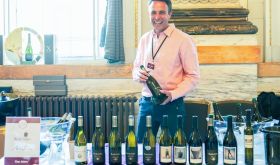
I took the photograph below at L'Évangile but Chinese influence was in evidence everywhere. Chinese buyers, or at least tasters, seemed to be back in force.

RIGHT BANK 2016 STARS
I gave all these wines at least 18 points out of 20 but a host of wines, not all of them likely to be particularly expensive, earned at least 17. See our growing body of hundreds of tasting notes on 2016s.
Pomerol
Hosanna
Lafleur
Petrus
Le Pin
Trotanoy
Vieux Château Certan
St-Émilion
Ausone
Canon
Cheval Blanc
Figeac
Tertre Roteboeuf