For some typically lively discussion on this article, see our members' views on the forum.
A quiet revolution has been taking place on the California wine scene, driven by refugees from the worlds of finance and software development, a popular sommelier and the power of online bulletin boards. For years, long hang time on the vines resulting in notable ripeness and alcohol levels of 15% and above have seemed the goal of California wine producers, but more and more wines have been emerging that run counter to this paradigm. Although you can see the trend in some Chardonnays, the most obvious variety to display this novel freshness and delicacy is the red burgundy grape, Pinot Noir.
In Burgundy itself, it is character rather than size that has always been celebrated. Red burgundy is notoriously unpredictable, but gloriously eloquent at expressing minute differences in site, or terroir. It is the tantalising nature of red burgundy that seems to have inspired a new generation of California vignerons to seek out West Coast sites with a chance of producing Pinots with fine red burgundy's delicacy and vivacity.
It takes some nerve, or perhaps blind passion, to sink substantial time and funds into making a style of wine that has yet to carve out a substantial place in the market. Most California Pinot is very unlike red burgundy. It tends to be dark crimson, notably sweet-tasting (from high alcohol and sometimes from residual sugar) and Pinot's delicate fruit flavours can often be occluded by the effects of new and/or heavily toasted oak. A few years ago, the California specialist of the dominant American wine magazine Wine Spectator, Jim Laube, memorably produced a 16% Marcassin Pinot Noir as an example of top wine quality at the Masters of Wine symposium in the Napa Valley. Such potency is by no means unusual in California, whereas 14% is exceptionally high in Burgundy.
In California's generally warm, sunny climate it has been very much easier to find vineyard sites suitable for the late-ripening Cabernet Sauvignon than for the finicky, early-ripening Pinot Noir. The first wave of Pinot enthusiasts tended to seek out corners of the state that were aggressively cooled either by altitude, as in spots in Monterey such as Chalone, Mount Harlan and Santa Lucia Highlands, or by lingering foggy incursions from the Pacific such as Russian River Valley in Sonoma, the wind-cooled Carneros across the San Pablo Bay from San Francisco, and more exposed parts of the Central Coast region that extends south of Monterey to Santa Barbara.
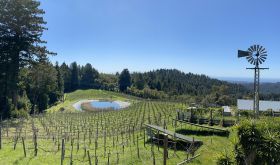
But the new pioneers of delicacy are seeking out even cooler spots. The vast – too vast – Sonoma Coast appellation harbours many of them. The likes of the Coastlands and Hirsch vineyards and McDougall Ranch are within sight of the Pacific itself and around 1,000 feet elevation. The even younger Alpine Vineyard, on a rocky slope scouted out at the beginning of this century in the Santa Cruz Mountains by Kevin Harvey of Rhys Vineyards, is at 1,200 to 1,490 feet. And Evening Land's Tempest Vineyard in the far west of the new, super-cool Sta Rita Hills appellation way to the south in the Central Coast is so new that it has yet to release its first, delicious vintage of Pinot Noir, the 2009.
Jamie Kutch's is one of the most romantic stories of these Pinot pioneers, many of whom are good friends. Until 2005 he was an investment banker in New York but was deriving more and more of his pleasure from online discussions about wine in general and Pinot Noir in particular. By the time he and his girlfriend had taken the plunge to become California vignerons, his fellow bulletin-board members had signed up to buy virtually his entire crop. He proposed to her by sending an engagement ring with the freshly picked grapes along the sorting belt. They live in San Francisco, rent space and equipment at a winery in Sonoma, do all the work themselves, and have leases on a total of 15 acres in eight different vineyards, mainly on the Sonoma Coast. Last year Kutch produced a grand total of 2,100 cases of a dozen bottles of wine, of which he sold off 800 on the bulk market because the quality was not quite what he was seeking.
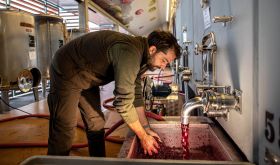
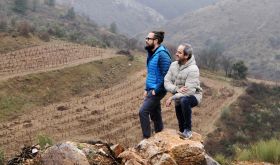
Jamie Kutch travels, is clearly besotted by Burgundy and arrives there with 'an arsenal of questions' for luminaries such as Jean-Marie Fourrier, Étienne de Montille, Jean-Marc Roulot and Christophe Roumier. He is a good friend of ex-sommelier Rajat Parr of RN74 restaurant in San Francisco, who is closely involved in a new Central Coast label, Sandhi, with winemaker Sashi Moorman and Charles Banks, ex Screaming Eagle. Check out my tasting notes on three of their first releases, 2009s, in our tasting notes search. The Sandhi Pinot Noir will be released this autumn but the two Chardonnays are outstanding, as I noted in last week's wine of the week. The wholemeal image above of burgundian technique and all-American blue jeans is from Sandhi's website.
Kutch's 2009s, only just over 13% alcohol, are completely different from the California Pinot norm, being much racier and not remotely sweet. Like most of this new generation, he believes in minimal intervention in the winery and that to retain freshness in California's climate it is essential to retain the acid-endowing stems by fermenting whole bunches rather than destemming and crushing individual grapes.
It's funny to think that Jamie Kutch's first vintage, thanks to Michael Browne's kindness, was at Kosta Browne, where he made a 2005 on his own account – at 16.3% alcohol. The alcohol levels in his 2009s, of which I have had the pleasure of tasting three, vary between 13.1 and 13.9%.
Kevin Harvey's path to Pinot finesse has been perhaps a little straighter and more comfortable – paved, if not with gold, then at least with a fortune acquired by astute activity in Silicon Valley, where he is based. He too built up his over-subscribed mailing list for the 5,000 cases he produces from Rhys Vineyards via regular exchanges with fellow burgundy-philes on America's wine bulletin boards. He began by simply planting some Pinot vines in his back yard in the foothills of the Santa Cruz mountain ridge that separates Silicon Valley from the Pacific. To his surprise, the produce was delicious and surprisingly burgundian. He then went scouting for further, cooler, higher sites in the Santa Cruz Mountains, which has a long history of making fine California wine upheld by the likes of Ridge and Mount Eden, and earlier in the decade planted four more vineyards up to 2,360 feet, each one meticulously planned and designed on shallow soils and rocky bases, as like Burgundy's finest as possible. The fun for Harvey seems to be in identifying different terroirs and having his team do its damnedest to express these in the winery he has built. Owning his own vineyards means that he is able to farm them biodynamically. There is no question of drifting pesticide sprays from neighbours in these isolated vineyards carved out of the undergrowth high above the Pacific.
I have tasted only one Rhys wine, from the cellar of a burgundy-lover in Washington who could hardly believe I was passing up her grands crus in favour of this native ferment, but I did not regret it for a moment.
Post publication note: Purple pager David Rapoport of San Francisco rightly points out in our Members' forum that some mention of Ted Lemon of Littorai should be made here since he is so thoroughly immersed in both Burgundy and some of Sonoma's cooler spots for Pinot Noir. You can also read about him in Monty Waldin's profile of Burn Cottage in New Zealand on Monday.
5 Jun - I have at last been rescued from a lack of online connectivity here in rural Puglia and can share the following suggestions for other practitioners of the delicate art of making elegant Pinot Noir in California: Sally Ottonson at Pacific Star; Toulouse, Drew, Foursight and Goldeneye; Peay, Porter Creek, Small Vines and, another pioneer, Joe Davies of Arcadian. Thank you very much, fellow tweeters, for those suggestions.
All in all, this article has generated a host of comments and correspondence. Ken Lamb draws my attention to the West Sonoma Coast Festival later this year, while Andy Peay draws my attention to the West Sonoma Coast Vintners association.
DELICATE CALIFORNIA PINOTS
The following are some of the more delicate examples that have come my way (tasting notes on them all can be found via our tasting notes search), a mixture of names old and new. But of course it's not easy to keep track of new releases from California from as far away as London. I have added some of our West Coast editor Linda Murphy's additional recommendations below.
Au Bon Climat, La Bauge au Dessus 2007 Santa Maria Valley
Calera, Mills Vineyard 2006 Mount Harlan
Cobb, Emmaline Ann Vineyard 2008 Sonoma Coast
Copain, Kiser en Haut 2006 Anderson Valley
Kutch, McDougall Ranch 2009 Sonoma Coast
Rhys, Alpine Vineyard 2006 Santa Cruz Mountains
Saintsbury, Brown Ranch 2005 Carneros
Sandhi, Evening Land-Tempest 2009 Sta Rita Hills
LINDA'S ADDITIONAL RECOMMENDATIONS
Peay Vineyards, Sonoma Coast – Most of its Pinots are delicate, though vintage-specific.
Wind Gap, Santa Cruz Mountains Woodruff Vineyard – The winery is in Russian River Valley but it purchases grapes throughout Northern California; winemaker is Pax Mahle.
'Particularly delicate may not fit, but the finest California Pinot I've tasted this year – supremely balanced, complex, nuanced, will develop with age – is the 2008 Alysian Rochioli Riverblock Pinot from Russian River Valley pioneer Gary Farrell's new brand. I wish I had a case of it.'
You can find these wines either using www.winesearcher.com or from the producers' own websites. LHK Wines in the UK is currently offering a mixed case of Kutch 2009s for £355.