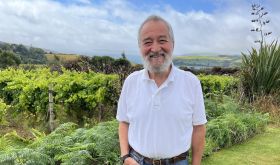
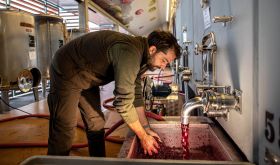
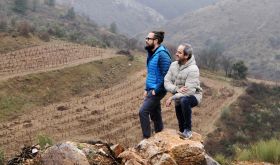
When I asked him what his winemaking style was he insisted, “I’m a chameleon. I don’t have principles. We build something together. I don’t have a style I want to impose. I try to understand what they want – obviously within the possibilities of their terroir. The most important part of my job is listening to them – and tasting together too so that I can hear what they have to say about the wines.”
The great bulk of the ‘people he works with’ are in the Languedoc-Roussillon, the troubled underbelly of the French wine industry, riven by militant protest at declining subsidies yet dotted with astonishing achievement. He is involved with, for example, Bertrand Bergé who to my mind makes the finest Fitou, the highly regarded Château Puech-Haut and Domaine de l’Arjolle in Coteaux du Languedoc, Dom Borie la Vitarèle and Mas Champart in St-Chinian and Pierre Cros and Domaine de l’Escandil in Minervois – all of them punching well above average Languedoc weight. He is also particularly close to Château de la Négly on the rocky mass of La Clape just south of Narbonne which in recent years has been admirably revitalised by the current incumbent Jean-Paul Rosset. Since 2001 Gros has been making his own wine Domaine de Boede on Négly’s sister property. “The job of being a winemaking consultant is very particular,” he told me. “ I think we should all make our own wine too.”
For some years now he has been a partner with Bordeaux-based American Jeffrey Davies in Clos des Truffiers, a full-blooded Languedoc red designed for export. Thanks to this connection, Gros was, most unusually for a man of the south, taken on to replace a Bordeaux oenologist in the making of one of Bordeaux right bank’s more successful new wines, La Fleur Morange. Davies has been sending a steady flow of the so-called garage wines across the Atlantic for some years now – so successfully that La Fleur Morange was virtually unknown in the UK when I first came across it last year. Tasting it blind in a line-up of 2005 red Bordeaux for Decanter magazine, the owner of fine wine traders Farr Vintners and I took it for Château Ausone and Pavie respectively. When the label was revealed, we were surprised, to say the least to find that the wine had been made from grapes grown by a carpenter in the village of Saint Pey d'Armens, some way east of the vineyards traditionally thought to supply the good stuff on the right bank. Claude Gros was brought in late in 2002 and have overseen a steady rise in both quality and, alas, prices of La Fleur Morange since then.
Nowadays he has several more Bordeaux ‘people he works with’ including the vast Château de la Rivière in Fronsac, Domaine du Bouscat and a Puisseguin-St-Émilion, even though he prides himself on being an outsider there. He reckons that one of the reasons that the Roussillon wines of Domaine Calvet-Thunevin of the Agly valley are now so good is that he and Calvet have “a much less Bordeaux vision than Jean-Luc Thunevin”, the owner of St-Émilion ’s Château Valandraud who is now an arm’s length partner in the project. As a native Catalan he is particularly comfortable in Roussillon – his first job was at the co-operative in Maury, virtual epicentre of the Roussillon wine revolution. “ I’m thrilled by what’s happening there now,“ he told me. “When I was there the local growers were insisting on planting Syrah, which was catastrophic. Now they understand that Grenache is best for their dry wines as well as their sweet ones.”Other Roussillon domaines he works with include Coume del Mas in Banyuls and Mas de la Devèze, whose owner Olivier Bernstein is in the process of invading Burgundy with Gros, who describes it excitedly as “another country”, in the guise of setting up a negociant business based in Gevrey-Chambertin..
Gros is steadily working his way south over the Pyrenees however, now working with Melis in Priorat and Matarromera in Ribera del Duero. But perhaps his most exotic partner in winemaking is Santomas in Slovenia whose tight-knit group of winemakers he admires tremendously for their curiosity, distaste for chemicals, flexibility and general dedication to wine culture – in stark contrast, he feels, to the Languedoc. He told me admiringly how the Juliens of Fleur Morange in Bordeaux love their vines so much they virtually have a name for each one. “That would never happen here,” he told me as we lunched together in the bright Languedoc sunshine, surrounded by overburdened vines. “We’re basically a region of vignerons, for whom grapes, not wine, are the product. There’s no culture of wine drinking here. They prefer pastis, and don’t even have local wine festivals.” He shook his head sadly. “Wine is a bit absent in this region, which poses a bit of a problem.”
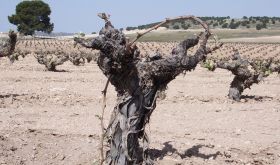
I asked what he thought of the new Appellation Languedoc Contrôlée, created to encompass the entire region and, it is hoped, create greater awareness of it. He chuckled throatily. “It’s basically a a big dustbin. We’ve done things backwards in the Languedoc, making lots of little appellations first and then one big one. I’m not sure at all sure myself that it will improve the image of Languedoc.But overall I’m optimistic about the Languedoc. I think the region can sort out its problems. Not everyone will survive of course, only those who can master the market will manage it. There’s no market for so much of the wine made here. As for the newcomers to the region, I’ve seen too many people arrive here with money, thinking that you make wine with building work, with stainless steel tanks. But that’s all on the surface. What you really have to look after first is the vineyard.”
Gros is the first to admit that there is no single recipe for making good wine. “Tastes evolve, both mine and those of the people I work with. At one point everyone concentrated on maturity of the grapes, but that’s stopped in the Languedoc-Roussillon because it’s pretty facile – like vinifying jam. Not all terroirs can make well balanced wines in that style so you have to step back and reflect on what’s more desirable. You need drinkable wines but they also have to have some structure. There are lots of wines in the new style that are easy to drink but have no structure. Everything is less technical nowadays than it once was.”As a sworn enemy of the special techniques widely used by some Bordeaux winemakers to make their wines taste more concentrated, Gros must be delighted with this trend.
SOME FAVOURITE GROS WINES
in descending order of price (with UK stockists)
Ch La Fleur Morange, St-Émilion(www.interestinwine.com)
Ch Puech Haut, Coteaux du Languedoc (Villeneuve Wines of Peebles)
Ch de la Négly, La Clape, Coteaux du Languedoc(widely available – see www.winesearcher.com)
Dom Bertrand Bergé, Fitou(Linlithgow Wines of Scotland)
Dom Calvet-Thunevin (Waitrose and Laithwaites)
Mas Champart, St-Chinian (www.albanwines.co.uk )
FRANCE
LANGUEDOC-ROUSSILLON
Coteaux du Languedoc
Ch de la Négly
Dom de Boede*
Ch Puech-Haut
Dom Clavel
Dom Causse d'Arboras
La Peira en Damais
Clos des Truffiers*
Pic St Loup
Dom la Roque
Ch de Lascaux
Fitou
Dom Bertrand Bergé
Les Mille Vignes
St-Chinian
Dom Borie la Vitarèle
Mas Champart
Faugères
Dom Albaret
Corbières
Dom du Grand Arc
Ch La Bastide
Minervois
Dom Cros
Les Aires Hautes
Roussillon
Dom Calvet Thunevin
Mas de la Devèze
Dom Cazes
Camp del Roc
La Coume del Mas
Vins de Pays
Dome de l'Arjolle
L’Aube des Temps
Foncalieu’s special Cazouls project
BORDEAUX
St-Émilion
Ch La Fleur Morange
Puisseguin-St-Émilion
Ch Rigaud et la Maurianne
Fronsac
Ch La Rivière
Côtes de Castillon
Clos Louie
Bordeaux Supérieur
Dom du Bouscat
Ch Bois Noir
Ch Puynard
BURGUNDY
Olivier Bernstein of Mas de la Devèze’s new negociant business
SPAIN
Priorat
Melis
Ribera del Duero, Toro, Rueda, Cigales
Matarromera Group
SLOVENIA
Santomas
*Claude Gros’s own wine, or wine made in partnership