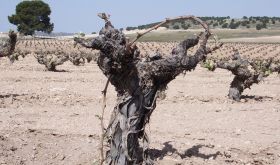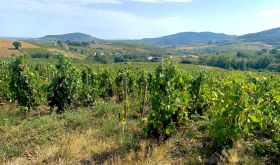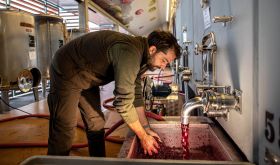

4 March 2020 Matthew Hayes reports. Might a vineyard like this one in the Hautes-Côtes be home to Syrah?
Twenty years ago, no one ever pronounced the C-word. Now it’s on everybody’s lips, in every news bulletin and visible in every back garden in northern Europe. February is the new March, or so it seems.
The C-word is of course CLIMATE, and more pertinently climate change. It is unfortunate that some in positions of power choose to deny it, or ignore it, but it is a reality, and the effects and long-terms trends are likely to have a pronounced effect on wine, what wine becomes and how it is produced.
Burgundy is of course a pre-eminent and classic cool-climate production area. From Chablis and Irancy in the north to Chassagne in the south of the Côte d’Or, Chardonnay and Pinot Noir produce racy, classically modelled wines, emblematic results of Burgundy’s specificity. Terroir, a word so much used in Burgundy, is quite simply a complex combination of place and climate, producing wines inimitable elsewhere.
In the Côte d’Or and Auxerrois, Chardonnay’s touchstone remains minerality and grace, or ‘tension’, another word on everyone’s lips nowadays. Further south into the Côte Chalonnaise and then the Mâconnais, a couple of extra degrees of heat make marked differences to the wines produced. The Mâconnais style is richer, rounder and boasts a more exotic profile. Even I can spot them in a blind tasting, and that’s not to disrespect them, the style is great, the prices welcome, but they are perhaps less true to the ideal of cool-climate Chardonnay than the wines produced further north. But what if Meursault and Chablis were to permanently gain those extra degrees too?
There are some very fine Pinot Noirs coming out of New Zealand, Chile, the United States and elsewhere, but it has long proven a tough challenge to imitate the Burgundian original exactly. Chastened by what can best be described as a moderate climate, Burgundian Pinot Noir surely remains the acme of this grape’s expression: refined elegance, concentration, but rarely sun-filled exuberance. Pinot Noir is, even if just slightly, different here. And it can only be because of the climate. The current rise of German Pinot Noir is a case in point. Rising temperatures are seeing rising quality there, and a relative surge in popularity. Twenty years ago, who would have thought of Spätburgunder? Now, it’s all the rage.
It is, however, important not to confuse two things: weather and climate. Vintages are inevitably the result of weather, not climate per se, and Burgundy has for the last so many years been relatively blessed with its distinctly average, mundane weather. In vintage terms, it’s hard to remember a recent horror story. You have to go back to 1992 for a really disastrous vintage, and even then, the earlier picked whites remain a reference point for burgundy connoisseurs.
Recent burgundy vintages have mostly been relatively benign. It is true that vintages have tended to be small, but what is burgundy generally, if not very hard to get? Even in the relative dogs of a vintage such as 1998 or 2000 (both heavily affected by rot), the wines sold through. Recently the most damaging weather phenomena have been frost and hail. These, like downy and powdery mildew, are linked to weather conditions not climate and have been the burden of vignerons for aeons.
Climate, however, appears to be making these weather phenomena more common. More rain in winter, less snow. Milder temperatures (the winter of 2019/20 has been exceptionally mild) and all the complications that can ensue with confused vines budding earlier, sap rising before warm and wet springs seem inevitably to bring on mildew. More warmth and more moisture do a happy fungus make.
In the 20 years that I have lived in Dijon I have seen snow two feet deep and -15° C (5 °F) for days on end. But I honestly can’t remember the last time it snowed and the coldest day of the year so far has been -3 °C (26.5 °F). That cold snap lasted three days. Not much rest for the vine there.
As Bertrand Lilbert of Champagne Lilbert told me recently, ‘Maintenant le froid est parti’ (now the cold is over). The date was 16 February. As I previously noted, the vines would ideally rest for another month in an ideal annual cycle.
Unfortunately, Burgundy’s generic organisation the BIVB and Météo France were unable to provide specific data for the Côte d’Or but their data for France as a whole, here, from the last 10 years makes grim reading. January 2020 was the second hottest January ever.
Annual French temperature data has been collated since 1900. Of the last nine years, and in descending order, 2018, 2014, 2019 and 2011 were the hottest years on record. Since 2000, 2003 gets a dishonourable mention too. With regard to the 120-year average, 2018 was 1.4 °C (2.5 °F) higher and 2011 1.1°. This is not good news and provides wine producers with a huge challenge.
Upcoming, a pan-Burgundian view of the effects of global warming. From Chablis to the Côte Chalonnaise, even down to the Mâconnais if I can. Is climate change a reality in the vineyard, or just a fiction? Will this influence the style of burgundy in the future, and how, if necessary, can that be combatted?
And what of the of different regimes: biodynamic, organic and lutte raisonnée? There are many great domaines that refuse to be identified with any of these regimes.
As a starter for ten, I can relate that just last week the viticulturist at Chapoutier, the very established northern Rhône biodynamic producer, Alexandre Laroa (slightly) bemoaned the reality that getting their vineyards to such great natural health creates much extra work, controlling cover crops as early as mid January in their lower-lying vineyards. In January a vineyard is supposed to be totally at rest, not being overrun by competitive vegetation.
I heard a rumour that someone, somewhere, has planted Syrah in the Hautes-Côtes (pictured above), and just this last Friday, Le Bien Public, Burgundy’s local paper, related that Domaine Mongeard-Mugneret have planted Malbec. For now, the official line is ‘for the love of Malbec’, but it’s a very peculiar choice. I’ll have more on that, too.
So, coming up, the views and maybe some answers from the organic Dom A & P de Villaine in the Côte Chalonnaise, Dominique Lafon (biodynamic) of Meursault, Frédéric Mugnier of Chambolle-Musigny, new négociant Laurent Ponsot and Dom Armand Rousseau, among others. Keep visiting.