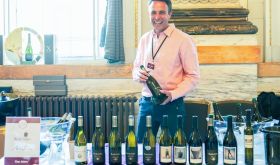
Douzens is a little village of fewer than 800 inhabitants strung out along what was once the main road between the Atlantic and the Mediterranean. Now sandwiched between the A61 autoroute, the old road that now bypasses the village and a busy railway line, it is currently distinguished for wine lovers in being, most unusually, home to four certified organic winegrowers who, most unusually, all get along with each other swimmingly.
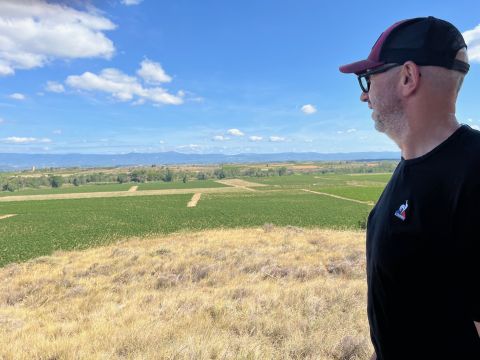
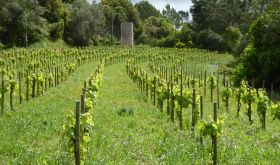
I pointed out the rarity of this co-operative spirit to the rather serious Jean-Pierre Py (pronounced ‘pee’), pictured above surveying his 50 ha (124 acres) of IGP vineyards. He runs the biggest of the four enterprises, Domaine Py, and for the first time during our encounter he smiled, and agreed. ‘Yes, and it’s super! In other villages, they think other producers are competitors.’ I wondered whether it was a question of terroir or personalities. ‘Both’, he said firmly.
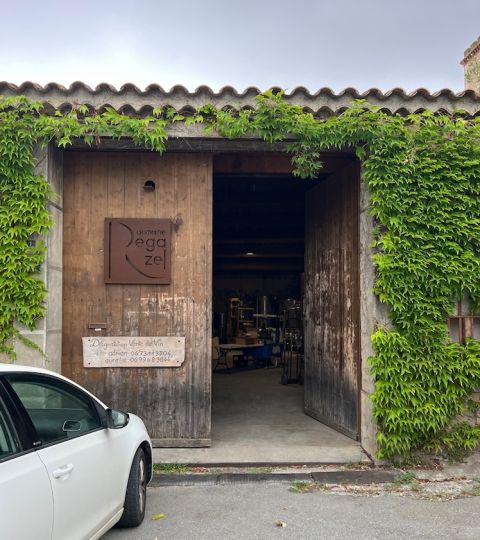
Every Wednesday evening at the little fête in the village square, they take it in turns to supply the wine. Adrian Moréno of Domaine Régazel can bring his bottles by hand. His slightly ramshackle barn of a winery, pictured above, is just round the corner from the square. He told me how, when his wine press broke down on the first day of the 2022 harvest, all his fellow vignerons rang him that day to offer use of their press. Meanwhile Jennifer Buck and Didier Ferrier of Colline de l’Hirondelle at the eastern end of the village routinely use Moréno’s pneumatic press for their white wines because they don’t have one themselves.
It all works because the four of them produce quite different wines from each other – including thoroughly modern orange wines, vogueish red and white grape blends, pet-nats, no-sulphur-added wines, boxed wines, all from a huge array of grape varieties – but are committed to the same principles. So, for example, the common danger of other producers’ agrochemical sprays drifting into an organically managed vineyard is minimised.
As for terroir, Douzens is in the far north of the Corbières appellation and has the distinction there of elevation. The commune is dominated by the 600-m-high (1,969 ft) Montagne d’Alaric, the northernmost Pyrenean foothill, and, as local oenologist Olivier Mérieux, who has clients all over the western Languedoc, puts it, the soils and rocks around Douzens are particularly varied.
His Douzens client is Domaine Sainte Marie des Crozes, run by the feisty Christelle Alias. Like Py, her father was not only a local grower but also a wine broker whose job was to sell bulk wine to local merchants. The previous generation were driven by quantity not quality. I asked Py how his father felt about his son’s decision to go to the trouble of having his own vineyards certified organic (and subsequently biodynamic), persuaded like so many others by the fact that the agrochemical salesmen recommended wearing protective clothing while using their products. ‘My father didn’t have the same philosophy as me so we did exchange views a little’, Py admitted, rapping his knuckles together.
Alias owns 35 ha (86 acres) of vines and, as was evident during a hair-raising tour of them in her little white, open-sided jeep, she revels in their varied terroirs, and is especially proud of her highest vineyard 350 m (1,148 ft) up in the Montagne d’Alaric. She has planted the increasingly popular white-wine vine variety Roussanne there, which was destroyed this year by the hail that is becoming much more frequent in French vineyards. She claims that wines grown on the slopes of the Alaric have a special freshness and character that makes them stand out in a blind tasting.
The major problem for all these growers, apart from the fact that most of their wine is red while demand for white is growing, is drought. Although this spring was unusually wet, they saw not a drop of rain between October last year and April. Dark-skinned Grenache has suffered particularly, while Carignan, which has a long history in the Languedoc, manages to hang on to its freshness and acidity come what may. Alias is not the only Languedoc grower to feel that it was a mistake, when drawing up the appellation regulations, to privilege the imported Syrah, Grenache and Mourvèdre vine varieties at the expense of the more established Carignan and Cinsault. Today, even the most delicious wines made from ancient Carignan vines may not constitute more than half of any red Corbières wine, and happy, fruity, well-adapted local Cinsault has to be limited to 20% of a blend. So, many of the wines this foursome make are labelled simply Vin de France.
Alias clearly feels for her vines. ‘Grenache, that can give so much to wine, is saying this year, “That’s enough guys. I’m gonna take a break. Come back next year.”’ For her, Grenache is a grumbling grandpa while Carignan is ‘a silent grandpa laughing at the struggles of the young vines’.
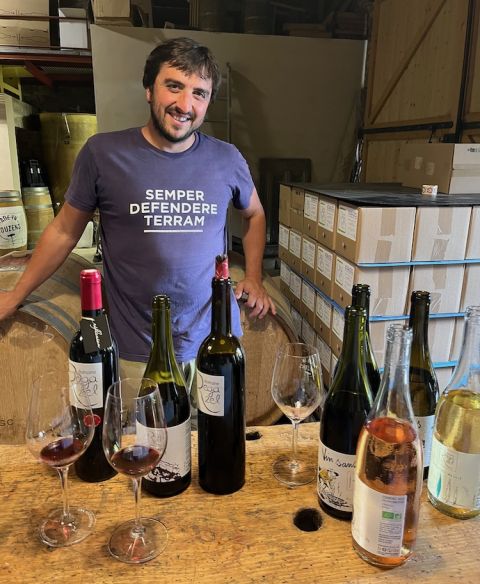
While Alias, Py, Moréno (above) and Ferrier all come from families that have been growing vines, generally taking their produce to the local co-op (now looking decidedly down at heel), for several generations, Ferrier’s wife Jennifer Buck is an exotic import from Berkeley, California. Ferrier’s grandfather was mayor of the village practically all his life and Ferrier himself was such a good rugby player that he snagged a job in communications for a local wine group that allowed him lots of time to play rugby.
When they laid him off, the pair decided to travel round South America. While in Mexico they decided family life back in Douzens could be quite fun. Didier’s father was an ace vigneron; ‘he can drive a tractor like no one else’, according to Buck. So he was well-placed to teach them that side of things and Buck signed up for all sorts of courses in organics. At first she took her notebook to the local co-op and asked how do you make grapes ferment?
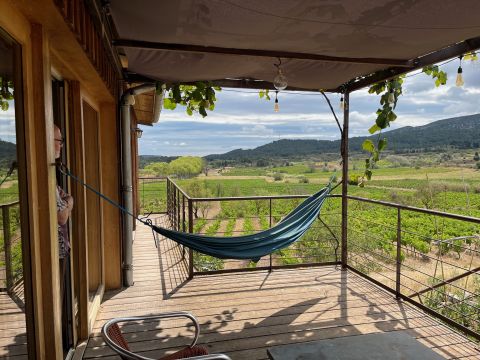
They now have 9 ha (22 acres) of vines and live above their new winery with their two daughters in a rather dreamy, pre-assembled house they designed themselves, with a hammock on the deck, on a hill overlooking a vineyard high in the foothills of the Alaric that’s accessible only on foot. She is one of the producers featured by Naked Wines (which rescued them when 2019 turned out to be a massive vintage) but Buck is still a hesitant winemaker. While giving me a taste of her À La Volée 2022, a garrigue-scented 13.5% mix of Syrah and Mourvèdre, she admitted, ‘Blending is very stressful for me because once you’ve mixed liquids, you can’t unmix them.’
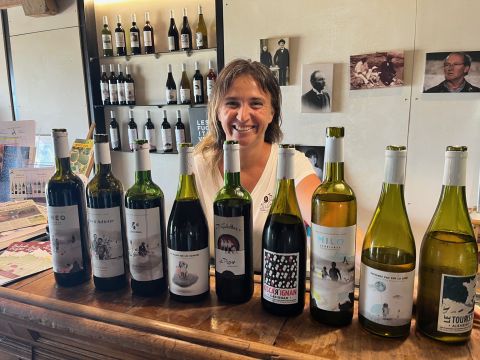
The wines of all four are imaginatively labelled and named, albeit each with their own identity. Py makes 13 different wines, Alias (pictured above) 10 (though one changes every year), Moréno 7, and Buck 11, including La Joupatière, their pride and joy from a small, originally conventionally farmed vineyard planted with at least 16 different ancient Languedoc varieties by someone who didn’t even have a car, just a moped and a tractor. The grapes used to go to the local co-op but it took a Californian to recognise the current value of ‘field blends’. It apparently needed about 10 years of Ferrier’s vineyard magic to convert it to organic viticulture, however. ‘It’s like taking someone off drugs’, Buck told me. ‘The vines really suffer. It’s horrible to watch.’
All of these producers, with the possible exception of Moréno (who also grows asparagus, which he sells at the cellar door in season), wish they had slightly fewer vineyards so they could concentrate on their best. Selling not making wine is the current challenge. As Py, who is diversifying into pistachios, pointed out as we surveyed his vines by the motorway, ‘Three or four years ago this would have been worth €12,000 to €16,000 a hectare. Today it’s more like €7,000 to €12,000, even though our yields are only 30 to 35 hl/ha, and going down in these drought conditions.
‘Sadly, Corbières just isn’t in vogue.’ Corbières, and these not-Corbières, should be.
Douzens favourites
Spicy reds
Domaine Ste Marie des Crozes, Les Mains sur les Hanches 2022 Corbières 14%
€17.50 twil.fr
Colline de l’Hirondelle, Sur La Crête Vin Nature 2022 Vin de France 14.5%
2021: £21 Taste Union
Colline de l’Hirondelle, Oiseau 2019 Vin de France 15%
2017: £19.99 Naked Wines
Colline de l’Hirondelle, Carignan 1515 2019 Vin de France 15%
2016: £21 Taste Union
Colline de l’Hirondelle, La Joupatière 2020 Vin de France 14%
2017: £45 Taste Union
Orange
Colline de l’Hirondelle, Bleu Comme la Terre 2023 Vin de France 13.5%
£22 Taste Union
Where to find them
Domaine Py wines from €8 a bottle are available on the domaine's website and three older vintages than the ones I tasted are available from Yapp Bros from £15.50 a bottle.
Domaine Ste Marie des Crozes wines from €8 a bottle are available via the Twil website.
For Domaine Régazel wines, use the contact button on the wines page of the Régazel website.
For Colline de l’Hirondelle wines, see their website. Some are available in Canada and via Sacred Thirst in California and Golden Vines in New York and Connecticut.
For tasting notes, scores and suggested drinking dates, see Douzens – centre of collaboration.