See our guide to coverage of 2011 burgundy, particularly the reviews of more than 900 examples tasted both in Burgundy in November and in London last week, and this thread in our Members' forum for our most recent impressions.
If you're a burgundy lover, you've got to love the laconic Jacques-Frédéric (Fred) Mugnier, maker of particularly fine Chambolle-Musigny. 'I prefer good wine to great wine', he confided disarmingly when showing me his 2011s last November. 'Great wines are made to last. But the longevity of wines, and their tannin level, has nothing to do with quality. My aim is to make wine for people who want to drink them, not necessarily keep them. Our customers today are probably more likely to move often than to have long-term cellars. My wines do age, much more slowly than I would have thought, but that's not my main aim.'
Mugnier's wines are characterised by extreme transparency, both in terms of their paler-than-most hues and by how well they communicate the differences between his vineyards, from the extensive Clos de la Maréchale Premier Cru in Nuits-St-Georges, which has really got into its stride since 2004 when he took it back into the family domaine from négociant Faiveley, to his knock-out Musigny. Another of this year's more memorable pronouncements from this ex-pilot when referring to the concentration evident in the wines of some of his neighbours was, 'There seems to be a power complex of virility. We need more women making wine in Nuits-St-Georges.'
The 2011s from the Côte de Nuits, the northern half of the Côte d'Or and Burgundy's red-wine heartland, are highly unlikely to break any records for longevity. The best wines are the sort you want to drink really quite young, balanced and full of fruit but with neither particular concentration nor marked tannins. It's no wonder that those who like to define vintages by their similarity to other vintages leapt to categorise 2011 as a copy of 2007, a vintage that is already providing early, easy (and hugely pleasurable) drinking. Such a comparison may have been encouraged by the fact that both were vintages that were picked particularly early. But among the three dozen vignerons I visited in Burgundy last November there was not one who saw a direct parallel with 2007.
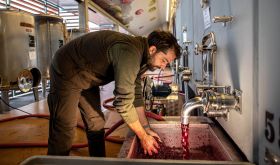
For both winemaker Diana Snowden Seysses of Domaine Dujac and Olivier Bernstein, recently installed in glamorously historic cellars in Beaune instead of a dilapidated garage in Gevrey-Chambertin (see my picture above of the wine nerve centre in that village), 2011 is denser than 2007. Denis Bachelet (with whom I concur) suggested '2011 is a bit like 2002 but with more ripeness; wines don't have to be 15% alcohol to be good'. Romain Taupenot of Domaine Taupenot-Merme sees 2011 as a blend of 2007 and 2010 (which turned out so much better than anyone dared hope) with the low summer temperatures preserving freshness and aromas. For Jean-Marie Fourrier, the vintage is also '2007 with a touch of 2010, but with lower alcohols'.
The potential alcohol levels in the 2011s are generally the lowest in many a year, closer to 12 than 13%, with the majority of producers returning to the old practice of chaptalisation, adding a little bit of sugar to the fermentation vat, in order to prolong the fermentation rather than simply to make the wine more potent.
So why did they pick so early? (Sylvie Esmonin, for example, started her 2011 vintage on 3 September, two days earlier even than she did in the heatwave 2003.) Because after an early, warm, almost dangerously dry start to the growing season ('spring that was like summer') followed by flowering in fine weather and then a horribly cool, stormy July and first half of August ('summer that was like autumn'), the grapes were so swollen by rain that some of them split on the vine and rot was a constant threat. According to Jean-Marie Fourrier, the key to success in 2011, or at least to being able to sleep at night, was having old, mixed vines with their loose bunches rather than the newer clones whose tighter clusters encourage the spread of rot. He claims to have had to reject a mere two or three per cent of grapes on the sorting table in 2011, although he added, 'what saved the vintage was the last two weeks that were sunny. It was all about keeping the foliage free of traces of downy mildew so photosynthesis could continue. Mildew was the big problem that drove the growing season all year long.' (As it would be, even more so, in 2012 with its smaller crop.)
Heavy rains between 18 and 20 August diluted the sugar levels and growers had to wait for the grapes to concentrate again in this final window of fine weather. But in many instances the leaves, fed up with fighting downy mildew and the rampant vegetation encouraged by the wet summer, stopped photosynthesis and started to change colour. The ripening process was over. Worried by the forecast of yet more storms, most growers started to pick at the end of August – very early by the standards of the Côte de Nuits. Even Domaine Ponsot, traditionally one of the latest pickers, started their 2011 harvest around 10 September.
All vignerons are agreed, however, that once the grapes were gathered in, they were easy to transform into wine, and they have been surprised by their firm, stable, limpid colour. This is not an especially tannic vintage and such tannins as there are have tended to come from the pips rather than the skins. The malolactic fermentations proceeded easily and the best wines have retained attractive energy.
I write this, however, having tasted only at some of the best domaines in Burgundy and before immersing myself in the 27 tastings of 2011s from often less grand addresses organised by British merchants this month. But strictly on the basis of what I have seen so far, I am reasonably enthusiastic about the best Côte de Nuits reds in 2011. These are not wines that will have to be cellared for decades before they reveal themselves. They are fruity wines characterised by truly burgundian delicacy that may not be the most persistent wines ever but they express well the nuances between different appellations and vineyards and should drink well over the next five to 10 years while we wait for the three vintages made immediately before 2011 to develop fully in bottle.
Next week I will be writing about the Côte de Beaune and will include a list of recommended producers in 2011 from both the Côte de Nuits and the Côte de Beaune.