See also tasting notes on nearly 60 Etna wines.
One of the most exciting things about my job is the discovery of a new wine region. And these are not always in far-flung corners of the wine world. Nor indeed are they new in the strictest sense of the word, with the upper Agly valley inland from Perpignan being one of my favourite examples.
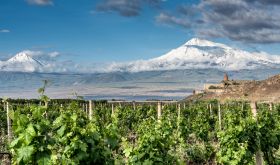
Last month in Sicily I had the thrill of witnessing the launch of another new-old wine region, on the slopes of the decidedly active volcano Mount Etna, see here on a winter’s morning. “The Etna” is how locals refer to this brooding cone that dominates the east of the island. At any time of year it seems an almost human presence, its slopes larded with the dark, lumpy remains of old lava flows, its summit emitting constant visible whiffs of sulphurous smoke. Covered with fresh snow in the spring sunshine, the Etna was a particularly obvious presence both for skiers and those who live on its flanks, constantly marvelling at its changing aspect in the Mediterranean light.
Our short trip to Sicily was inspired by Le Contrade dell’Etna, a giant tasting of wines from the different small areas on Etna’s slopes, each known as a contrada and each uniquely defined by its aspect, elevation, climate and soil, in this case quality of lava if you please. Round here there is lava one-upmanship. Growers in one contrada where the soil is particularly black may be rather sniffy about another where the lava is yellower and flowed in an unpropitious way for vine growing.
That viticulture is nothing new on Etna is evident from the ancient narrow stone terraces, many of them abandoned, that trace contour lines around the mountain. In fact the combination of dark soils and breathtakingly skilful wall building reminded me of the wild Aran Islands off the west coast of Ireland. It is clear that vines were traditionally the most important crop on Etna, even if their produce for long found its way into blending vats on the Italian mainland, especially Calabria, and even in France. But it is only very recently that the particularly mineral-influenced wines grown on Etna’s slopes have begun a renaissance in their own right, and many of these densely-planted old terraces are being rehabilitated.
New wave Etna wine could be said to stem from 2001 when, separately, Belgian Frank Cornelissen and Andrea Franchetti of Tenuta del Trinoro in southern Tuscany identified something special about these volcanically inspired vines and began to make wine from them. Cornelissen had been brought up with fine wine and wanted to find somewhere where he felt there was a chance to make great, completely ‘natural’ wine from old vines with minimal chemical inputs. On the slopes of Etna, or at least in a segment on the north slope between Randazzo and Linguaglossa, the climate is so protected from rain that in his seven vintages here Cornelissen has only ever had to add the most basic Bordeaux mixture, copper sulphate, and that just three times in total. Today, Cornelissen’s wines, made in terracotta amphorae, walk defiantly on the wild side, although there are some that should appeal to all palates.
Franchetti is arguably even more eccentric as a character but his wines, most called Passopisciaro (see this wine of the week) after the local village, are a little bit more recognisable to the modern wine drinker, although he too was attracted by the unusual age of so many vines on the slopes of Etna – up to 100 years old or more. The idea for Contrade dell’Etna was his and it was at his stone winery, backed by terraced slopes leading up to one of Etna’s subcones, that the event was held. Ten years ago there were eight wine producers on Etna. At his wine fair nearly 40 of them showed their wares, and according to the inevitable carabinieri presence almost 1,500 people turned up to taste the wines and enjoy music and barbecued lamb with fennel sausages afterwards.
Although Calabretta and subsequently Benanti are well established locals, it was generally felt that it needed an outsider to organise this debut event. The number of outsiders involved with Etna wine production is growing every year. Not only have most of the island’s top wine producers based further west – the likes of Corvo, Gulfi, Planeta, Regaleali and Tasca d’Almerita – moved in, but many high profile wine producers from mainland Italy. The most prominent, and passionate, of these is American-born Marco de Grazia who first made Etna wine in 2002. Over nearly 30 years he has built a highly successful business exporting fine Italian wine all over the world, and especially to the US. His grandparents emigrated to America from just north of Etna but he claims it was wine quality rather than family sentiment that drove him to establish his Tenuta delle Terre Nere (see this wine of the week) on Etna, which he calls the Burgundy of the Mediterranean. “It’s as if the consumers of the world were waiting for this to happen.” he told me over sautéed baby Sicilian artichokes. I sell truly extraordinary wines by any standards to 42 different countries, but I have never sold a wine that everyone wanted as much as this one. I put it down to the power of the Etna.”
It could be the power of his wines. They are pretty potent. Even his basic Etna Rosso, a wonderfully characterful fruity mouthful that he is able to sell for just 4.50 euros at the cellar door, is upwards of 14% alcohol and his special contrada bottlings are sometimes nearly 16%. But they have great freshness and balance, as though those lava deposits are reining in mere ethyl alcohol. And the wine he has made for the first time in 2006 from a special patch of pre phylloxera vines by his Etna winery is truly phenomenal.
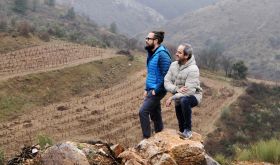
The tally of outsiders who have so far invested in Etna includes Cottanera, a label developed by a group of oenologists from Rome, and the young Belgian couple running Terre di Trente (from whose website I took the picture of Etna). As I tasted the wines of this be-denimed pair, a young American came up to them and told them he too had just bought a small wine farm across the hill from them.
Not that it is necessary to buy vineyards to make great wine here. Andrea Franchetti and others are fulsome in their praise of the local farmers who, although more and more of them are beginning to make wine themselves, can still be persuaded to sell hand-reared, fully ripe yet beautifully balanced grapes. “It’s a wine that’s all vineyard not winery,” says Franchetti. “I’m beginning to like it a lot.”
The dominant grape variety is Nerello Mascalese. (On Etna they are disparaging of the western Sicilian red grape Nero d’Avola as too simple and heady). Nerello Mascalese ripens late, and grapes are grown up to a cool 1,200 metres on the slopes of Mount Etna so that they may not be picked until the end of October or even the beginning of November. The variety certainly holds its acid well and has a certain very obvious nobility, and lovely gentle tannins, to it, making the wine good to drink young and able to age too. At Le Contrade the most respected long term producer of Etna wines, Calabretta, was showing off his 1999 Etna Rosso, with good reason.
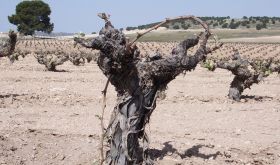
There is also Nerello Cappuccio, much fleshier and more obviously charming, “the Merlot to Nerello Mascalese’s Cabernet”, as de Grazia descrbed it. In Etna’s 2,000 hectares of vineyards it is common to find these ancient vines supported by a single thick wooden stake, a promiscuous mixture of the two Nerellos, table grapes for vineyard workers to eat, white grapes such as Malvasia and the local Carricante, and even wild vines.
It is hardly surprising that Etna now produces such a wide variety of wines, but this is just the beginning of the rebirth of “the Etna” in a glass.
See also tasting notes on nearly 60 Etna wines.