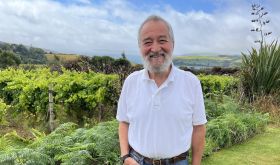
‘Terroir and microterroir are not owned by Europe’, Tuscan wine consultant Alberto Antonini declaimed at the London launch of his new wines from Australia’s Barossa Valley. ‘Geology doesn’t know where the New World and Old World divide.’
This is such an obvious point and one that was underlined by the style of the Alkina range. I found myself writing things like ‘pale ruby’, ‘dances on the palate’, ‘so fresh’ and ‘slightly floral’.
If served these wines blind, I would never in an eon have guessed they came from Barossa Valley, whose wines tend to be impenetrably concentrated and are much more likely to impress than refresh. In fact the Alkina wines reminded much more of the transparent, appetising reds aged in concrete rather than oak that Antonini has been conjuring from the soils of the Andean foothills and the Caucasus.
But he would be the last person to claim he is trying to impose his personal style on geography. His philosophy is the same as that of his frequent collaborator Pedro Parra, known as Doctor Terroir for his eagerness to dig soil pits to chart his clients’ vineyards’ varied geologies. Their whole aim is to maximise the inherent expression of any given block of vines. It’s a ubiquitous mantra in wine production today to let the vineyard express itself, but no one does more detailed work to ensure this actually happens than Parra and his new disciple Paul Krug, of the famous Champagne family.
They work all over the world – I recently came across a southern Burgundy producer whose vineyard had just been mapped by Parra and Krug, to his extreme delight. When I spent time with Parra in his native southern Chile in 2017 he already mentioned clients all over Italy, California, Oregon, Argentina, Spain and Burgundy. ‘There are lots of discoveries in Meursault’, he assured me, of something about which I was entirely ignorant. ‘There are three different sorts of limestone there and how it breaks up makes a big difference to the sort of wines you can make.’ He loves nothing more than digging so deep under the vines that he can’t even see ground level.
Parra and Antonini have only increased their international client lists since then, including Parra’s influence on this new Australian project. In this case, Parra was brought in rather late, two years after the land had been acquired by the owner, Argentine oil and gas magnate Alejandro Bulgheroni, who seems willing to pour huge amounts of money into Parra’s holes in the ground and believes strongly in both organic viticulture and an extremely long-term approach. His first flagship wine estate was Garzón, in south-east Uruguay, but he has since expanded into his native Argentina (including Patagonia), Tuscany and now Australia.
It was not just Antonini, a long-standing advisor of Bulgheroni’s who knew just how varied and interesting the soils of Australia can be, who encouraged him to look there. Simon Farr, one of the UK’s more thoughtful wine merchants, who had came across Bulgheroni when he acquired the Argentine wine brand Argento from Farr’s old company Bibendum, was of the same opinion.
Farr remembers that they toured various possible sites in Australia in what he regarded as dangerously luxurious style if they wanted to secure a good price. In the end it was a Barossa local, Amelia Nolan, who now runs Alkina and had been responsible for selling Bulgheroni’s wines in Asia, who led them to the farm that Bulgheroni eventually acquired in 2015.
She knew that discerning Barossa winemakers were always prepared to pay handsomely for the grapes from Les Kalleske’s farm near Greenock in the north-west of the valley, and Bulgheroni’s team took it from there.
There was considerable unplanted land on the farm so Parra was drafted in to examine its potential. First he measured subterranean electro-conductivity to discover where to dig the pits. And then, according to Antonini, ‘we discovered a goldmine. We got very excited by the diverse soils on the farm, including schist, limestone, granite and basalt.’ All of these are highly valued by winemakers but have very different potential effects on wines grown in them, if they are allowed their fullest expression and are not smothered by layers of winemaking.
Antonini spells out who the enemies are in this respect: overripe grapes; over-extraction in the winery of what they have to offer; over-use of oak; viticulturists who believe in using synthetic chemicals; winemakers ‘who want to be part of the flavour’; and the market. ‘The market can be an enemy because you don’t want to “make wine for the market” – which market? You have to find a market for what you do.’
He of course can afford to say this because his work is bankrolled by a billionaire who is in no hurry to see a return from his wine investments. I asked leading Australian wine writer Max Allen what he thought of the new Alkina wines and his chief impression was of ‘very ambitious pricing’.
This is true. Alkina’s UK importer Raeburn Fine Wines suggest retail prices of between £39 and £230 per bottle for the launch vintages of 2018 and 2019, made from vines planted decades ago on the property rather than the new plantings inspired by Parra’s work.
The wines are lower in alcohol than the Barossa norm: 13.5% to 14.2%. Antonini claims that you can still extract great flavour from the grapes even if you pick them three weeks earlier than your neighbours, provided the vines are grown organically. ‘Organic viticulture is more productive because the vine is more fertile, leading to better-quality wine and a much longer life for the vine. It can cut costs too.’ In Argentina, for example, he’s now picking in the second week of March when he used to pick three to four weeks later, and this is not just because of climate change. ‘It all depends on the soil type.’
He does admit however that their farm is by no means unique in Barossa. The valley is characterised by an extremely rich array of soil types and underlying rock and many other producers could make the sort of wines he is aiming at if they wanted to.
If his theory of changing tastes is accurate, then the style of Barossa wine may evolve to something closer to Alkina’s, and some producers are already showing signs of this. According to him, the recent improvement in diet, especially in the US, has had a big effect on people’s palates. ‘They no longer need big, bold, concentrated wines that they sought when their diet was chock-full of sweetness and glutamate.’
Antonini is worth listening to because he is reflective and knows so many different wine regions, producers and markets. And it’s not just upmarket wines he’s responsible for. His most recent project was making a trio of Italian blends with which chef Gordon Ramsay has entered the burgeoning celebrity wine business. They were launched this week in Tesco stores at £8 each.
For him the future is bright, but challenging. ‘What we’re drinking now is no more than 20% of what Nature could offer us. There is still so much to do. It’s great that wine is now part of our civilisation. It’s no longer just something that was a routine part of a meal as it was when I was young; my parents drank the same wine at all meals. My children want to explore, they want to know the world through wine.’
Alberto Antonini’s clients
Tuscany – Montalcino
Biondi-Santi, Argiano, Podere Brizio, Poggio Landi, Renieri, Tassi
Tuscany – Chianti Classico
Dievole, Castello di Bossi, Le Filigare
Tuscany – Chianti Montalbano
Poggiotondo
Tuscany – Bolgheri
Tenuta Meraviglia
Abruzzo
Farnese/Fantini
Sicily
Settesoli/Mandrarossa, Curatolo Arini
Spain
Bodega Trus (Ribera del Duero), Bodega Proelio (Rioja), Bodega Nivarius (Rioja)
Argentina – Mendoza
Altos Las Hormigas, Argento, Finca Flichman, Trivento, Trapiche/Peñaflor, La Celia, Casa de Uco
Argentina – Patagonia
Otronia
Chile
Concha y Toro, Viña Leyda (Leyda Valley), Viña Intriga (Maipo Valley), Viña Bisquertt (Colchagua Valley), Viña Falernia (Elqui Valley)
Uruguay
Bodega Garzón
Armenia
Zorah
Australia
Alkina (Barossa Valley), Pizzini (King Valley, Victoria)
Israel
Barkan/Segal (Jerusalem Hills and Galilee)
USA
Seghesio (Sonoma Valley), Hamel Family (Sonoma Valley), Renwood (Amador County), Ramiiisol (Virginia)
Tasting notes on Alkina and many other of these wines, including the new Gordon Ramsay wines, on Purple Pages of JancisRobinson.com. International stockists on Wine-Searcher.com.