Italy has no shortage of official wine territories – 575 at the last count – but there is one that has recently been exciting more interest than any other, Etna in eastern Sicily. The name may be delightfully easy to spell and pronounce, but it is its distinctively sultry wines that are so memorable.
The slopes of this active volcano constitute some of the strangest wine country in the world. Etna itself is omni-present, whether via the warning booms that could be heard throughout this summer (heralding a great vintage for Etna), or the dramatic lava flows, or the cone itself – snowcapped in winter and spring, plumed with cloud in summer and autumn – or the terrain. The land is dotted with strange dark crusts of dried magma, in shapes no designer could create, and with torrette, piles of lava stones stacked up by smallholders after clearing sufficient space for a field or vineyard. The land has been so twisted and turned that large plots do not exist, and there is massive variation between each small one. The best vineyards have been painstakingly terraced, often with lava stones. Many of the vines are centenarians. These are vineyards that demand workers who understand the very special land that is Etna.

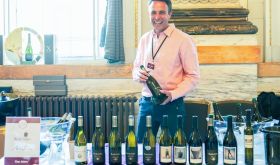
Michele Faro's grandfather owned two hectares of vines south of Etna and one of lemons – enough for a family to live on then. (Michele is pictured here.) His father Venerando built up a considerable business selling Mediterranean plants in this particularly warm, wet corner of Sicily overlooked by Etna. But in 2004 they realised that Etna was about to be engulfed not by molten lava but by an influx of wine producers and made their move, acquiring some particularly favoured 40-, 80- and 100-year-old vines for their Pietradolce wine project in the late-ripening northern sector that is particularly suitable for red-wine production because of the length of the growing season. Their tiny Barbagalli vineyard (in which Michele is standing) in an amphitheatre almost at the upper, 1,000-m limit of the Etna DOC is a haunt of butterflies, cactus, wild cyclamen and fennel best reached on foot.
Crossings on the single-track Circumetneo railway are still hand-operated, by men who sit in cabins with their feet up, waiting for a phone call from the previous station. 'Fifteen years ago', Michele Faro explained after pointing one of them out, 'there was no reason to come here. There were perhaps five wine producers in total.' Now, so fashionable have Etna wines become that he regularly shows representatives of the big northern Italian wine companies round his Etna vineyards. But they tend to retreat, shaking their heads at how hard it is to work the tiny plots of such uncompromising land, with ancient vines that might yield just half a bottle each. Nevertheless, most of Sicily's big wine companies – Cusumano, Duca di Salaparuta, Firriato, Planeta, Tasca d'Almerita – have recently invested in land on the mountain, some of them even building wineries there. There are now about 60 growers, of whom a good 20 also make wine.
There have always been smallholders and vine growers who would either make wine for themselves or sell to the small local co-op or one of the region's very few wine producers: the old Baroni di Villagrande enterprise based in Milo on the eastern slopes of Etna best for white wine production, Murgo and Benanti. The Etna wine revolution began with 2001, the first vintage for Passopisciaro, a small estate founded on ancient, high-altitude vines by Andrea Franchetti of the mould-breaking southern Tuscan estate Tenuta di Trinoro. It was also when the Belgian wine broker and wine fanatic Frank Cornelissen made his first small quantity of defiantly natural wines, and was the first bottled vintage of I Vigneri, a loose association of Sicilian growers whose wines are made by the quintessentially indigenous Salvo Foti. Italo-American wine broker Marco De Grazia followed hard on their heels and his Terre Nere is now one of the best-distributed Etna labels.
Until three years ago, Foti was Benanti's oenologist, but now, helped until recently by Gino the old mule, he concentrates on his own small patch of lovingly raised gnarled vines, a field blend of traditional Etna varieties Nerello Mascalese, Nerello Cappuccio and Grenache, their leaves orange and yellow in the autumn sun. (Most producers concentrate on the first of these today, but few of them can boast 200-year-old vines.) As we picked our way between different vineyard plots along rough, stony paths on top of carefully built walls, he pointed dismissively at the bright green vines of a neighbour advised by a Tuscan oenologist, the last two words pronounced as though profane. Black irrigation tubes snaked along the wired rows of vines. Rainfall is high on Etna but the water runs off rapidly into the fertile loams on top of the volcanic rocks. Irrigation keeps roots close to the surface, he commented disapprovingly.
There could hardly be a greater contrast between the vineyards of the old hands and those of Duca di Salaparuta, owners of the Corvo brand. They bought a nine-hectare vineyard just over the hill from Pietradolce's most favoured vines, at the propitious altitude of 700 m, and promptly razed its terraces, re-landscaping the terrain so that it is now virtually flat and has widely spaced, high-trained rows of Pinot Noir vines looking for all the world as though they had been designed for mechanisation. I was assured that all grapes are picked by hand, but found it hard to see much Pinot character in the result. The warm, earthy traces of the mountain clearly impose themselves in most Etna reds, whichever the variety – although some oenologists seem determined to smother these characteristics with new oak.
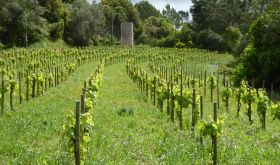
In stark visual contrast to this was what Cusumano, another big producer from central Sicily, had done to another top-quality vineyard they bought from Benanti, who had pulled out its vines two years ago. Here they had painstakingly reconstructed the terraces and had planted a forest of alberello individually staked vines on them in the traditional fashion – helped by a government grant, and access to workers on their other 600 hectares of vines on the island.
But a traditionalist such as Foti insists that local Etnese hands are essential to really understand how to grow vines here. 'Etna people don't understand that they have their fortune at their feet', he said. To judge from his cellar-door prices, just 10 euros for a bottle so lovingly made by man and mule, he is a true romantic.
SOME ETNA FAVOURITES
Terre Nere, Calderara Sottana 2012
£110 for six bottles in bond Justerini & Brooks
Pietradolce, Archinieri 2011
£25 Hic Wines, £167.94 for six bottles duty paid Armit
I Vigneri, Salvo Foti, Rosso 2012
£25.50 L’Art du Vin, Hedonism Drinks, Kensington Wine Rooms
Graci, Contrada da Arcuria 2012
£29.95 Berry Bros
Passopisciaro single-contrada 2012s will be offered by Corney & Barrow from 20 November (some 2009s are still available for just under £40). Many of the vines are higher than the upper limit of the Etna DOC so the wines have to be sold as IGT Terre Siciliane and with only an initial rather than the name of the contrada.
See my detailed tasting notes .
The photo of the Guardiola vineyard in winter is taken from the Terre Nere website.