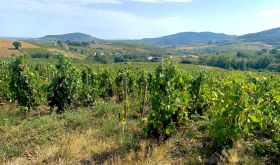
In the heat of summer in our household, we search desperately for wines that are not too potent. And yet as our summers get hotter, our wines get stronger. Sunshine is converted into sugar in grapes which is fermented, by increasingly powerful yeasts, into more and more alcohol.
I remember red bordeaux with labels stating unashamedly 10.5 and 11 per cent alcohol but nowadays percentages of less than 13 are becoming a rarity even in the temperate climate of Bordeaux. In warmer wine regions, in Australia and California for example, the trend in potency has also been upwards, but from a higher base. As long-serving winemaker Bob Lindquist of Qupé in Santa Barbara told the New York Times recently, “It used to be anything above 14 per cent was really up there. Now, 15 is the new 14."
The general planetary tendency towards stronger and stronger wines is particularly pronounced in the better quality wines of California. Here winemakers, encouraged by a culture which is fearful of chewy tannins or even a whiff of the leafy aromas they have been taught to associate with underripeness, are apparently obsessed by giving grapes longer and longer ‘hang time’ in the vineyard.
The most common reason given for this now-popular practice is that winemakers are concerned that flavours build up more slowly in their grapes than sugars do and so, also anxious to soften the tannins in the grapes on the vine, they have to pick grapes later and later in the ripening cycle – even waiting until they start to shrivel and turn to raisins on the vine.
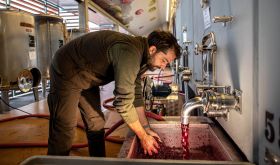
This can boost grape sugar levels to such an extent that the resulting wine would be unpalatably strong, so it is now common practice among ambitious, rather than unscrupulous, California winemakers to add water to the fermentation vat to ‘bring back’ the final alcohol percentage (see Adding water to wine). Indeed California’s winemaking regulations were specifically changed recently to allow producers to add water 'to replace that which was lost from grapes through field dehydration'. Some producers resort to more sophisticated, and expensive, means of reducing alcohol such as those used to produce seriously low-alcohol wines, but most use simple dilution, and are by now well skilled in the ways of reducing alcohol without reducing flavour.
So far so good (except for the headaches that can result from high-alcohol wines) but California’s grape growers are becoming increasingly dissatisfied with recent developments. Much more often than in Europe, the business of growing wine grapes is quite distinct from that of making wine. Professional growers sell their produce to winemakers, usually being paid on the basis of weight. Not surprisingly, grape growers are increasingly loth to keep grapes on the vine so long that they dehydrate and lose weight, only to see the winemakers make up the difference from the faucet. This is currently a hotly debated issue, particularly in the Napa Valley.
Some growers have even accused winemakers of deliberately adopting extended hang time in order to pay less for the grapes. I have also heard the theory that the high-profile winemaking consultants typically responsible for making the most famous and expensive California ‘cult Cabernets’ are spread so thinly that they are not able to devote the time needed to soften tannins by careful work in the winery, so softening them in the vineyard by extending hang time is a useful replacement.
Whatever the reasons, the phenomenon of increasingly potent wines is undeniable. A calculation of average alcohol levels in Napa Valley Cabernets between 1970 and the 2001 vintage shows that while in the early 1970s the wines averaged about 13 per cent alcohol, in 2001 the average was 15.1 per cent. And for Zinfandels and some grape varieties originally from the Rhône, it is not at all uncommon to see alcohol levels at 15.5, 16 or even 17 per cent on California labels. It is worth bearing in mind that US wine labelling laws allow a tolerance of one per cent either way on wines over 14 per cent (and two per cent on wines of 14 per cent or below), so a wine labelled 15 per cent could quite legally be 16 per cent in reality.
However, these increasingly prevalent high-alcohol wines are effectively un-exportable, at least to Europe. The problem for California wine exporters is that wines with more than 15 per cent alcohol may be exported into the EU only if they come from a country that has hammered out a bi-lateral wine agreement. And there are so many contentious transatlantic trade issues outstanding between the EU and US – American beef and ‘champagne’, anyone? – that the necessary horse-trading between Brussels and Washington has been lumbering on for almost 15 years without any sign of conclusion.
I asked James Hocking of Vineyard Cellars, the specialist importer of fine California wine into the UK, how this prohibition affects his business. “It’s impossible,” he sighed. “Most Zinfandels made in 2001 and 2002 from our producers are completely out. Luckily 2003 and 2004 were a bit cooler, but it’s all very difficult, even for some Chardonnays.”
And it’s likely to become increasingly difficult if summer temperatures continue to rise and extended hang time continues to be so popular, particularly since the EU ban applies to the actual alcohol level of the wine rather than what’s written on the label.
But the increasingly potent wine phenomenon is by no means limited to California. Temperatures have been rising everywhere, which has naturally inflated alcohol levels – even in England. There has also been a tendency for blockbuster wines to perform well in the comparative tastings than dominate wine criticism today, which has encouraged many winemakers all over the world to make increasingly powerful wines. So how do other warmer wine-producing countries cope with the increasing need to export these knockout drops to the continent with the world’s keenest wine importers?
Chile and South Africa put in the necessary time in Brussels in the last few years and have made the required concessions so that they can send as much wine over 15 per cent alcohol as they like to the EU, although in the UK additional excise duty is payable on all wines over 15 per cent alcohol.
The Australians hammered out their bilateral wine agreement 11 years ago, promising to phase out the use of such terms naughtily borrowed from Europe as Burgundy, Chablis and Hermitage. In return, they too can send us their mushrooming category of dry reds over 15 per cent alcohol, but they are supposed to put the words Special Late Harvested on the label somewhere. This is all part of a sub-clause of the original agreement, surely intended for sweet white wines, for wines made from “fresh ripe grapes of which a significant proportion has been desiccated under natural conditions in a manner favouring the concentration of sugars in the berries”.
One possible solution to the worrying issue of ever more potent wines is to use yeasts which have been genetically engineered to result in wines with the softness that modern winemakers seek but perceptibly lower alcohol levels, but this would be highly contentious.
Some industry observers believe that alcohol levels can be tamed in the vineyard, either by fine-tuning the ratio between bunches and leaves on the vine, or with more precise irrigation regimes. Others seem perfectly happy with the status quo.
According to George Hendry, Napa Valley grower and winemaker, referring to northern Europe’s century-old practice of chaptalisation to boost final alcohol levels, “Bordeaux has to add sugar. We have to add water. We can make the alcohol level whatever we want it to be.”