Earlier this year I wrote a series of eight articles suggesting possible approaches to collecting wine without paying over the odds. But there is absolutely no point in building up a wine collection unless you store it carefully. It’s no good if temperatures fluctuate wildly, and if they get too close to 27 °C (81 °F), you run the risk of boiling off subtle flavours and of the wine expanding to such an extent that the cork, or screwcap, is no longer a perfect seal. The conventional ideal temperature of a cellar is around 13 °C (55 °F) – much cooler than most people’s spare bedrooms. But it’s probably more important that the temperature is reasonably steady than that wine is kept as cool as this.
It is generally thought that because heat speeds up reactions, the cooler the storage conditions, the more stately a wine’s progress towards perfection. Wine stored by one of the Scandinavian alcohol monopolies at one stage attracted a premium, and there is a current fashion among certain wine producers for storing crates of wine bottles in the sea. But private collectors should be wary of outdoor sheds, which can be disastrous, as one of my wine-writer colleagues knows to his cost, if the temperature is ever likely to fall below -4 °C (25 °F). Depending on alcohol content, the wine will freeze, expand and push out the bottle’s stopper.
You need somewhere reasonably dark, especially for sparkling wine and wine in clear bottles, which are particularly susceptible to a condition called lightstrike that can give the wine a really horrid smell. You also want to be sure that your wine is stored somewhere that is odiferously neutral – so probably not the garage if there is any danger of petrol or oil smells. A relative-humidity level of around 75% at 13 °C, lower at higher temperatures, is ideal for keeping corks damp and doing their job. This is why bottles stoppered with corks are kept horizontal. Screwcapped bottles can be stored at any angle but wine racks, with a depth of one or two horizontally stored bottles, however stoppered, are great for holding as many bottles per square foot of floorspace as possible, and for retrieving them with ease. But the bane of wine collectors is the increase in fancy bottles, especially those too wide to fit into conventional wine racks.
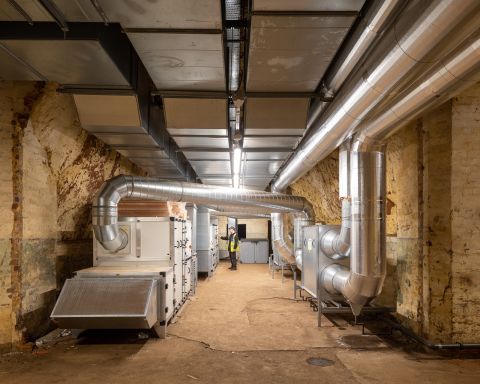
I know of some British wine enthusiasts who insulate a room or cupboard at home in an attempt to replicate cellar conditions. One collector recommends 110–170 mm (4.5–6.5 in) of polyurethane with a thermal conductivity of 0.020 W/mK, but he also installed a cooling unit. (I and others use a large container of water to maintain relative humidity, checking it with an inexpensive humidity meter.) Below is all the equipment needed to ensure wine stored by London City Bond (LCB) is kept at an ideal temperature and relative humidity.
For many a well-heeled American collector, designing their own walk-in, temperature-controlled wine cellar seems an integral part of connoisseurship. Underground storage has the great advantage of very low energy use and Spiral Cellars sell prefabricated concrete ‘bins’ for multiple bottles arranged round a spiral staircase, typically accessed via a trapdoor either indoors or out. I once had one installed in the garden of our old house but tree roots punctured the thick rubber casing so it was no longer waterproof. Some of the labels on my bottles prove it. (Too damp a cellar may render your wines impossible to sell, but shouldn’t affect the wine itself.)
Some Paris flats may come with associated lockers in the basement but in most big cities, properties with underground cellars are all too rare. Wine fridges that can be set at a given permanent temperature are increasingly popular, not least with kitchen designers, but you may well want to store more wine than most can accommodate. In this case, professional storage is the most obvious solution.
There are many underground options in the UK. Old munitions stores, for example, use less energy than above-ground warehouses (though some need dehumidifiers – see above). Wine stores above ground need constant temperature control. In the UK, most wine merchants offering storage options use third-party storage facilities but Berry Bros & Rudd, Lay & Wheeler (whose storage arm is called Coterie Vaults), Seckford and The Wine Society all have their own temperature-controlled bonded warehouses.
It can be helpful to buy and store wine in bond, which means that you don’t have to pay duty on it until you take it out of storage, and taxes in the UK are just VAT and duty, not capital gains. This can also make selling your wine easier. Because there is no shortage of good-quality wine storage in the UK, many a serious wine collector, especially those based in hotter Asian countries, store their wine collections under English turf. (Wine storage providers multiplied in Hong Kong after wine duty was reduced to zero in 2008 but the granddaddy of them all is Crown Wine Cellars hollowed out of the mountain in Deep Water Bay.)

It is far from unusual for wooden cases of wine stored by Octavian or LCB, for example (as above), to change owners several times while sitting in exactly the same place. Fine-wine merchants everywhere are increasingly encouraging their customers to trade wine between themselves, taking a commission, generally 10%, on the deal. An increasing number of merchants and wine-storage specialists provide valuations of wines stored with them, some of them in real time.
Some wine collectors pursue a deliberate policy of buying more wine than they need and financing their cellars by systematically selling a proportion of their collection. This works only when wine prices are rising, however, and the fine-wine market is relatively soft at the moment.
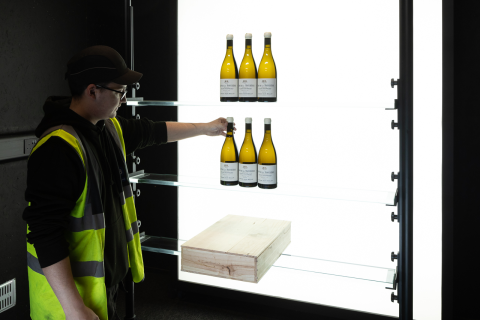
Warehouses can supply condition reports on wine purchases, for a fee. Below, LCB staff check fill levels.
There is a tendency for keen wine collectors to ignore storage charges in their calculations. Most outfits charge roughly £15 per case of wine a year, with a certain minimum annual charge and, in some cases, punitive charges for retrieval and delivery, especially of fewer than a dozen bottles at a time. So from a financial point of view there is little point in paying for professional storage of wine that is not going to appreciate in value. But in the UK anyway, fine wine tends to be offered on the market in quantity only when it’s very young; far too few merchants, unlike their American counterparts, keep much stock of mature vintages. So collectors in Britain are more or less forced to buy young and store long.
Since it would be impossible for me to visit wine warehouses all over the world, I canvassed members of and colleagues on my website about their experiences of various professional storage options and those cited below seem the most popular. Collectors particularly appreciate being able to withdraw just a few bottles at a time. The Wine Society don’t charge for extracting and delivering at least three bottles from an unsplit case of wine, but you can store only wine bought from the Society and they don’t (yet?) offer an inter-member trading platform. It, like an increasing number of storage providers, offers the possibility of managing all this online, with specific delivery dates. Like Fine + Rare, Lay & Wheeler and LCB, The Wine Society will store individual bottles, not just cases.
Insurance is a big issue, especially for really expensive wines. Collectors are generally advised to ensure that their wines are insured at replacement value themselves.
Individual lockers are popular with city dwellers who appreciate the ability to access them at any time of day – and, especially, night – but they are not bonded. WineBANK, started by Rheingau vintner Christian Ress as a locker-based wine club in 2003, has spread from Germany to Vienna and Washington DC.
Some providers charge a year’s storage fees in advance; some invoice in arrears by the quarter. Some count a half-full case like a full case.
There is no industry standard but the most important thing is to store with a substantial outfit with a long and successful history. And to check the details of your insurance policy.
Wine storage facilities …
… recommended by members of JancisRobinson.com
UK
LCB, near Kidderminster in Wiltshire, and both in and near Burton-on-Trent
Octavian in Corsham, Wiltshire
Smith & Taylor in London (lockers)
The Wine Society in Stevenage
US
East Bank Storage in Milwaukee, Wisconsin
Manhattan Wine Company in New Jersey
Portland Wine Storage in Oregon (lockers)
Presidio Wine Bunkers in San Francisco
Vintage Wine Warehouse in New York and Delaware
Europe
Grand Cru Wijnopslag in Oldenzaal, Netherlands
Vinocerf in Uithoorn, Netherlands
Asia
Vinum in Singapore
Members of JancisRobinson.com can join the discussions about professional storage and cellar temperatures, and a great deal more, on our Members' forum, described by one member as one of the most courteous boards in the world of wine websites.
See also Where to store in our free Learn section. If you are aware of any necessary updates to the information provided there (last comprehensively updated in 2022), please email [email protected] to let us know.