As co-authors, Hugh and I see eye to eye on most things, which is convenient, so I was rather taken aback by this and decided to try to establish just what proportion of the world's vineyards are cultivated organically (a first step towards biodynamic viticulture). I asked Matthew (Monty) Waldin, who has now written three books on the subject, to write this comprehensive five-part report and was quite surprised by how rapidly the phenomenon has taken hold recently – albeit governed by very different influences in different countries.
When he wrote his first book, the Organic Wine Guide published in 1999, he reckoned that he was writing about wines produced from well under 1% of the world's vineyards, and confessed that he was probably guilty of exaggerating the figure then. Today he reckons, conservatively, that 5-7% of the world's vines are now organic or are in conversion to organic viticulture, and of them as many as 30% could be subject to some form of biodynamic techniques.
It is fascinating to compare the different national routes that have been taken to conversion from what used to be known as 'conventional' viticulture with its reliance on agrochemicals. Which region would you guess had the highest proportion of organic vines? It would not be helpful to use a weather map to decide for it is one of the wine world's cloudier, wetter regions – even if admittedly most of the rain falls after the growing season. Oregon can boast that a full 14% of its vines are grown organically, some of them biodynamically. Admittedly that figure is boosted by the fact that its biggest producer, King Estate, is a believer, but it is also because of sheer human commitment in a particularly tight-knit wine community.
Organic and biodynamic viticulture is no longer a niche oddity. Each of the world's three biggest wine producers – Spain, France and Italy – have 7-8% of the country's vineyard cultivated organically, according to Waldin's estimates. And these estimates exclude the many, many producers who claim to their customers and visitors that they farm organically without actually being certified. I sympathise with those who lose patience with the form-filling needed for official certification by one of the accredited bodies – no one hates officialdom and officiousness more than me. But I do think that only those who have been certified by an outside body should claim organic or biodyamic principles as part of their sales pitch.
For example, I deeply admire Alfred Tesseron of Château Pontet-Canet, the Pauillac classed growth. He set about conversion to organics at a time when it was ridiculed by most Bordeaux producers. He withstood the ignominy of losing certification when the challenges of the 2007 season pressed him into spraying and is now back to being certified as both organic and biodynamic. No one could be less beards-and-sandals than this member of the Bordeaux corkocracy but, boy, has the quality of his wines shot up.
Burgundy and Alsace of course have long been hotbeds of this particular counter culture with many, if not most, of the top names having set off down the organic and then biodynamic path many years ago. This must have helped promulgate these alternative methods throughout France.
In Spain, much of whose climate, like Chile's, is so dry that it is not prone to the many fungal vine diseases and is therefore particularly suitable for chemical-free viticulture, it's a rather different story. The big incentive for conversion to organic techniques here has been less emulation and conviction and more the pragmatic one of taking advantage of the subsidies that the EU has been handing out for conversion to organic agriculture in general in the wake of the 'mad cow' scandal and a perceived need to move away from industrialised food production.
There has been a similar phenomenon in Italy except that all has by no means flowed smoothly. There has been a lack of real Italian figureheads of the likes of Lalou Bize-Leroy and Dominique Lafon, who have demonstrated that great wines can be produced biodynamically. No Italian specialist soil guru of the stature of Claude and Lydia Bourguignon has emerged to provide inspiration and practical succour, and many of the 'organic' wines have disappointed the critics. Although an estimated 7% of all Italian vines are theoretically organically grown, there is some evidence that many of those in Puglia and Sicily who took the conversion subsidy are abandoning the philosophy. See Walter on how Italy grapples with natural (and organic) wine.
Some of the most interesting developments have been in New Zealand and Australia. New Zealand jumped very publicly on the organic bandwagon in its generic sales pitch long before this matched reality but has recently seen almost feverish conversion and genuine dedication to the principles – not least because young New Zealanders are such inveterate travellers and many have been inspired by what they have seen in Burgundy in particular. Waldin estimates that as much as 10% of all NZ vines are either organic or in serious conversion.
For long Australia's vignerons were as sceptical about this wild and woolly way of growing vines as their counterparts in Bordeaux (I have many reservations about the detail of biodynamics, too). But the dramatic turnaround in the fortunes of Australia's most commercial wines, not helped by the strong Australian dollar, has resulted in a re-evaluation. A new generation is revelling in this phenomenon at the other end of the spectrum from super-efficient, super-technical semi-industrial wine production. Waldin estimates that the proportion of vines grown organically in both Australia and South Africa has risen from 1% to 4% in the last five years.
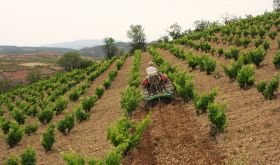
Who knows? Perhaps by the time the eighth World Atlas of Wine is published, I'll have persuaded my co-author to have nothing but horses in the vineyards.
Monty Waldin's photograph above shows Arnaud Dautas wrestling with a horse in the Château Monty vineyard in Roussillon.