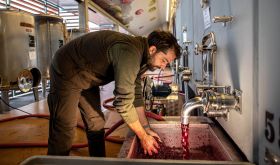
'You can't drink that, that's what the coloureds drink!' I so clearly remember being told this by a winemaker jokingly as we sat enjoying a beer at the end of the day mid harvest. Should I be surprised? We were sitting in a bar with the old South African flag proudly on show and a sign on the wall declaring 'There are two official languages here, English and Afrikaans'. Here we were, hardly an hour's drive from Cape Town, a whopping 28 years after Mandela was freed, and with apparently zero acceptance of the rainbow nation and its 11 official languages...
My three months of harvest were based in a tiny village. It consists of a settlement of simple and functional 'houses' and lean-to huts, a small shop selling fizzy drinks, snacks, cigarettes and phone credit, a few warehouse-like buildings, a bottle shop and a bar/hotel where only whites were allowed. The bottle shop was mostly frequented by the local population and the average beer was 8.6% alcohol. Wine was sold by the litre in plastic bottles made to a recipe of water, sugar, yeast, acid and caramel extract.
I don't know whether you have ever spotted on the back labels of Craig Hawkins' Testalonga that the wine is ‘made from grapes’. Most people think it's a joke but this liquid is what it stems from. Much 'wine' in the area I worked in was, and apparently still is, made in this manner for the local community.
Afrikaans certainly dominated, with two very distinct groups: whites and the coloured community. I feel comfortable using that word despite it being derived from apartheid, as that is how those I spoke to mainly liked to be called. There was just one Black guy in my little town, a man from Lesotho. In the cellar we had a super local who had worked with the winemaker for several years. He was brilliant. A hard worker, calm and efficient. He was devoted to his family and I learnt a lot from him. Shockingly, he was the only person in his family working full time, supporting his wife, two grown-up children still living at home, and one grandson. We were able to have some very interesting conversations, and many about race, the tribal make-up of South Africa and the problem of alcoholism.
This was February/March 2018 and although farm attacks have of course been an issue for many years, there were several high-profile ones in Stellenbosch and Paarl in one week, including Charles Back at Fairview, who was extremely lucky to survive. Speaking to my local informant, it became clear that racism in South Africa very much continues in a far more complex way than just Black v white. Each tribe or group had their own stereotype and position in the pecking order, the Khoisan being the most victimised at one end of the scale, and the Zulu being the most aggressive at the other end. The coloured community was one that suffered worse attacks, dealing with racism from both the Black community and the white. It seems mad to be writing these words in the twenty-first century as this was an issue in the early years of the Dutch settlers, and yet in rural areas it continues today!
Talking about white v POC overall (rather than differentiating between Black/coloured), he did have various horror stories, which he was impressively not bitter about. He said he had worked for enough decent white people to respect and like them. He said that often women were worse than men, and I certainly spotted numerous occasions when acid-tongued white 'tannies' were monstrously rude and patronising for no reason at all. He spoke of the old dop system (whereby labourers were paid in booze rather than money) and how he had lost many friends to it through problems with alcohol. I have since heard of very severe racism against Black Zimbabweans as well. It seems that after Mugabe died, it was very clear they were no longer welcome in South Africa and it was time for them to return home...
Alcoholism is a whole other story. I feel I have to touch on it, as I do think it is why it is so hard to break down such institutionalised racism. To see my little town on a Friday late afternoon, at the end of the working day and after wages had been distributed, was one of the most shocking sights you could ever imagine. The street was full of leering, inebriated workers and partners drinking Carling Black, the queue from the bottle shop spilling into the road, with little regard for anyone else or a car coming through. And in two hours, as soon as darkness hit, the street would be empty, the only remnants being broken glass, the odd bottle rolling in the gutter and empty crisp packets blowing in the wind. On bad days, there would be an abandoned drunk slumped on the side of the road. Even though I never saw it, apparently this charade would be repeated on Sunday after church.
I once quizzed a winemaker as to why money was still doled out every Friday evening when it so clearly had such destructive results and was such temptation to anyone who was trying to improve their livelihood and their future. The winemaker couldn't answer me really, any more than that it was the easiest way to manage the workers to make sure they kept coming and kept working. Forget any potential social mobility. Just keep these poor guys in their current, almost hand-to-mouth state, and you're got your team of workers...
I felt I had to pass all this on. But while these horror stories cannot be erased, one hopes that the future can only be brighter, whatever the extent of the nation's ingrained issues. That change is needed can no longer be ignored. More businesses must commit to meaningful transformation rather than treating it as a passing fad or to be seen solely as a proactive gesture. More opportunities must be created for social development for those without the means themselves. More funding for programmes that are doing fantastic things such as the Cape Winemakers Guild Protégé programme. More role models to lead the way both for companies and for people of colour themselves. Wine has the most wonderful ability to tell stories. What better time to use it for good than now?
Erica Moodie took the picture above of the Vergelegen Cape Dutch manor house and gardens for Wines of South Africa. It has no connection whatsoever with the internship described above.