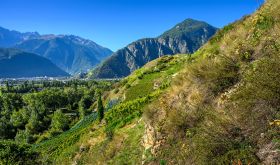
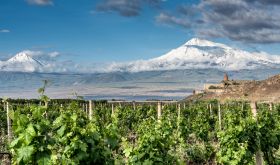
The volcano came to me. Or I stumbled blindly towards it. I can’t really remember. Around a decade and a half ago while writing an article about some then-new favourite wines and places to watch – Etna reds and whites, Assyrtiko from Santorini, the new wave of dry Furmint from Tokaj, Somló and Balaton in Hungary, among others – it suddenly occurred to me that all these captivating wines originated on volcanic soils. The concept of ‘volcanic wines’ as a category, or perhaps better described as a family, crystallised. Countless air miles, far too many geology lectures, a few scientific projects, not to mention an award-winning book and a multi-year conference later, and I remain as convinced as ever that there’s more than just romance to the volcanic-wine story.
The picture became even clearer this past February, during the second running of the Volcanic Wine Awards in New York City. Established by Volcanic Wines International (VWI, of which I am a co-founder) and run in collaboration this year with the crack team at JancisRobinson.com, this edition brought together some 260 wines from volcanic soils around the world. That is, more technically, ‘wines made from grapes grown in soils derived from parent volcanic materials’, which was the only abiding entry criterion.
To assess the wines, we assembled a group of experienced tasters from hospitality, education and media backgrounds and tasted through the wines, blind, organised within multiple regional categories. Most fascinating to observe was how the panellists naturally tuned in on a definition of ‘volcanic-ness’ amid the noise of so many grapes, regions and wine styles. More on that.
Why a competition based on a soil type?
Simply put, soils are a significant determinant of wine quality and style. Indeed, many growers in regions where wine has been made for centuries rank soils higher than variety in shaping and defining an expression of place (Burgundy, for many the epitome of vineyard articulation, and where Chardonnay or Pinot Noir are rarely mentioned, springs to mind). Grape varieties, after all, are shared around the globe. Winemaking techniques, too, are universal.
Soil chemistry, microbiology, structure, depth and underlying geology are all critical factors in determining a vineyard’s performance. Factor in the specific subterranean ecosystem created by mycorrhiza, the symbiotic association between soil-bound fungus and the vine’s rhizosphere (root system) that drives nutrient absorption and uptake, and the specificities of place become even more pronounced, should growers do their best to preserve and enhance these features. Winegrowers can of course modify and amend their soils, but only to a limited degree. And in any case we’re talking about quality wines, for which good farming is a sine qua non.
Diego Tomasi of the Centro di Ricerca Viticoltura ed Enologia di Conegliano adds additional weight to the soil component of terroir: ‘These days, you can’t say hot, cool, wet or dry vintage any longer. Weather has become totally unpredictable, with extremes even within one growing season. Climate is simply too variable. Soils are quickly becoming the most significant and consistent factor that defines terroir, and wine quality.’
Why volcanic soils?
The Volcanic Wine Awards was not established to demonstrate that volcanic wines are superior; plenty of different geologies, and the soils that form on top of them, yield memorable wines, and could be the framework for other competitions. But wines born on volcanic soils have a special allure; certainly no rock-forming earth processes are as arresting and dramatic as volcanism, making volcanic soils a useful starting point to shift the narrative.
And humankind has been attracted to volcanoes since the dawn of time, not for the thrill of putting one’s life in peril, but rather for the magical things that happen around them. Soothing hot springs and highly mineralised water sources invariably surge nearby. Volcanic soils nurture the world’s most prized coffee shrubs, and some of its most intensely flavoured vegetables, herbs, nuts and fruits, including grapes. And the wines made from these grapes happen to be particularly good, a fact known for millennia, as the 6000 BCE proto-winery Areni 1 in Vayots Dzor in the volcanic Armenian Highlands, or the wine-containing amphorae buried on Santorini in the epic eruption of 1620 BCE, or the vineyards lost in Pompeii in 79 CE, all hint at.
Practically speaking, volcanic soils (some, but not all) have many useful properties that make them especially suited for high-quality wine. For one, young volcanic ‘soils’ formed on recent lavas are often more rock than soil – they haven’t had time to weather into water-retentive clays – and thus hold little moisture. It’s well established that limited water favours higher grape quality. Volcanic ash and sand likewise drain readily, and by the nature of where they form, volcanic soils are often on hillsides where water runs off.
Secondly, despite their reputation, the best volcanic soils for winegrowing are relatively infertile. Although lavas contain generous amounts of nutrients (and a wider range of minerals than most rocks), they’re not readily available. That’s because these elements must first be weathered into available form and then be dissolved in water to be taken up by roots. But water, as we’ve just learned, is scarce, and minimally weathered soils/rocks release precious few nutrients.
Thus, vines get a broad diet, but in small quantities (low fertility but without particular deficiencies), which triggers them to focus on ripening fruit rather than growing shoots and leaves. Semi-parched, semi-starved vines produce less fruit, smaller bunches, thicker grape skins (where most aromas and flavours are stored), and result in concentrated, structured, complex and often ageworthy wines.
What might seem like a very niche category covers in fact a huge range of wines. In fact, one of the most interesting, if unanticipated, aspects of volcanic terroir that I discovered was just how many indigenous varieties were inadvertently preserved, for various reasons, bequeathing a wealth of biodiversity of great value to the wine world. Where it not for things like the absence of phylloxera (it can’t spread in very ashy, sandy and rocky soils common in volcanic terroirs), and the extreme difficulty of cultivating many of these steep or incredibly stony terroirs, I’m sure many of these unique varieties would have been lost to commercial pressure during the age of industrialisation that occurred post-phylloxera and World War II until the beginning of this century.
The volcanic category also encompasses a huge range of climates and winemaking cultures, not to mention the variations in volcanic soils themselves. There are hundreds of types of soils that can be called volcanic. Even pure lavas come in Technicolor variations. So, expect a broad range of textures, flavours and personalities.
Yet there are recurring features that appear in the best examples that link volcanic wines into a big, compelling family: a mouth-watering quality related to salinity and acids; more savoury than fruity flavours; a density that can only come from genuine extract. Volcanic wines can be gritty, salty, powerful, maybe even unpleasant to some, but distinctive. ‘When you consider the common, intense and distinctive smoky-salty character of wines from volcanic regions such as Hungary’s Tokaj, Madeira, and some of the best Riesling vineyards in Germany, volcanic subsoils clearly have a strong influence on the vines and wines’, the late David Elswood, the former head of international wine sales at Christie’s, once pointed out.
How the wines were judged
For the awards, panels of four or five tasters were assembled including Tara, Sam or myself as panel chairs. Wines were tasted over three consecutive days at the offices of Colangelo & Partners in New York City in regional groupings where the number of submissions merited a separate category (eg Etna), or country groupings (eg Armenia), with no more than 40 wines in any session.
Panellists tasted each submission in short flights of like wines within each grouping with only appellation, vintage and grape variety(ies) revealed, and scored on the 100-point scale. Panel chairs then averaged the scores for each wine and led discussions on wines with significant score discrepancy until consensus was achieved. Wines with an average below 86 points received no award; 86–86.9 received an honourable mention, 87–88.9 bronze, 89–90.9 silver, and 91+ gold.
The wines that our tasting panels awarded medals to are those that confidently exposed the essence of their particular volcanic soils, not sanitised or homogenised by terroir-antagonistic interventions, with the right combination of climate, grape and technique – in a word ‘terroir’. It’s a collection of some of the world’s most singular wines.
Over the next few weeks, we will be releasing the results of these awards in several tranches, with a brief introduction to each represented region. Announcements will culminate in the Chairman’s awards – the gold-medal-winning wines retasted by the panel chairs and deemed to have an additional dimension deserving of special recognition. Come back weekly for the latest instalments.
John Szabo MS was the first Canadian Master Sommelier. He has been reporting on wine for a quarter of a century and is now a principal critic for WineAlign.com. He’s co-founder of the Volcanic Wines International conference, coming to Manhattan on 10 June 2026, and author of Volcanic Wines: Salt, grit, and power, recently re-released as an e-book.