28 May 2021 On Ian Fleming’s birthday, Jonathan Reeve turns literary sleuth and breaks news of their Bond connection to wine producers in Germany, France, Turkey and Italy. Original Bond book jacket designs @Estate of Richard Chopping.
While writing about James Bond and champagne, I revisited certain wine-focused sections of Ian Fleming’s original 007 books. This revealed new depths to Fleming’s penmanship, particularly how he used wines and spirits to develop characters and plot. He used some drinks to set a tone of luxury, some to set the scene geographically, and some to reflect Bond’s emotional state. Below are four examples of this, all from Goldfinger or From Russia with Love. Each example highlights an unsung James Bond wine from the 1950s, and a little about that wine today – what it’s like and where you can find it. These wines may be less overtly glitzy than Bond’s favourite champagnes, but they’re all worth seeking out, and are accessible even to those of us not armed with an MI6 credit card.
I was really pleased to find that the wines are still available today, almost 70 years after Fleming wrote the books, but even more pleased with the reaction from the winery owners. They were entirely unaware – but obviously proud to learn – that their wines were James Bond wines.
Goldfinger’s Goldtröpfchen
At Goldfinger’s country estate, in-between 18 holes of golf and a bottle of Ch Mouton Rothschild 1947, Fleming inserts an intriguing little passage into his story:
‘Please try the Hock. I hope it will be to your taste. It is a Piesporter Goldtröpfchen '53.’
It was nectar and ice cold. Bond congratulated his host. Goldfinger gave a curt nod.
For those not familiar with it, Goldtröpfchen is a beautiful, much-respected vineyard on the Mosel which Michael Schmidt calls the holy grail of Riesling. Its intriguing name – fundamental to this story – means ‘golden droplets’. Shirley Bassey’s lyrics ‘Golden words he will pour in your ear’ spring to mind, even if they are slightly inaccurate; there’s nothing at all golden about Goldfinger’s words or actions (although he has pretty good taste in wine). Fleming’s storytelling skill kicks in shortly after the exchange above. After allowing the Goldtröpfchen to shine briefly, Fleming described Goldfinger watching Bond drink the wine alone while drinking nothing himself. Like most Bond villains, Goldfinger was proudly teetotal. Chills and suspicion descend under a darkening shadow of doubt. Poison? And … teetotal?!
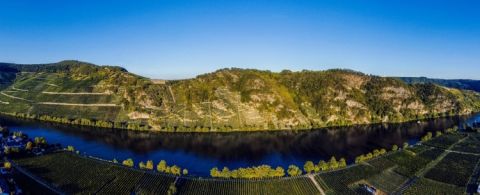
The wine wasn’t poisoned, as it turns out, but it was nonetheless mysterious. It’s so unlike any other James Bond wine, and so unexpected. Writing in 1959, when attitudes to machismo were more constraining than today, Fleming clearly had a specific reason to have his hard-hitting, macho spy enjoy a sweetish, low-alcohol white wine. He was indulging in a little golden wordplay, while casting the shadow of menace in the reader’s mind and reinforcing Goldfinger’s character as Germanic, ego-maniacal and completely gold-obsessed.
The Goldtröpfchen vineyard produces many fine Rieslings, but my recent favourites are those made by Nik Weis at St Urbans-Hof. His luscious Goldtröpfchen Auslese embodies the vineyard’s name perfectly, giving honeyed mouthfuls of ripe mandarin, candied grapefruit and peachy botrytis, all lifted by mouth-cleansing acidity. Weis says he would have served Bond a dry Goldtröpfchen Grosses Gewächs – something highly focused, with refined power, just like Bond. For me, Weis’s most Bond-like wine is his Goldtröpfchen Kabinett – deceptively complex and dangerously drinkable. Find these wines
Nik Weis was very happy to learn that Goldtröpfchen was a Bond wine, but it also stirred negative emotions for him, remembering the sad decline of Mosel wines’ reputation in the second half of the twentieth century. ‘It makes me both happy and sad. I’m really proud that the wines of my home region were mentioned as something special. Mosel wines were once among the world’s most prestigious and expensive. The region has regained significant reputation now, but it still hasn’t quite got the international recognition it had in the 1950s, when Fleming wrote the James Bond novels. It would be great to see a Mosel wine served in a Bond movie today. Maybe it’s about time for that again.’
Pints of pink Pommery
Briefly, before his Goldtröpfchen experience, Bond had been in Miami, dining poolside with millionaire Mr Du Pont.
Mr Du Pont slapped his menu shut. He said to Bond, ‘Now, why don’t you just leave this to me? If there’s anything you don’t like, send it back.’ And to the head waiter, ‘Stone crabs. Not frozen. Fresh. Melted butter. Thick toast. Right? Two pints of pink champagne. The Pommery '50. Silver tankards. Right?’
The champagne seemed to have the faintest scent of strawberries. It was ice cold. After each helping of crab, the champagne cleaned the palate for the next.
Fleming uses the pink Pommery here to paint a scene of Miami sunshine and wealthy Western decadence. The wine adds depth to Du Pont’s character, too – his functional glamour reflected in the silver tankards, his Florida flair in the pink champagne. (Note that ‘pints’ here means the old-fashioned bottles of 568 ml – Winston Churchill’s preferred champagne bottle size.)
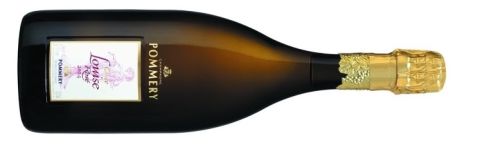
Curiosity piqued, I tried a modern-day Pommery rosé myself, with crab linguine (sans silver tankard). The strawberry notes are indeed present, despite the wine’s dry restraint. Pommery’s chief winemaker Clément Pierlot concurs: ‘Fleming was absolutely right emphasising the Pommery Rosé’s subtle strawberry notes, and it would indeed have worked perfectly with crab. You find the same finesse and subtle notes of wild strawberries in the Cuvée Louise 2004.’ Find this wine
A few years before Goldfinger, in From Russia with Love, Fleming used champagne to paint a much darker scene, of Russian agent Tatiana Romanova being coerced into drinking champagne by Colonel Rosa Klebb, SMERSH Head of Executions. For Klebb, the champagne was a cold-blooded, functional tool to trick Tatiana into accepting a fatal mission (‘this beautiful, guileless, innocent girl … must be loosened up’). For terrified Tatiana, the champagne was an object of suspicion, to be gulped nervously – a far cry from Bond’s pink Pommery. This particular book was a favourite of President John F Kennedy – a famous Bond fan. Surely even Kennedy shuddered at Klebb’s spine-tingling toast '… to the health of your new department, Comrade. To SMERSH!'.
Ouzo, raki and Kavaklidere
The action in From Russia with Love takes place largely in Turkey, a location introduced and enlivened by Fleming’s vivid references to wines and spirits. After a bumpy landing in Istanbul, Bond immediately seeks out a restorative dose of ouzo.
Bond climbed out of the plane with the handful of pale, silent passengers … He ordered a tumbler of ouzo, drank it down and chased it with a mouthful of ice water. There was a strong bite under the sickly anisette taste and Bond felt the drink light a quick, small fire down his throat and in his stomach.
Partially recovered, Bond is welcomed to Istanbul by his contact, Kerim Bey, with ouzo’s stronger cousin raki – ‘a glass of milky liquid in which ice twinkled’. Several doses of raki return Bond to his comfort zone, allowing the scene-setting to progress with something a little richer, and less fiery.
The second course came, and with it a bottle of Kavaklidere, a rich coarse burgundy like any other Balkan wine. The Kebab was good and tasted of smoked bacon fat and onions.
Kavaklidere is Turkey’s oldest winery. In Fleming’s day it was about the only significant Turkish wine brand available (note the small ‘b’ in ‘burgundy’, indicating a general wine style, not geographical origin). Today’s Kavaklidere is quite different; an international business importing, exporting and producing wines and spirits. Modern Kavaklidere wines are finer than Fleming’s description suggests, having evolved over the decades towards a more elegant, international style. The winery’s Prestige Boğazkere and Öküzgözü are decent examples of these two traditional Turkish grape varieties, made in an approachable modern style. My suggestion would be the ‘1929’ Cabernet Franc, named after the winery’s first vintage. Find these wines
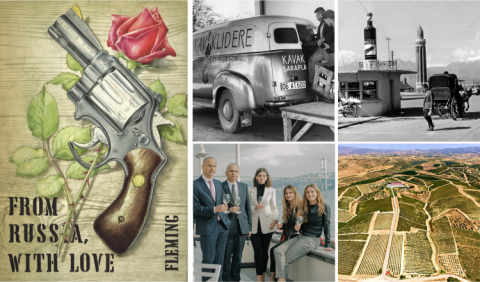
Uncharacteristically, Fleming missed something that would have raised Bond’s eyebrows: Kavaklidere is, and has always been, a wine made predominantly by women. I talked with one of them – Asli Başman, a fourth-generation member of the Başman family who own Kavaklidere.
Asli confirmed that ‘Women have always had an important place at Kavaklidere … in every step from the vineyard to the management. Today, most of our managerial positions are held by women.’ Kavaklidere’s production director and head winemaker are both women, and three female members of the Başman family hold senior positions there: Cevza (marketing director), Zeynep (human resources and communications) and Asli herself, who manages the family’s two châteaux in Castillon Côtes de Bordeaux.
Asli told me ‘We didn’t know that Kavaklidere was mentioned in From Russia with Love. We are not surprised though – in the 1960s Kavaklidere was the best-known Turkish wine (and is still the market leader today). Being mentioned in a James Bond story is a proud moment for us.’
Bro(g)lio
The film of From Russia with Love has a clever scene in which a SMERSH agent masquerading as a British spy blows his cover by ordering Chianti with grilled sole. Red wine with fish? Very suspicious. Sadly, this fishy faux pas was created just for the film and does not feature in the book. In Fleming’s original version, however, Bond and Tatiana do share ‘European hors d’oeuvres’ with ‘a bottle of Chianti Broglio’. Note that Fleming’s spelling with a ‘g’ is an archaic form of ‘Brolio’. Happily for those of us interested to sample classic Bond lifestyle, Brolio wines are still produced today and the range includes some modern gems.
As always, Fleming referenced a specific drink for a specific effect. The bottle of Brolio Chianti marks a waypoint on Bond and Tatiana’s escape route from Turkey, away from raki and rustic reds, and towards the relative safety and comfort of Italy, with its finer food and wine. In Fleming’s day, Chianti was well respected, and had not yet experienced the decline in quality and reputation it suffered in the second half of the 20th century. When Fleming picked Brolio as Bond’s Chianti, it was the Chianti brand, as solid and prestigious as the Castello Brolio fortress after which it is named. Brolio was even served at Buckingham Palace for the coronation of King George VI. This OCW entry confirms the lasting importance of the noble Ricasoli family, which owns Castello Brolio and produces the wines.
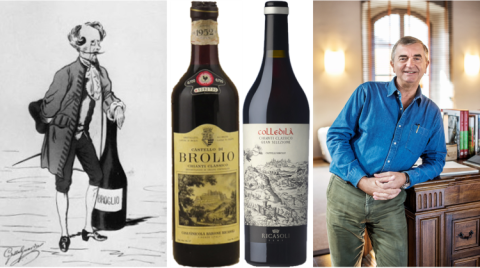
The affable Francesco Ricasoli (above right) is the 32nd baron to rule Castello Brolio. He clearly cares a great deal about his family’s heritage and his wines. Was he aware that Brolio was a Bond wine? ‘No! Like you, I am a Bond fan. I have watched all the films, but I have never read the books.’ As with everyone above, he was unaware – but extremely happy to hear – that his beloved Brolio is a James Bond wine. From the various wines in today’s Ricasoli wine range, Baron Francesco knows exactly what he would serve if Bond were to visit. ‘Castello di Brolio, no question. James Bond is the representation of something extremely classic. Castello Brolio is a great classic. Something that is reliable in its style, and consistent in its quality.’
I understand the baron’s logic, but would instead pick the winery’s single-vineyard, pure-Sangiovese Colledilà. This wine feels more ‘Bond’ to me – a classic wine in modern clothing. It also ages well. I recently tried Colledilà from 2017 and 2008. Both were impressive. The 2017 promises a long life, and the 2008 has several more years before its peak. Perhaps Baron Francesco and I could agree that Castello di Brolio is Sean Connery, and Colledilà is Daniel Craig? Find these wines
Bond wines of the future
Back to the present, and the future. My previous article suggested that 007 might give up alcohol completely. Assuming that doesn’t happen, which wines might future Bonds drink? Angélus’ two full-frontal appearances in Casino Royale and SPECTRE confirm that the films have a place for strong, identifiable branding, so prime candidates include Sassicaia and Tignanello – classy and fashionably Italian (Italy featured in four of the last five Bond films) – or perhaps Castillo Ygay, Penfolds Grange, Harlan or Dominus? Castello Brolio might even work well, as a trendy nod to 007 nostalgia and history.
To keep Bond truly modern and profitable, he’d do well to be seen with – but not actually drinking! – China’s definitively luxurious Ao Yun from LVMH or Long Dai from the Lafite Rothschilds. Long Dai could actually pass as a Bond movie title. Whichever wine gets the spotlight, wouldn’t it be great to see the scriptwriters working it into the actual story, as Fleming did?