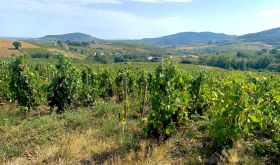
The white burgundy village of Meursault is home to an increasing number of brilliant vignerons, but the two most famous names are Coche-Dury and Comtes Lafon.
Dominique Lafon is in many ways Burgundy’s best-known ambassador, certainly of his generation. As well as running one of the village’s most blessed, and more aristocratic, domaines, he travels the world and has made wine in the US, makes wine for his personal négociant label, and led the way to extending a Côte d’Or operation into the more affordable vineyards of the Mâconnais. He is too much a man of the soil (as witness his fingernails) to be called urbane but he is certainly cosmopolitan and very well aware of his place in the wine firmament. I find it endearing that on most of my annual tasting visits to Lafon, Dominique is always so concerned – a bit like a three-star chef – about the responsibility of living up to the reputation of what he produces.
The Comtes Lafon domaine, based in particularly extensive cellars attached to one of the village’s grandest houses, was built up astutely a century and more ago. It boasts well over three hectares of premier cru vineyard as well a precious slice of white burgundy’s crème de le crème grand cru Le Montrachet. Lafon Montrachet sells for many hundreds of pounds a bottle.
Domaine Coche-Dury is a rather different kettle of fish. Based in decidedly workmanlike cellars below the most ordinary of suburban houses, it is run today by young Raphaël, who took over the helm from his father Jean-François five years ago. The disconnect between the lifestyle of the Coches and the reputation of their cultish wines is marked, to say the least.
Raphaël, now a father himself, has inherited from Jean-François one of the shortest focuses I have come across in Burgundy. As far as I can see the Coches are completely fixated on their vines, shared between less than one hectare of premier cru vineyard, a little over four hectares of village Meursault and, a more recent acquisition, a third of a hectare of the grand cru Corton-Charlemagne, generally much less exalted than Le Montrachet except in the hands of a winemaker as admired as a Coche. (Both the Coches and Lafon make some excellent red burgundy too; note the Volnays.)
If you want to visit Coche-Dury you are almost certainly out of luck. They closed their visitor’s book years ago. Even those of us who have long been regular tasters there are received only at six in the evening when it is too dark to work in the vines. And nowadays, after some unfortunate experience, we wine writers are no longer allowed to taste wines from barrel. For Jean-François Coche the 20-mile trip north to the Château du Clos de Vougeot for one of the fancy Chevaliers du Tastevin dinners where I shared a table with him once was a major outing. Not for the Coches winemaker dinners around the globe. They prefer to stay within spitting distance of their barrels – only a modest proportion of which are new.
And the extent to which toddlers Mathieu and Guillaume Coche are involved in cellar visits suggests that this philosophy will be passed on to the next generation too.
Whereas Lafon has embraced biodynamic viticulture, experimented with various winemaking techniques and continues to expand, such as with the addition of a major share of the old Domaine René Manuel, acquired, with his friend Jean-Marc Roulot, from négociant Labouré Roi, the Coche-Dury domaine has stuck faithfully to the recipe instituted by Jean-François. And why should it change when Coche-Dury’s white burgundies are the most sought-after in the world?
It could be said that Coche, unwittingly I would surmise, instigated the worldwide trend towards the reductive ‘struck match’ flavours in white wines. Coche wines – even their village wines, let alone their premiers crus – are famously long-lived The Lafon style has always been more generous, more open, more obviously fruity (with some of Dominique’s earlier vintages ageing dangerously fast).
Coche wines are sufficiently rare, and Lafon’s not that much easier to source, that a comparative tasting organised in August by our wine collector neighbour in the Languedoc Graham Nutter was a very special occasion indeed. One participant had a particularly important role to play. Dominique Montier had just flown in to Carcassonne from Stansted with Ryanair, who would not let him on the flight unless he paid £45 – even though he had printed out his boarding pass. We were all mightily glad that he gave in and paid up since he provided the bottle of Coche Corton-Charlemagne 1999, worth more than 30 times the Ryanair surcharge. (His father had first bought from Coche: Bourgogne Aligoté from Jean-François’ father.)
We tasted vintage pairs, not blind, first of all 2008 village Meursaults, of which the Lafon was already extremely friendly and open, the Coche rather austere and standoffish. Lafon was also the more charming of the two 2005 village Meursaults – in fact it tasted as though it was at its peak whereas our particular bottle of the Coche was unusually flat. The 2002 pair were not exactly a fair fight. The Lafon representative was a Charmes Premier Cru, from a superior vineyard whose wines really are always extremely charming – this one was stunning – whereas the Coche village Meursault 2002 was a little more reticent, though it will probably continue to unfurl for at least the rest of this decade.
But from then on, it was Coche that was in the ascendant. The regular village Coche 1999 was one of the most glorious wines of the evening. We’d been due to compare it with Lafon’s Clos de la Barre 1999 but it was spoilt by the burgundian scourge of premature oxidation so we tasted a Lafon village Meursault 1998 instead that was a little stolid by comparison. And of the two 1996 village Meursaults, the Coche was much livelier, the Lafon flat and rather lacking fruit, suggesting a hint of oxidation.
And finally a grand cru from each domaine, each of them totally glorious, but the Coche Corton-Charlemagne even more ethereal than the Lafon Montrachet, although admittedly from a much better vintage, 1999 rather than 2004.
The wines we tasted may have conformed to each domaine’s reputation but there are (small) signs of change. Dominique Lafon permitted himself a little step towards ‘le matchstick’ style with his négociant bottling of 2013 Meursault, while Raphaël Coche is arguably making very slightly fruitier, more accessible wines than his father.
Tasting notes in Coche v Lafon tasting.
SOME GREAT COCHE AND LAFON WINES
I have given all of these wines at least 18 points out of 20
Dom Coche-Dury
Corton Charlemagne, Grand Cru 1986, 1988, 1989, 1992, 1993, 1996, 1999, 2000, 2001, 2002, 2003, 2004, 2005, 2006, 2007, 2008, 2009, 2010, 2011, 2012
Meursault Perrières, Premier Cru 1997, 2001, 2004, 2006, 2007, 2009, 2012
Meursault Genevrières, Premier Cru 2005, 2009, 2010, 2011
Meursault Caillerets, Premier Cru 2006, 2008, 2009
Meursault Rougeots 2000, 2001, 2002, 2004, 2009
Meursault 1999, 2002, 2005
Puligny-Montrachet, Enseignères 2002, 2006
Volnay, Premier Cru 2010
Dom des Comtes Lafon
Le Montrachet, Grand Cru 1996, 2004, 2005, 2007, 2008, 2009, 2010, 2011, 2012, 2013
Meursault, Perrières, Premier Cru 2004, 2005, 2007, 2010, 2012, 2013
Meursault, Genevrières, Premier Cru 2005
Meursault, Charmes, Premier Cru 2002
Meursault, Clos de Barre 1999, 2001
Meursault 1989
Volnay, Santenots du Milieu, Premier Cru 1999
Volnay, Santenots, Premier Cru 2005, 2013
I recommend Les Héritiers du Comte Lafon’s Mâcon-Uchizy, Les Maranches 2013 (£23.95 Berry Bros & Rudd) as a bargain way to experience Dominique Lafon’s magic touch.