Andrea Franchetti sent me this account of the beginnings of this idiosyncratic southern Tuscan estate and I thought it a great read and perhaps of interest to those who wonder what goes through the head of a wine producer in a completely new region.
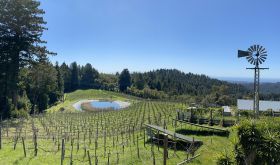
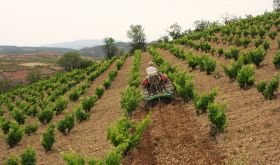
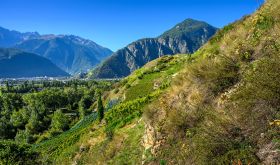
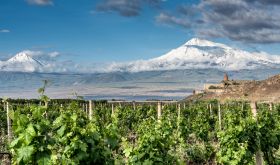
When I first crossed into the Val d'Orcia, coming from the soft shapes of Valdichiana I was struck by its dry air and blinding light. A sash of it lay caught along the mountain's side facing south at an altitude of about 600 metres; through broom, wild roses and plum I saw the dry walls that used to fashion the precious land some fifty years ago into large clearings which still lay there, like hidden carpets of aromatic weed suggesting a restoration. I bought a tractor and started up the little scraper. Far below was hurled the blue clay of an ancient ocean floor, so up there, where it met the eroded rock of the mountain, the vines were later cemented in a very hard conglomerate. I started the planting where the soil was loosest and with the thickest order possible on that steep exposure: one metre by one metre. The work was carried out by a swearing French team accustomed to the light soils of Médoc, but then they came back, year after year, planting some three hectares at a time from 1992 to 1999.
I had chosen the Bordeaux varieties: Cabernet Franc, Cabernet Sauvignon, Merlot, Petit Verdot, with a strong preponderance of Cabernet Franc. This material came from clonal selections developed by the Blanquefort Institute (the ones with the smallest grapes) as well as from field selections I had cut from some old parcels that traditionally had produced the best wines in certain châteaux in the Graves and in Saint Emilion.
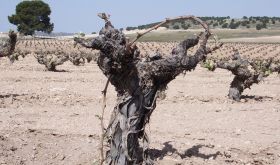
These plants are accustomed to living in weakness and can produce a grand vin if they are forced to continue to do so and 60 per cent of their crop can then be thinned in late summer when they start losing their seasonal vigour. Small berries means more skin with respect to pulp, the secret of good red wines; the plants' transformations are concentrated on a smaller mass; one can pick later because of airing between the berries making a wet autumn's mould harder to set in. The closely planted roots offer a small and tired nourishment that thickens the grapes' skins and hurries ripening; the plant is stressed and has to stop producing vegetal material and concentrate its efforts on maturing its fruit: the grape is already mature as it enters the long months of cold autumnal nights. Phenomena produced by dense planting increase as the vineyard ages, ultimately producing berries that cause the wine to be very concentrated in tannin, minerals, polyphenols, and sugars.
High alcohol is the mark of great wines in southern Europe: because of the sun, low-yield viticulture produces high sugars at our latitudes and banking on cool weather by planting high in the mountains is no use. Why is concentration in wine so important? Because it is more recognizable; a wine that exaggerates in its perfume, its colour and taste and imprints itself in the memory, over the years can be recognized. Slowly, slowly it becomes a classic, and with such concentration the wine can acquire what is known as terroir. Terroir is a particular taste that causes one to say 'Ah! This is that typical taste of wines that comes from "there"!' It's like all those other wines from 'there', and 'there' is a particular geographic zone, a certain territory that is near a sea which reflected in a certain sky throws a certain light on a certain gravel that makes the vineyards shine in a certain climate. A vein of tar sneaks in the taste of all the wines of the area, and vintners seek to feature it and take great care not to lose it.
With tight planting, keeping yelds low, I am coming to see that here in Trinoro where vineyards have practically never existed before, every year that passes will increase the wine's identity, its capacity to resemble itself.
In the beginning and for a generation I must myself make the wine, decide when to pick each small part (because harvest timing has more effect on the style of the wine than any other act of winemaking). Afterwards I myself again have to choose how best to assemble the wines that emerge from the numerous fermentations. Slowly a style, a model will appear during the discarding and choosing and mixing.
In ancient selected places like a château in Bordeaux, where one's own viticulture and winemaking has gone on for centuries, there is a time-honoured job routine: the director of the vineyard and his deputy, the cellarmaster and his deputy preserve continuity through a cycle of promotions whereby it is understood that a wine is made by le patron [the master] ie, by the château. It is the patron who makes the wine, the patron never the oenologist or the consultant.
In a new place, in Italy, the new patron's inspiration will be the way light changes about him throughout the year. Well-planted vineyards will ride out wars because plants, kept short, last 100 years and more. However the wine over time keeps very much changing: the terrain can be packed with manure, filled with nitrogen and potassium for a few decades, for larger and greener crops, for wines that are meant to be consumed after the softening of long aging; then the fashion changes, as is happening now, and a vineyard is starved to hunger, production reduced to one quarter. The vineyard, really, undergoes an alternation of treatments because of the constant changing of the image of wine, and this image is just as capricious as the changes of architecture, fashion or automobile design. Wine 'reflecting as close as possible the pure expression of its soil', with biological or biodynamic cultivations, etc, is again a new fashion, another change of image. The terrain of a vineyard is the result of the long series of changes, so the terroir in a wine comes both from the climate and the vineyards as much as from the cumulative treatments inflicted on their soil.
Today the mental image that keeps emerging is 'restoration of nature'. The image is a bit stressed: 'we were Titans; we exaggerated in our interventions and now we must be more humble and "follow Nature"'. This is the picture that the market presents to the new wine producer who, accordingly, fertilizes less; after years of manure he now adds borax to the soil, and magnesium, and even silicon if he follows biodynamics. He will also make smoother, rounder wines to reflect the perception of a 'nature' that is relieving and forthcoming (which it is not) in the wine.
So, understanding terroir involves the times. It also involves time itself, an intimate, not historical time, in the special sense in which it is important to the vintner: it is the year with its days of green and red, its white mornings and its nights, where the owner follows his uncertain thoughts, and ponders his vineyard too. Surely the vintner who dwells on his property finds his habitation central to the production of good wine. Slowly as the splendid earth and its plants react chemically with the air and water, imperceptibly the style of its wine begins to form and grows in the chemistry of that owner who 'stays', cultivating his preferences, preferences that develop and change because of their exposure to the light of his property.
It is best to make wine with a minimum of three types of grape, each of which matures at a different time; at least one, every year, will manage to fit its particular cycle into the weather changes of that vintage. In Bordeaux they have selected and discarded until they were able to gather a number of grape varieties that are exceptional both by themselves and in their capacity to be assembled with others. In this respect I have copied Bordeaux and like there, in January to February after the harvest I can put together even more diverse lots of wines and further improve my wine. Even though many successful years in the market have allowed a certain sleepiness to creep into Bordeaux, with a habit of quantity in the vineyard, ultimately their wine is unbeatable.
Light in a vast photosynthesis affects the leaves of the vineyard and the spirit of its owner together; the shining earth and the changing climate are elements that one can assign to botany, pedology and to meteorology, but in fact they also participate to a realm in which we too are part (and where we can actually sometimes be lost): nature itself.
The transformation bestowed on some berries by the process of fermentation is an extraordinary happening. It seems as if a shade of nature itself, hidden, were taken by surprise and revealed, mirrored in a red and thick print.
The fundamental brickwork of terroir is this delicate sensitivity of wine to the presence of nature; when we so passionately poke our noses in wines from unfamiliar places, we seek the shapes of those exotic towns together with something of ourselves.
To express all this the wine must ferment in a pond-like state. This comes about in small and wide containers up to 40 hl, half filled, small quantities that reflect the small lots in which the vineyard was harvested.
Fermentation continues after running the wine, on account of the high sugars in the grapes; the wine can be run after nine or ten days, still warm, without trying to extract any more from the skins, because grapes cultivated that way quickly give away the substances that concentrate the wine.
In contrast to the stage of actual fermentation, during which it is necessary to push, drown and otherwise constantly move that which is already moving, in the following two years the wine is tended almost without doing anything. In the beginning it is left on its lees in a warmish temperature, to develop in a crescendo of enrichment, until the summer after the harvest; then, after removing it from wood, it must stay in the cold all the way to the second summer. You taste it often as it grows, and you become less worried as time goes on because it begins to stabilize.
The next year's harvest falls in between these two periods and taking last year's wine out of wood also distracts us from all the new vintage's decisions. If the wine is thus concentrated, even after a difficult harvest with 'rotten' grapes, the wine that comes out bottled from the cellar will continue to close in and sharpen into an increasingly raw and cutting youth for a few years, before it starts its long turning into the age when people start wondering if it is ready to be drunk.