A version of this article appears in the Feb 04 edition of British Airways' inflight magazine High Life.
It would have been quicker to have flown from Tashkent, Kabul or even Delhi to inspect this new wine operation but it is Chinese, so instead I took a five hour flight over the Gobi Desert from Shanghai on the eastern coast of China to Urumqi in the far northwest. Urumqi, on the old Silk Road, is the capital of Xinjiang province, substantially Muslim, with Kazakstan and the other ex-Soviet Central Asian republics to the west, Tibet to the south and Mongolia to the north.
Even in late September the nearby Tian Shan (Heavenly) Mountains were snow-covered, and on my plane were several westerners in climbing gear (as well as a saffron-robed Buddhist monk in the front row of business class). One could see from the air that the meltwater from this snow had long been channelled to irrigate the bright green oblongs that punctuated the arid desert landscape below.
The first shock on landing was how modern the airport was. The outside world may never have heard of Urumqi but it has an airport with enviable efficiency and cutting edge design and at least five thoroughly modern skyscraper hotels of which
mine was unquestionably superior to any large British city centre hotel I have yet encountered.
But this is true of any sizeable city in China. What makes Xinjiang province so unusual is that it is in mosque and kebab country – not the obvious site for China's most ambitious new wine development. But this much-disputed part of the world on the politically sensitive pivot of the Soviet Union, China and India has long been famous for the quality of its grapes. Urumqi's departure lounge was littered with stout cardboard boxes full of bright green sultanas, the local speciality served with walnuts, spiced meats and pilaff.
Less than two hours south of Urumqi in the Turpan depression a smallish wine outfit called Lou Lan after a local ruined city had already alerted me to the wine potential in this western part of China, so distant from the eastern coastal regions
where most of the country's vineyards have so far been planted. Lou Lan Cabernet 1999 had been by far the most impressive wine I had tasted on my first brief visit to China in January 2002.
I was here to take a look at the biggest vineyard in the area – indeed its owners, who go by the wonderfully cheerful name of Suntime, claim it is the biggest in Asia. In 1998 Suntime, a trading company based in Xinjiang, did not have a vine to its name. But it saw that wine, especially red wine, was the coming thing in China – a fashionable drink with social status and reputed health benefits that could profitably be sold to this vast country's emerging middle class. (One revealing
statistic is that China already has no fewer than 60 million internet users.)
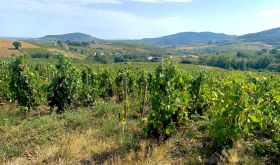
Today Suntime has an area more than half as extensive as the entire Beaujolais region planted with young vines, most of them Cabernet Sauvignon and Merlot, and a vast modern winery at Manas an hour's drive along the Silk Road from Urumqi
towards Kazakhstan. It was notable here that all the road signs were not, as in most of China, in Mandarin and English but in Mandarin and the swirling script of the local Uighir language. The wide highway was made much less wide at this
time of year, I may say, by the swathes of yellow corncobs and red peppers drying not by the roadside but on the roadside, taking up a good lane-width of traffic. In Manas massive blue trucks queued patiently outside the town's canning plant,
filled to overflowing with tiny, bright red tomatoes glowing with health. With no shortage of irrigation water, hot summer days, cool summer nights, and a climate too dry for the fungal diseases that can plague vines, things looked promising for
wine quality.
Wine was produced here more than 2000 years ago, introduced from Central Asia. The People's Republic of China re-introduced vines in Xinjiang in 1950, for raisins and table grapes. In 1997 there were just 30 hectares/75 acres of vines planted for wine grapes in northern Xinjiang. By 2000, thanks to Suntime, that figure had grown to 10,000 hectares/25,000 acres. (When the Chinese decide to do something, their efficiency and single-mindedness is only just this side of
terrifying.)
In fact although northern Xinjiang has some important climatological advantages for vine-growing, like most Chinese wine regions it has one major disadvantage: winters are so cold that the vines would die if they were not buried in 20 or 30 cm of earth. This means that every autumn the vine canes have to be bent horizontal and covered by long mounds of the soft, sandy, loamy soils typical of most Chinese vineyards which in summer are carefully re-shaped so as to provide irrigation channels. The gravels of the Medoc or the giant stones of Chateauneuf-du-Pape would make this almost impossible; apparently, with this in mind, vineyards have to
be cleared of stones before being planted. It is difficult to think of anywhere else in the world which could field enough skilled labour to undertake this painstaking annual operation and still manage to sell wines at around two US dollars a bottle – or in Suntime's case reputedly, less than a pound for a six-litre softpack in one particularly desperate attempt by this new company to grab market share.
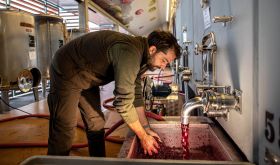
I took a look at these vineyards after a brisk walk round the Manas winery, a forest of gleaming stainless steel tanks with the regulation cellarful of expensive imported French oak barrels. It was harvest time and I was impressed to see the
grapes being picked into the small plastic crates used by all of the world's top wine estates, designed to minimise the danger of grapes being crushed and oxidising before they reach the winery. However do these Chinese do it?
The next day I flew to Beijing and had the chance to compare conditions with more established vineyards in the east, many of them within easy reach of the country's greatest concentration of wine drinkers clustered around the capital and its magnificent Great Wall tourist magnet. Here were the same mounds of earth to protect the vines against winter cold but many of the vines also need to be covered with nets to protect them from greedy birds in summer. It's not easy,
ripening grapes in China.
This is especially true in view of the typically Chinese tendency to be over-efficient. Thanks to a massive official change of direction in the late 1990s when wine production was positively encouraged by the government in a move to keep
cereals for the bowl and plate rather than being distilled into something for the glass, China's thirst for wine has grown more dramatically than in any other country I can think of – by 35 per cent between 1997 and 2001 to the equivalent of more than 400 million bottles annually. This is still under half a bottle per Chinese adult head per year, but enough, for example, to provide every living Australian with a bottle every fortnight. Numbers in China have a unique enormity -
which makes the speed of the emergence of the wine industry so scarily impressive.
But what are the wines like? Are the top chateaux of Bordeaux now under threat not just from the hordes of eager Australian wine exporters but by a potential riptide of fine Chinese wine set to flood the wine markets of the world?
On the basis of what I tasted it seemed to me that it will be some time before China has any significant quantity of wine of serious interest to the rest of the world (although given Chinese collective determination, that time could be much
shorter than I imagine). The imperative of the farmer in a country of more than one billion people is to produce quantity – and this means that the tendency has been to coax too high a yield out of the vines by over-enthusiastic irrigation, which
leads to too many leaves and not enough ripe fruit.
And to make matters worse, most of the vines, since the big switch from white to red wine in the late 1990s, are terribly young which inevitably means a certain lack of concentration in the wine. Admittedly the phylloxera louse is so far unknown
in China, so farmers simply stick vine cuttings in the ground and harvest their first crop that year rather than three years later as in the case of the rest of the world where vines suitable for wine production have to be grafted on to phylloxera-resistant roots. But the average age of vines in China cannot be more than six years. Add to this all that irrigation water and you tend to get a pretty thin product.
By far the most commonly planted vine variety is Bordeaux's Cabernet Sauvignon which accounts for 48 per cent of all vines planted, followed by Merlot which notches up just 10 per cent. One of the more sophisticated of the handful of big companies that dominate Chinese wine, Dragon Seal, is making a conscious
effort to offer some variety from the usual remorseless diet of Cabernet, Merlot or Cabernet-Merlot. They are betting on Syrah (virtually unknown in China) for some of their smartest reds and proper German Riesling as an alternative to
Chardonnay. The lesser Italian Riesling, with six per cent, covers slightly more ground in China than Chardonnay. Meanwhile a grand total of 17 per cent of vines are one of a mix of local varieties such as Longyan (Dragon's Eye) and
Baiyu (White Feather) which was imported from Russia. Some outsiders think the most promising indigenous grape may be Cabernet Gernischt which produces wines more like the aromatic Cabernet Franc than the supposedly deep-flavoured Cabernet Sauvignon.
In fact, with the exception of those listed in the panel, most Chinese Cabernet Sauvignons are so lacking in concentration that they taste more like a light, Loire Cabernet Franc. The better ones at least smell clean and fresh but are pretty
bracingly crisp. The worse ones taste thick and syrupy and may be hangovers from the old days when 'Chinese wine' was stretched by blending in very basic wine imported in bulk or even non-grape products. For some time the law required that
Chinese wine had to contain at least 50 per cent grape-derived liquid but nowadays, and not before time, that proportion has to be 100 per cent.
The Chinese wine market is hardly the most sophisticated. The great mass of the population find it too expensive relative to beer even to contemplate. The middle classes know that wine is officially approved of and is the height of fashion but do not necessarily like its taste. Stories of diluting wine with cola and lemonade are legion. Much to my disappointment I have never actually witnessed this heretical act, but I am told it is particularly commonplace in Szechuan. As for China's VIPs (who seem to have myriad heavily-signposted special perks), they are in no doubt that wine is the drink of official choice nowadays for banquets and other forms of all-important business entertaining (often a prelude to karaoke, I was told).
French symbolism and imagery are still used extensively to sell Chinese wine. One winery is even called Chateau Rouge. And there was a time when many of the big wine producers were part-owned by foreigners, but they have largely been eased out of power – or chosen to depart. Direct foreign influence is instead most obvious in wine retailing. The French supermarket chain Carrefour, one of the best places to buy imported wine in China, has more than two dozen hypermarkets in China, while Walmart and Park'n'Shop are also represented.
But perhaps the most telling indicator of where wine stands currently in Chinese society was the first question I was asked by a group of journalists in Shanghai at a press conference held in a VIP suite (sic) at the smart new Four Seasons hotel, interrupted constantly by the loud chimes of the assembled company's phalanx of new-generation cellphones. "What, in your experience," asked an extremely well-dressed young woman writer, "is the difference between red and white wine?"
Best wines of China I have so far tasted
Grace Shanxi Vineyard Tasya's Reserve Merlot 2001
Very luscious and round with obvious but not too obvious good
quality French oak from a producer funded from Hong Kong,
although non-Chinese are not allowed to own land in China. In
fact all of Grace's wines I have tasted so far have been distinctly
superior, especially the red Bordeaux grapes.
Rongchen Diamond 2001
Ridiculously overpriced at 800 RMB, about 100 US dollars, a
bottle but at least the Cabernet and Merlot are ripe – and the
packaging, complete with explanatory hard-backed book, is
amazing! From a small, tourist-oriented winery near Beijing.
Lou Lan Cabernet 1999
Made under strong French influence in the Turpan Depression in
south eastern Xinjiang. Much better than the subsequent
vintage.
Dragon Seal Riesling 2002
True German Riesling (a rarity in China where most Riesling is
Welschriesling) and not too sweet. Would be great with Chinese
food, though it's the wrong colour for most Chinese drinkers.
Pernod Ricard once ran Dragon Seal.
Huadong Chardonnay 1998
This wine from the mild eastern coast was probably China's
best Chardonnay to date. Later vintages made after Allied
Domecq pulled out have disappointed.