Francesco Ricasoli’s story is extraordinary by any standards, and not just in the context of the Chianti Classico heartland of Tuscany in which he operates. His family were already nobles in the court of Charlemagne, owning so much land between Siena and Florence that at one time they were barred from public office because deemed not sufficiently impartial. But by the 19th century Bettino Ricasoli became the newly formed Italy’s second prime minister, and famously (among us winos) drew up the rules for producing Chianti.
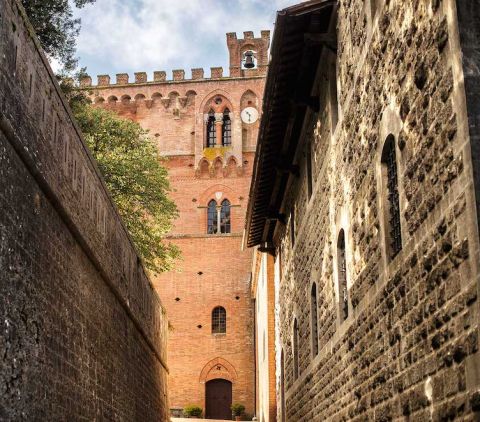
The family’s seat, the Castello di Brolio high above the village of Gaiole, dates from the 12th century but was razed to the ground in 1478 by the Aragonese. On its hilltop is now a crenelated red-brick 19th-century reconstruction of a medieval castle with so many rooms that Ricasoli says he has never bothered to count them. It’s open to the public and used for only the most exclusive events, such as his Milan lawyer daughter Sofia’s wedding from which he was still visibly recovering during my visit there last month.
But what’s really extraordinary is what happened to all this heritage in the 1970s and 1980s. The family, who were under financial strain, sold Ricasoli to Canadian liquor giant Seagram, who ran the reputation of the wine into the ground. This decline continued under the subsequent owners, the Australian company Hardys. Brolio Chianti Classico became a discounted supermarket staple.
In 1993 Francesco Ricasoli, at the time a photographer famous enough to be hired to shoot ads for the likes of Valentino and Ray-Ban, decided that enough was enough and managed to buy back the beleaguered brand, encouraged by Lapo Mazzei, the prominent head of Fonterutoli, another famous Chianti Classico estate 30 minutes away in Castellina in Chianti.
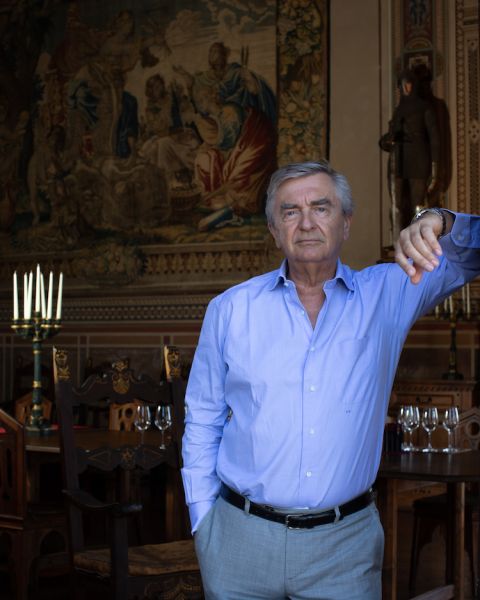
‘You could see the sky through the roof of the winery’, says Ricasoli today, pictured above, about what he encountered on his return. ‘It all had to be rebuilt. And the vineyards were in very bad condition. I’d bought back a huge basket of risk.’
Nowadays the reputation of Brolio has been restored, and a popular bar and osteria added. Ricasoli is already starting to replant the vines he planted in the 1990s to replace what was left by the Australians, with the improved clones that his researches have identified. In conjunction with local scientists he’s not just been looking into plant quality (prioritising Tuscany’s indigenous Sangiovese over the bordeaux varieties that were once popular in the region), but also the estate’s 19 soil types, cork quality, and even the precise relationship between oxygen and sulphites.
Another project with the University of Pisa is designed to come up with a scientifically determined aromatic profile for each wine that could eventually, and usefully, prove whether a certain wine comes from a specific vineyard. ‘The more we know, the fewer mistakes we make’, he assured me over his detailed maps of the soils in each of his vineyards.
His pride and joy are his distinctly different single-vineyard Chianti Classicos, which are priced even above Castello di Brolio, his classic offering in the top Chianti Classico category known as Gran Selezione. Single-vineyard Chianti Classico is now a major trend throughout the zone. ‘It’s like having a different angle on the region without changing the components’, according to Ricasoli.
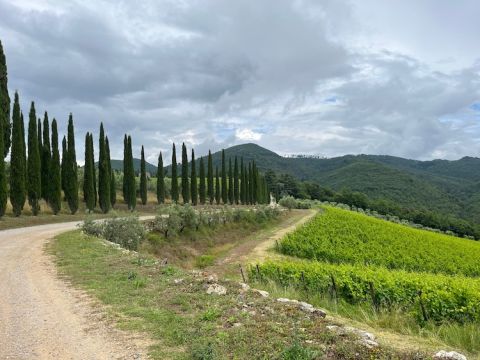
He was born and brought up in the Castello, and clearly has a deep love of every one of the estate’s 1,200 hectares (2,965 acres). This, the biggest estate in Chianti Classico, includes 800 hectares of carefully protected woods, 240 hectares of vineyards and 26 hectares of olive groves. When driving me round between showers – 2023 brought Tuscany’s wettest spring and early summer in living memory – he would stop and marvel at the views. ‘Look! There’s Siena’, he’d nod approvingly at the horizon.
Ever since the buy-back, Lapo Mazzei’s older son Filippo has been CEO of both Brolio and Fonterutoli, sharing the latter role with his brother Francesco Mazzei. To an outsider this looks like a strange arrangement but Ricasoli explained it thus in an email: ‘I knew very little (almost nothing) about vineyards and the wine business and asked Filippo to help me. We have known each other since childhood and trust between us has never been in discussion. The proof is that after more than 30 years our friendship and trust has not failed! Nowadays I am still involved in daily decisions and operation and Filippo is next to me for whatever important decision has to be taken.’
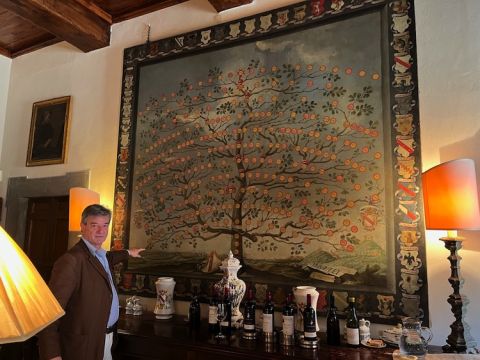
It is not normal business practice for rival companies to be run by the same person but then these Tuscan estates are not normal businesses. If Ricasoli can trace his family’s involvement with wine back to 1141, the Mazzeis of Fonterutoli can claim that it was their ancestor Ser Lapo Mazzei who in 1398 first documented a wine called Chianti in correspondence with a merchant in Prato. Filippo Mazzei is seen above with his family tree. Perhaps such historic genealogies make modern commercial rivalries seem rather inconsequential. The important thing for both the Ricasolis and the Mazzeis is presumably to continue the family tradition by making better and better wine in order to stay in the game. (And not to sell any part of the business to foreigners.) Ricasoli insists he has ‘never taken a lira out of the business’.
The Mazzeis, two brothers and two cousins of the next generation, certainly aren’t sitting on their laurels either. They keep adding new vineyards and now have 117 hectares (289 acres) of vines in seven very different locations in three of the 11 Chianti Classico communes that are, for the first time, permitted on wine labels from the 2020 vintage. Part of the rationale for such disparate expansion by Fonterutoli is to spread the risk of hail, which is becoming increasingly common in Chiantishire (and in many French wine regions too).
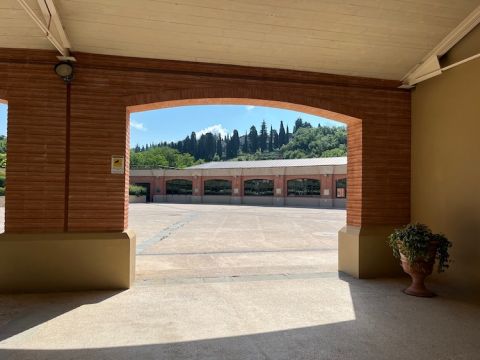
As I toured some of the vineyards closest to the extremely smart winery above designed by Filippo and Francesco Mazzei’s architect sister in 2007 with them and Filippo’s son Giovanni, we bumped into Devonian Howard the gamekeeper on his quad bike. ‘Hallo, Marchesi’, he yelled cheerily and inclusively. (All of the wine producers mentioned here have titles.) Our route had taken us through the little town of Castellina past a particularly ugly animal feed plant. ‘It’s there to remind us how beautiful the rest of Chianti Classico is’, said Giovanni, who is responsible for their new 100% Sangiovese wine Ipsus, which has its very own ageing cellar and an eye-watering price tag of well over £200 a bottle.
The Tuscan landscape with its wooded hillsides and more formal lines of cypresses is famously scenic but the region’s vineyards are not quite as beautiful as they once were because most have to be fenced nowadays, so voracious are the local deer and wild boar. But the wine producers of Chianti Classico are on a roll. At the end of the last century many of them felt inferior to the wave of new producers in Bolgheri on the Tuscan coast because the vogue then was for Bolgheri’s super-ripe reds based on the bordeaux grapes Cabernet and Merlot.
But in our hotter times Chianti Classico producers are able to refer scornfully to the heat of the Tuscan coast and to treasure their much higher altitude and cooler climate. And there is now newfound respect for Sangiovese, the hallmark grape of Chianti Classico, partly thanks to research into superior Sangiovese plants, partly because of a worldwide wave of enthusiasm for indigenous rather than imported grape varieties. From 2027 the minimum proportion of Sangiovese in any Chianti Classico is to be raised from 80 to 90%. (It used to be much lower.)
Producers’ top wines used to be the so-called Supertuscans, wines containing a high proportion of French grapes. But now, an all-Tuscan heritage is something to be proud of. As Francesco Ricasoli and all those Mazzeis can attest.
Some noble wines grown in Chianti Classico
Ricasoli/Brolio
Barone Ricasoli, Torricella Chardonnay 2021 IGT Toscana 13%
€18 Call Me Wine (Italy) and other European stockists
Barone Ricasoli, Brolio 2021 Chianti Classico 14%
£17 The Wine Society, £18.75 VINVM, £19.60 Hedonism, £21.99 Cambridge Wine Merchants
Barone Ricasoli, Castello di Brolio 1997 Chianti Classico 13.5%
£37 Nemo Wine Cellars
Barone Ricasoli, Castello di Brolio 2020 Chianti Classico Gran Selezione 14.5%
£280 per case of 6 Millesima UK
Mazzei/Fonterutoli
Castello di Fonterutoli, Fonterutoli 2021 Chianti Classico 13.5%
2020 (not tasted) is £18.95 Divine Fine Wines, £22.50 London End, £23.95 Davy’s Wine Merchants and others
Castello di Fonterutoli, Concerto 2018 IGT Toscana 14%
£46.80 Nickolls & Perks
Castello di Fonterutoli, Vicoregio 36 2019 Chianti Classico Gran Selezione 13.5%
£77.99 Handford Wines
Castello di Fonterutoli, Siepi 2018 IGT Toscana 14.5%
£78.60 Nickolls & Perks
Tasting notes, scores and suggested drinking dates in Glorious Sangiovese. More stockists on Wine-Searcher.com. See also our dozens of articles about Chianti Classico.