22 August 2009 See also my tasting notes on 100 BC wines.
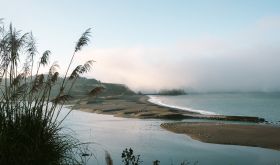
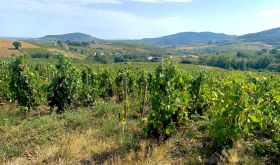
The countryside is stunning. A ribbon of lakes with sandy beaches threaded  between slopes of ponderosa pines, granite cliffs and vine-covered benchland. The Okanagan Valley, an hour’s flight inland from Vancouver, is unusual in having been a tourist destination before it was a wine region rather than the other way round. (This picture gives you only a hint, and was taken by Mike Biden for Blue Mountain, one of the most accomplished Pinot Noir producers.)
At the southernmost end is Canada’s only desert and the US border (over which a handful of American farmers grow grapes in this far-flung corner of Washington state). Outsiders might be surprised to learn that some of the wines produced here have routinely to have their alcohol levels reduced, usually by reverse osmosis, so high are summer temperatures. I arrived in a haze of bushfires last month.
What I found particularly interesting on my first visit to the region was what non Canadians who make wine there have to say about it. For Californian Bill Dyer, an experienced and respected consultant based in the Napa Valley who advised Burrowing Owl for many years and now consults for the intriguingly named Church & State wine operation, the region’s main viticultural characteristic is the narrow window between achieving full ripeness and the onset of winter, so the growing season is relatively short. Locals counter this with their claims that, at 50 degrees north, and without Pacific fogs, their vines benefit from two to three hours’ sunshine a day more than California’s, although, as one Vancouver wine writer put it, ‘if your grapes aren’t ripe by 15 Sep, you’re toast’.
For Frenchman Pascal Madevon, who makes the Okanagan’s most revered wine, Osoysoos Larose red blend, a joint venture between the Taillan group of Bordeaux and the local band of native Indians, or ‘first settlers’, Okanagan’s distinction is that the grapes are so reliably healthy and consistent that he doesn’t even need a sorting table, de rigueur in the much damper, more variable climate of Bordeaux.
Certainly the wines show quite extraordinary directness of fruit; they almost punch you between the eyes with their frankness. And, like the wines of the deserts of eastern Washington to the south, they all have good natural acidity thanks to the Okanagan’s routinely cool desert nights. The most common winemaking prop in this part of the world – apart from the irrigation that is mandatory and often via overhead sprinklers that help ward off frost – is a little bit of sugar to boost the final alcohol level in the north of the Okanagan (a routine addition in Bordeaux and Burgundy too).
The quality of winemaking may not yet reach the peaks achieved in Washington, Oregon and California, but this is a relatively tiny, much more youthful wine scene that has been dependent on European Vitis vinifera vines – as opposed to native American vines, hybrids and even loganberries – only since the 1990s. In this century, however, vineyards have been sprouting along the shores of the lakes and the old melon- and apple-growing sand and loam benches in between, and official BC figures for the total number of licensed wineries in 2008 was more than 160 so there are surely now more than 170 in the Okanagan.
So popular has vine growing become that some pretty marginal areas have been planted in this British Columbia playground. Some failed the test of last winter’s particularly low temperatures, which, as in eastern Washington, can freeze vines to death. Bushfires and winter kill, along with grape-eating bears and rattlesnakes, is certainly an unusual combination.
I picked up a wine map on my arrival at the little airport of Penticton and was slightly disconcerted by one small ad from House of Rose Vineyards in Kelowna, a strip-mall town about which my colleague Hugh Johnson apparently warned a BC wine PR person, ‘don’t take people there’. The ad promises: ‘Bring this to the winery for a free bottle of our homemade wine vinegar – no purchase necessary.’ Not very reassuring to those of us who know the derivation of the word vinegar.
But overall, winemaking standards seemed quite dramatically much better than when I last tasted a range of top British Columbia wines five years ago (see How good are BC wines?). One notable characteristic of the Okanagan, not uncommon in young wine regions, is how many different grape varieties are grown. As Vancouver wine writer Anthony Gismondi puts it, ‘what we like is the diversity here. We’re not eliminating anything yet.’ As a result, almost 60 different varieties can be found in the region’s 7,500 acres of vines, with cooler climate grapes, including all the Alsace varieties, to the north and the other red wine grapes in the hot south, although late-ripening Cabernet Sauvignon can be a challenge and is generally best when blended with other Bordeaux grapes.
I tasted only about 100 of the Okanagan wines reckoned to be better than most, so can hardly generalise, but I was particularly impressed by Pinot Blanc, even though in terms of total area planted it is dwarfed by fashionable Pinot Gris. Indeed, local Master of Wine Barbara Philip chose as her MW dissertation to explore the potential of Pinot Blanc as a flagship for the Okanagan in the same sort of way as Sauvignon Blanc put Marlborough, and New Zealand, on the map. Her extensive research revealed that it did indeed make particularly good Okanagan wines, but its relatively long history there meant that producers saw it as much more ordinary than the Pinot Noir, Syrah, Pinot Gris and Riesling on which they are currently setting their sights.
Wineries were just about to get the upper hand in grape sales negotiations but the cold winter put paid to that. Vine diseases are rare and Okanagan grapes are typically sprayed just four or five times a year, compared with up to 14 times in Canada’s other significant, and older, wine region in Ontario in the east. It is, incidentally, difficult to find BC wines in Ontario and vice versa, and the prices locals are prepared to pay for them tend to militate against exporting much outside Canada. An exception was made for super-expensive sweet Icewines to the gift markets of Asia, but Canadian enthusiasm for Icewine seems generally on the wane – as well it might be in view of global warming.
Optimum yields in Okanagan are apparently around 2.5 tonnes per acre (44 hl/ha), about the same as in Pauillac, although they are higher for cheaper brands. Lower than this and the skins are too thick and the grapes too dry to produce harmonious wines.
The giant Canadian wine company Vincor, now owned by Constellation of the US, grows by far the dominant proportion of all BC grapes, with Jackson Triggs their Okanagan winery and prime brand name (naughtily used for imported ‘Cellared in Canada’ blends too – see Canadian con contd). The land they farm is mostly owned by the Oyosoos Indian band and its charismatic Chief Clarence Louie, who has steered the band to prosperity via golf courses and resorts. So, au fond, the fledgling Okanagan wine business is completely dependent on those first settlers, some of whom now work in it. Indeed the ultimate BC Indian wine is now made by two Osoyoos Indians. Perhaps only they can pronounce its name, Nk’Mip, QwAM QwMT, with real confidence.
MY OKANAGAN FAVOURITES
Sumac Ridge, Pinnacle Sparkling Rosé 2000
Tantalus Riesling 2008
Black Hills, Alibi 2007
Lake Breeze Pinot Blanc 2008
Nk’Mip Pinot Blanc 2008
Wild Goose, Mystic River Pinot Blanc 2008
Quail’s Gate, Stewart Family Reserve Chardonnay 2007
Thornhaven Gewurztraminer 2008
Blue Mountain Pinot Noir 2007
Blue Mountain, Reserve Pinot Noir 2006
Hester Creek Merlot 2005
Cedar Creek, Platinum Reserve Merlot 2006
Jackson-Triggs, Sun Rock Cabernet Sauvignon 2005
Herder, Josephine 2007
Osoyoos Larose 2005
Road 13, 5th Element 2006
Sandhill, Phantom Creek Syrah 2007
Road 13, Jackpot Syrah 2007
Nichol Syrah 2005
Mission Hill, Quatrain 2006
Mission Hill, Oculus 2005
Mission Hill, Oculus 2006
Mission Hill, Oculus 2007
See also my tasting notes on 100 BC wines.