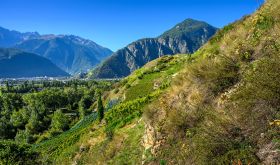
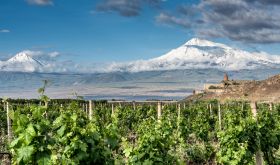
I used to think that South Africa’s was the most beautiful wine country in the world but now that I have at last visited Central Otago in the south of New Zealand’s South Island I am not so sure. And a growing number of Americans seem to agree with me.
Think lakes, mountains and crystal clear air which make the English Lake District where I grew up look like Toytown – and now, vineyards. The oldest of them, planted by Rolfe and Lois Mills by the sapphire waters of Lake Wanaka with its fringe of snow-capped peaks back in the 1970s, is one of the most photographed vineyards in the world. Indeed it is so obviously spectacular that Tesco, Britain’s leading supermarket group, blithely stuck a photograph of it on a bottle of Sauvignon Blanc from Gisborne, hundreds of miles away in the North Island, and it was spotted in Holland on a bottle of Australian Shiraz Cabernet emblazoned with that least New Zealand of symbols, a kangaroo.
But it is not just the scenery around Queenstown and Wanaka that has attracted the swelling band of Central Otago vignerons. Realising that their high latitudes give them unusual opportunities to succeed with the world’s most sensitive red wine grape, Pinot Noir, New Zealanders have fallen madly in love with it. It is now the country’s third most planted grape variety and may soon overtake Chardonnay to become second only to Sauvignon Blanc.
But of all the country’s many and genuinely varied wine regions, Central Otago has most rapidly established itself as New Zealand’s answer to Burgundy. There are many fine Pinots from Martinborough, Wairarapa and Waipara and notable others from elsewhere but, as one of the most ambitious North Island producers of Pinot Noir said to me, “we’re all jealous of Central Otago”.
The fact that “Central”, as New Zealanders confusingly call it, has the landscape of which New Zealand is most proud must help. And being such a popular tourist centre (almost too popular nowadays), it has no shortage of good restaurants, bars, cafes – even a tiny cinema with a noted wine list and an intermission in which to enjoy it. But this is not the whole story.
Temperatures are sufficiently low (especially at night) to give Pinot the extended growing season it needs. Like Burgundy, it has a thoroughly continental climate. Many Pinot producers go skiing for an hour or two before work in the winter, but summers can be so hot and the light so intense that 15 minutes inspecting Felton Road’s Block 3 on an overcast summer’s day left me with sunburn. Unlike Oregon, Central Otago benefits from dry autumns so there is no great pressure to pick if the summer has not been particularly warm (there was snow last December for example, and the weather warmed up only once everyone had gone back to school for the autumn term). The dry atmosphere means also that the fungal diseases that can plague Pinot Noir present few problems here.
The biggest viticultural problem is frost, for summers are short. Many vineyards are planted on slopes to minimise the risk of cold air enveloping and freezing young buds but 2004’s growing season, for instance, was plagued by both spring and autumn frosts so that, despite the extraordinary, almost alarming, rate of recent vine plantings, the total crop, just under 1,500 tonnes - was the smallest for five years. And New Zealand’s unusually miserable 2005 early summer resulted in horribly uneven fruit setting so that the 2005 crop has been dramatically reduced too, by about 40 per cent, putting a brake on the region’s planned export drive.
But these vagaries of the climate are decidedly Burgundian. Pinot Noir does not want long periods of intense heat. What is least Burgundian of Central Otago’s natural elements perhaps are the soils. Rather than classic limestone such as is found in Burgundy and some parts of Canterbury to the north and in the even newer Waitaki wine region in North Otago, Central Otago’s vines tend to grow in fine powdered loess, sometimes on clays, and occasionally schist, which help to retain what little water there is. The soils may be usefully poor, but irrigation is essential – another contrast with Burgundy.
What Central Otago has in common with the Burgundy of today however, is remarkable harmony and consensus among its leading wine producers. In both regions, the energy and passionate commitment to dissecting individual wines together and trying to do better with each successive vintage is palpable. The tight-knit wine community of, typically in Otago, laidback young men in their 30s, has strong links with its counterpart in Burgundy. They have virtually all worked in cellars and vineyards there. Their own cellars are stocked with Burgundy’s finest grands crus and premiers crus. They are, in short, Pinot maniacs. And there are now so many of them.
Ten years ago there were fewer than 100 hectares of vines in Central Otago. Now there are more than 1,000 – of which a full 70 per cent are Pinot Noir. But more extraordinary perhaps is that while 10 years ago there were just eight wine producers, today there are almost 100, including a significant number of Americans, some such as Susan and Terry Stevens of Wild Hare who live on their dream vineyard property and now have New Zealand citizenship, others like the improbably named wine importer Marquis Sauvage who commutes to his ambitious biodynamic Burn Cottage vineyard (consultant Ted Lemon of Littorai) from Chicago, if you please.
So, the most important question of all, what are the wines like? Not especially like burgundy, is probably the first thing to say. One reason for this is that, as in Oregon, the influence of so-called Dijon (originally Burgundian) clones is not (yet) widespread. The dominant Pinot clone is a New Zealand speciality called 10/5. But I suspect that because of the difference in soils, the wines will never be carbon copies of Burgundy. This, as a host of California Pinots has proved, does not necessarily matter. What I admire about the Pinots of Central Otago is that they have already, in a remarkably short time, developed their own style – which I would describe in shorthand as ‘exuberantly fruity’ yet which has quite enough acidity and ripe tannins to convince me that many will make old bones too. Some are even quite delicate, although as elsewhere they are picking later and later to achieve very ripe tannins and the result is fairly high alcohol levels, often more than 14 per cent, and routine acidification – in the world’s most southerly wine region!
Central Otago has several quite different subregions – cooler Gibbston which results in more sinewy, aromatic wines; warm Alexandra with its fullblown fruit; Bannockburn in what was once gold country; newish Bendigo which also produces ripe fruit but with particularly good structure; new but promising Lowburn; and the original Wanaka with its usefully low frost incidence. Vineyards tend to be planted on north-facing slopes to maximise ripeness but even within each subregion there can be huge variations.
Many producers own or manage several vineyards in different subregions as an insurance policy against the vagaries of each growing season. But the overall style and quality of the wines is quite remarkably consistent. I must have tasted several hundred Central Otago Pinots during my brief stay in Queenstown in early 2005 and I hardly encountered a faulty or badly made wine. This is probably because the established producers are so driven, and the newcomers tend to have their fruit vinified by one or two particularly competent and engaged contract winemakers such as Dean Shaw at the Central Otago Wine Company, chosen incidentally as a godfather by Pascal Marchand, one of Burgundy’s leading young winemakers. Real proof of a Burgundian connection - as is the fact that the wines are not cheap.