It is one of the tenets of French wine lore that geography is all. The burgundies grown on the Côte d’Or are certainly ruled with a rod of iron by the local maps. The centuries-old boundaries between different climats, some less than two hectares or five acres, determine how wines are labelled and presented to us consumers.
In Bordeaux things are rather different and I suspect many wine lovers would be surprised by the fluidity of the boundaries and shape of the various wine châteaux that have established such apparently immutable reputations. A glance at the excellent Enogea map of Pauillac, St-Julien and St-Estèphe for instance, a fine piece of detective work by Italian wine writer Alessandro Masnaghetti, shows just how intertwined are the vineyards of the rival Rothschild first growths Lafite and Mouton – belying the dramatic difference in the style of their wines.
At the other end of Pauillac, first growth Château Latour has made no bones about its recent vineyard buying spree, adding considerably to its holdings of disparate parcels of vines far inland from the Enclos that surrounds the recently excavated winery and provides its flagship Grand Vin. These outliers are destined to produce its increasingly important third wine, Pauillac de Latour. (Les Forts de Latour has its own plot.)
It is perhaps not surprising that the three Léovilles are intertwined because they are the remnants of one original estate, but Masnaghetti’s map shows just how few of the famous châteaux of this most extensive concentration of top-quality wine comprise one single uninterrupted plot of vines: Montrose and Lagrange are all I can see, each with a little slice of (presumably unsuitable) unplanted land in the middle. And the châteaux are always adding or swapping plots. Montrose, for example, recently added a considerable tranche of neighbouring vineyard to this highly regarded second-growth estate.
The wine producers who have arguably redrawn the Bordeaux map most vigorously are those in charge of Libourne négociant J P Moueix, Christian Moueix and his son Edouard. They may well feel that since Christian’s father Jean-Pierre Moueix effectively put Pomerol, the Moueix home territory, on the map, they have the right to amend it. Changes are considerably facilitated by the fact that this luxurious right-bank appellation is free of any official classification.
In next door St-Émilion, the distinctions between the various sorts of grand cru classé and grand cru are so sensitive that to make any change to the extent of a St-Émilion classed growth, the proprietor has to petition both the Paris organisation in charge of appellations and the local classification commission. A detailed dossier has to be assembled to prove that any additional land has exactly the same characteristics in myriad respects as the original property. (St-Émilion wine politics are a notorious minefield, partly because of this double layer of bureaucracy.) This is what the Cheval Blanc team had to do when they wanted to absorb the finest four-acre parcel of their recently acquired Ch La Tour du Pin into the St-Émilion first growth.
Extending properties in the Médoc on the left bank is a little easier because there it is the brand, or château, that is classified, not the land. (It would be fascinating to compare today’s map with its equivalent in 1855 when the famous classification of the Médoc’s top 60 châteaux was drawn up.)
But on the tiny but hugely valuable plateau of Pomerol there are far fewer constraints, which is presumably why the Moueixes have been able to be so creative. The world-famous jewel that is Petrus, now run by Christian’s brother Jean-François Moueix and his son Jean, was extended considerably by the acquisition last century of a portion of neighbouring Ch Gazin.
In the late 1990s Christian Moueix acquired Ch Certan Giraud across the road from Petrus and transformed its finest parcels into Ch Hosanna, selling lesser wines for the first few years as Ch Certan Marzelle.
But perhaps the most dramatic example is Ch La Fleur-Pétrus (the brothers have different policies on the accent on the E), a relatively modest Pomerol estate acquired by Christian and Jean-François’s father Jean-Pierre in 1950, this exceptional wine merchant’s first-ever vineyard acquisition in Pomerol.
If you read the magisterial Wines of Bordeaux by my FT predecessor Edmund Penning-Rowsell, who last updated it in 1985, you will be told that La Fleur- Pétrus consisted of 8 ha, made rather light wine but provided useful accommodation for the Moueixes’ numerous pickers. According to the 2004 edition of Féret, the Bordeaux gazetteer, there were 12.4 ha of vineyard and the 4 ha acquired from Ch La Gay in the mid 1990s are not specifically mentioned. Neal Martin’s compendious 2012 Pomerol agrees with the 12.4 ha total, but notes this was ‘prior to the absorption of Ch Guillot’. According to Stephen Brook’s The Complete Bordeaux, the vineyard total had risen to 13.5 ha by 2013. But the Moueixes’ current leaflet on La Fleur-Pétrus notes a total of 18.7 ha, made up of three different parcels up to well over a kilometre apart (quite a distance for the plateau of Pomerol).
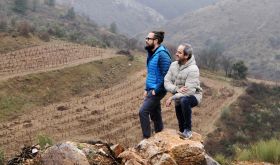
The original block is shown proudly on the Moueix map (being pointed out below by Edouard Moueix) as sitting between Petrus and the jewel that is Ch Lafleur to the north of the plateau. LFP1, as they now call it, is gravelly on an iron-rich subsoil.

This was supplemented in 2005 when Christian Moueix acquired Ch La Providence, a much more clayey parcel in the middle of the plateau between Certan de May and the church. Between 2005 and 2012 the produce of this central parcel was sold as Providence (no Château La), another new name from JP Moueix.
And finally in 2012, after years of courting the old owners of Ch Guillot (whom he describes as ‘a complex family’), Edouard Moueix (pictured above) added what is now known as LFP3, a particularly well-drained gravelly block to the south of the plateau shown as between Trotanoy and Le Pin; the latter's owners had had their eye on it for some time. The vines here are particularly old and are being replaced, but the 2012 vintage of Ch La Fleur-Pétrus does actually contain wine from all three plots for the first time, with some of the less exciting wine from LFP2 going into the last vintage of Providence. Got that? (Apologies in advance if I have failed to grasp every nuance of this complicated picture.)
I visited the new Ch La Fleur-Pétrus last summer. To replace the old two-storey building on the original LFP1 block, the more substantial three-storey château of the original Ch La Providence in the middle of LFP2 has been redecorated for Moueix entertaining and a spanking new winery installed.
The two vineyard plots between this château building and the road were lying fallow during my visit ready for redrainage. A new drainage system is currently being installed in LFP2 (as has been done for parts of Petrus) since the water table on the plateau of Pomerol is notoriously high.
The new regime is signalled across the plateau by a flagpole flying the red flag that has long adorned the La Fleur-Pétrus label. Long-standing followers of the wine may be comforted by this welcome token of consistency.
And Christian and Edouard Moueix have also managed to redraw the St-Émilion map, most notably by subsuming Ch Magdelaine into what was Ch Belair next door to and once a sister property of Ch Ausone. Ch Belair Monange, as the extended property is now known, is the home of Edouard Moueix and his American wife and young family, though I'm told it's the devil's own job getting Amazon to deliver there. New address, you see.
LA FLEUR-PÉTRUS
Some favourite vintages
1982
1989
1990
2001
2005
2008
2009
2010