‘Ah, Kabis! Ask anyone in the German wine business and they will say, “Kabis geht immer” (ie “it’s always a good time for a Kabinett”). In my opinion Kabinetts are the true USP of Germany.’ So began an emailed response from my colleague, specialist German wine writer Paula Redes Sidore, when I asked her for her thoughts on this neglected category.
My question was inspired by a recent London tasting based on Justerini & Brooks’ current offer of German wine. In this array of wines, mainly based on Germany’s signature Riesling grape and in a range of sweetness levels and prices up to £378 for six bottles of J J Prüm’s Auslese Goldkapsel 2024, it was striking how inexpensive the Kabinetts were. They are available for as little as £75 for six in bond, so with UK duty and VAT only about £17 a bottle. This despite the fact that they are Germany’s unique gift to the world’s wine drinkers – especially those watching their alcohol intake.
The majority of the wines shown by Justerinis were classified as dry, or trocken in German. Kabinett wines are not bone dry but they certainly don’t taste sweet. They finish dry on the palate because any residual sugar in the wine is so finely counterbalanced by fresh, appetising acidity. It’s not too fanciful to say that a Kabinett offers something of the thrill of watching someone on a tightrope. These wines have an electric tension when young, and as they age – and they tend to last much longer than dry wines – any sweetness fades into the background and the marked aroma becomes even more nuanced.
Because not all of the sugar in the grapes is fermented out to dryness, they are usefully low in alcohol, typically 7–9% alcohol (and therefore attract a relatively low rate of duty in the UK). Think of all the effort being expended in producing low-alcohol wines today, invariably using industrial methods. Yet here is a category that genuinely could claim to be 100% natural. The wines are just part-fermented grape juice – and inexpensive.
The Kabinetts of the widely admired Thomas Haas of Schloss Lieser just over the hill from J J Prüm, for instance, are offered at £80 for six in bond, whereas his dry Grosses Gewächs (see below for an explanation of German wine categories) from the same vineyard is priced at £180 for six. The grapes for the latter are picked later but that means they have less acidity, and more sugar, which is fermented out to dryness, meaning more alcohol. So while the Graacher Himmelreich Kabinett is only 8.5% alcohol, the Grosses Gewächs is 12% – and is arguably less distinctive.
While Riesling GGs are dry and concentrated, a good Riesling Kabinett is typically light-bodied yet powerfully aromatic with a teasing perfume of flowers, something mineral, perhaps a complex of citrus flavours.
As Sebastian Thomas of Ripley Wines, another of the regrettably few specialist UK importers of German wine, points out about the Kabinetts, which are now his favourite category of fruitier German wine, ‘When they are ten years or more in the bottle, they can be magical in a completely different way [from when they are young].’ He confesses, ‘When I fell in love with German wine in the early nineties, I thought the sweeter the better, and sought out Auslese and above. Now I have a cellarful of wines I hardly touch, and wish I’d focused on Kabinett instead!’
So why are Kabinetts so much cheaper than most dry wines in the portfolios of Germany’s hundreds of conscientious family wine producers (it’s a mystery how so many of them manage to attract the nth generation after two centuries or more of existence)?
When I asked Maximin von Schubert of Maximin Grünhaus, another famous historic Mosel estate, why the Kabinett wines in the tasting are such bargains, he smiled ruefully. ‘All winemakers love drinking Kabinett but the German public is not interested. It’s an export product.’ Like the late, unlamented Liebfraumilch, I thought – yet the wines are so wildly superior to the likes of Black Tower and Blue Nun.
The problem is that in Germany if a wine doesn’t have trocken on the label, or is not classified as Grosses Gewächs, the dry wines from single vineyards so heavily promoted by the VDP, the elite association of German winegrowers, consumers tend to reject it as being sweet and therefore unfashionable. I’d argue they’re drinking with their eyes rather than their palates. And overlooking the great asset of Kabinett: that it’s naturally low in alcohol.
New York importer Skurnik, having inherited the exceptional German wine portfolio of specialist Terry Theise, has one of America’s most comprehensive selections of German wine. Its German specialist Michael Lykens is proud of how much Kabinett he sells, and points out, ‘I believe off-dry Riesling is still the soul of German wine and is something no other wine-producing country in the world can replicate.’
Justerinis’ German wine buyer Mark Dearing also reports that their sales of Kabinetts are going well. ‘People get it, and it works well for restaurants, too. Once you get into the sweeter category of Spätlese, the wines don’t have the same broad appeal because people don’t know when and how to drink them. But you don’t need to know a huge amount to enjoy a Kabinett.’
(I have to admit, however, that the average age of the 160 attendees at Justerinis’ tasting – impressive on a tube strike day – was not young.)
Sebastian Thomas of Ripley Wines, which showed an array of Kabinetts at their tasting last June, reports that ‘Kabinett is increasingly popular. But it’s still very underrated, even by the growers themselves.’ He wrote to his customers recently about the category, ‘because it is inexpensive, it has often been neglected in favour of weightier Spätlese and Auslese. And there was a dark period in the 1990s and early 2000s when Kabinett was pumped up to Spätlese weight, which undermined the whole point of it. In the last 15 years there has been a return to classic Kabinett.’
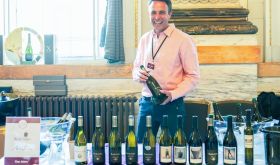
Of the many growers at the Justerini tasting, Thomas Haag (pictured above) observed the heartening news that, at last, younger German consumers are starting to be interested in Kabinetts, so ‘we have to be careful about sudden and extreme price increases. Kabinett is way too fair in price, especially compared to other wines’, he noted, so ‘of course, there is still room for some price adjustments, but I think it is important that it does not get out of hand and it stays kind of accessible.’
I hope this means that prices won’t go up too much. But now could be a very good time to invest in Riesling Kabinetts that will continue to age beautifully for years and are versatile enough to be enjoyed either without food, or with all but the heartiest dishes. Without a heavy imprint of oak or alcohol, they are an especial delight in hot weather, and with a wide range of spicy foods at any time of year.
2024 Riesling Kabinetts
All prices are for six bottles in bond from Justerini & Brooks.
Fritz Haag, Brauneberger Juffer (8%) £75
Schloss Lieser, Graacher Himmelreich (8.5%) £80
Schloss Lieser, Piesporter Goldtröpfchen (8%) £80
Dönnhoff, Oberhäuser Leistenberg (9%) £100
Maximin Grünhauser, Bruderberg (7%) £105
Maximin Grünhauser, Herrenberg (7%) £110
Zilliken, Saarburger Rausch (7.5%) £110
Willi Schaefer, Graacher Himmelreich (7.5%) £135
Willi Schaefer, Graacher Domprobst #03 (7.5%) £135
J J Prüm, Graacher Himmelreich (8.5%) £162
J J Prüm, Wehlener Sonnenuhr (8.5%) £168
Tasting notes, scores and suggested drinking dates in Germans in London 2025. For international stockists, see Wine-Searcher.com.
Back to basics
| What do German wine labels mean? |
|
In the late twentieth century Germany was much cooler and it was a challenge to ripen grapes fully, which meant that ripeness was treasured above all else. The ‘best’ wines were classified into so-called Prädikats according to how much sugar was in the grapes when they were picked, with Kabinett the least ripe Prädikat, ascending successively through Spätlese, Auslese, Beerenauslese to Trockenbeerenauslese, the sweetest wines made from nobly rotten grapes. (Eiswein made from frozen grapes is a special rarity.)
Wines made from grapes that didn’t make it to Kabinett ripeness tended to be so tart that they had to be sweetened up with grape concentrate, with the result that in the late twentieth century many drinkers dismissed such German wine as ‘sugarwater’.
Then came warmer weather, much riper grapes and sugar levels that could be fermented out to dryness, so Germans were able to make satisfying dry (trocken) wine.
Once they’d cracked how to make dry wines, German vintners changed their focus to geography, and a hierarchy was devised, inspired by Burgundy, whereby wines were labelled, in supposed ascending quality, with the name of a region, a village or the relevant vineyard, with superior vineyards classified as either Erstes Gewächs (first growth) or Grosses Gewächs (great growth). The latter, regarded as the crème de la crème of dry German wines, must be made from grapes that would have been ripe enough to produce a Spätlese if the sugar had not been fermented into alcohol.
Generally, if a wine is labelled, for instance, Wehlener Sonnenuhr, it comes from a vineyard called Sonnenuhr in the village of Wehlen. But there has been a tendency with GGs not to include the village name on the label, which can be very confusing since many vineyards have the same name. But at least all wines, whatever their status, should have the name of the relevant wine region on the front or back label. |