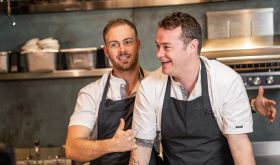

From the outside Racines (the French for roots) occupies what looks to be an unprepossessing site in the Brussels Ixelles district. Up three stairs, past a plethora of wine bottles, and you are face-to-face with an open kitchen and a counter with several seats before reaching the restaurant’s main space, with a private dining room on a mezzanine to the right. Into here comes, at least at lunchtime, an abundance of natural light through large windows that face onto a garden. It was this last feature which first attracted Ugo Federico, now 43, and Francesco Cury, 39, to this space almost nine years ago.
They finally opened Racines on 5 February 2015 although it was then very different from the excellent restaurant it has become today. ‘When we first opened our intention was to offer small plates of food with a wide range of Italian wines’, Federico admitted. My two excellent meals, by contrast, began with a series of antipasti dishes followed by three pasta dishes, a main course, and a wonderful piece of cheese to finish. How has this transformation come about and how has Brussels become the new home of one man from Capri and another from Florence?

It transpires that Florence holds the key, that the men met while working for the renowned restaurateur Fabio Picchi at Cibrèo, the great restaurant by that city’s market. There they prospered, Federico working initially as sommelier, Cury front of house before becoming Picchi’s assistant and ghost writer for six of his books. But Cibrèo was a family business destined to stay that way, and both men are ambitious.
Ten years ago Federico explained to Cury over a drink that he thought it was time to move on. And not just to another Italian city but to another country. Cury agreed and their search for a new home began.
They looked initially at London – too expensive. Berlin – too complicated and their German was not good enough. Paris – definitely a possibility. Then Brussels, for which they felt an immediate empathy. In Brussels they were helped by the facts that at that stage there was a large Italian population already (about 10% of its then 1.4 million inhabitants) and the number of Italian restaurants of the old-fashioned school meant that their more modern approach stood a chance of being appreciated. Brussels was also the least expensive of the various capital cities they considered.
Once they had decided on their new location, their luck only got better with even the banks approving their plans. And then, as they were looking for a site, they peered through the front window of their current address and behind all the rubbish they could see the light pouring in. They made enquiries, discovered a willing landlord, and eventually moved in with what, they now agree, were very limited culinary ambitions.
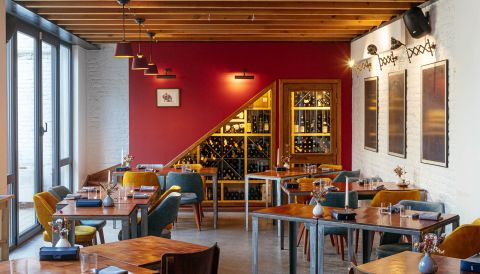
Racines from the outset attracted a large following who began to demand more and more. Federico and Cury obliged. As their customers increased, so did the size of their à la carte menu, but with it the number of staff. Pre-COVID they were employing 16: 10 in the kitchen and six front of house. ‘Basically Francesco and I were working for the pleasure of employing everybody else’, he said with a smile. But the long lockdown gave them time to reconsider their menu and to settle on a more pragmatic structure.
Their intention was always to run one of the best Italian restaurants in Brussels.
But when they arrived there were just the two of them and the path seemed unclear. They pursued an à la carte approach initially but discovered that a set menu was far more popular and profitable.
In my 2012 book The Art of the Restaurateur I interviewed Enrico Bernardo at his one-star Michelin restaurant Il Vino in Paris where you chose the wines first and then were presented with a set menu. He was clear about the advantages of such an approach: lower prices for the customer because of much reduced food wastage and a lower wage bill for the restaurateur, even more crucial today as it appears to be as difficult to find kitchen and waiting staff in Brussels as it is in London, Paris, Berlin, New York and everywhere else. With their new set menu, the owners of Racines currently employ just seven people.
It is therefore no surprise that set menus are today so popular – even if they tend to reduce the element of spontaneity in the service – but here it seems to have boosted the confidence of the kitchen, created a warm atmosphere, and allowed Federico and Cury to carry out a double-hander of a service performance that could only be accomplished by a pair of extremely well-trained Italians.
My first meal, with two friends, began with a collection of antipasti: a deep-fried ball of pungent endive; a mixture of equally flavourful chicken and rabbit livers on homemade brioche; a small bowl of soup made from beans topped with cavolo nero; and finally a small piece of sea bass, grilled and topped with the purest tomato puree. Best of all was a beignet of potato filled with a beef ragu that was a triumph and was made according to Federico’s grandmother’s recipe, Federico informed our table with great pride.

There then followed three variations of pasta. As one of our party was lactose-intolerant, a factor which Racines handled very easily, I shared the first with my host: a large ‘raviolono’ stuffed with burrata. Then came tagliatelle topped with diced tuna and finally, after a showing of the whole truffle, a tortellino topped with generous shavings from it. Each was first class, helped by the fact that here they make their pasta with 40 egg yolks per kilo of flour instead of the customary 30.
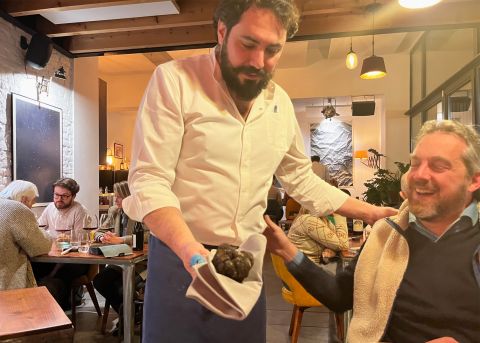
We finished with a small piece of beef in a winningly reduced sauce and a small piece of occelli cheese made from both cow and ewe’s milk and aged in chestnut leaves. With this we drank, thanks to my host’s generosity, an appetising bottle of Cedric Bouchard’s Roses de Jeanne La Bolorée 2011 (disgorged 2015) as well as a magnificent bottle of Soldera Brunello di Montalcino Riserva 2006 from his private collection.
As the evening progressed, it became clear to me that what a set menu also affects is that it releases the energy of the front-of-house staff. Relieved of waiting while customers dither over what to choose. relieved of running to and from the kitchen with pieces of paper, and able to focus entirely on the smaller, more personal idiosyncrasies of their customers, the waiting staff are able to become more like a troupe of entertainers.
At lunch the next day I had antipasti and a fabulous version of their spaghetti arrabiata plus pears cooked in two different ways plus a zabaglione – for €45.
Federico and Cury, both Italian to their fingertips and trained for a decade in a great school, Cibrèo, by a great restaurateur, are entertainers who seem to love their customers, who love the food and wines they have to offer, and seem as happy with it all as their satiated customers. Their arms and hands tell a great story. Their smiles reinforce this. But most of all I could see it in their eyes as they explained everything, corrected anything that might not be quite right, and revelled in a full and extremely happy restaurant. In these endeavours they are ably assisted in the front of the house by Erik Lessillard and their young sommelier David Lazar, while Mattia Zucchini and Abdoul Kone run the kitchen.
In the case of Racines, London’s, Paris’s, Berlin’s and Florence’s loss is, quite obviously, Brussels’ gain.
As I was about to leave I asked Federico to give me the names of his five top producers:
For anchovies: Acquapazza
For olive oil: Trebbio
For pasta: Mancini
For tomatoes: Petrilli
For Parmesan: Gennari
Racines 353 Ch d’Ixelles, BE-1050 Ixelles; tel: +32 (0)2 642 95 90
Lunch €45 for three courses, dinner €75 for seven courses