15 October 2020 We revive our tradition of republishing articles free on Thursdays with this welcome distraction. Brits, note that since this article was originally published, the Greek island of Santorini has come off the UK quarantine list.
28 September 2020 We continue our series of pictorial wine-travel articles, aimed at providing a little escapism for those who are travel-restricted, locked down, or even quarantined. Jonathan Reeve of Liv-ex, who comes out of his 14-day post-Santorini quarantine today, also shared his wine tour of Sicily, and has written an article of useful wine-travel tips, which we plan to publish when travel becomes more of a possibility.
Santorini sunsets are legendary. Those viewed from Santo Wine’s winery-cum-tourist-trap, sculpted vertically into a west-facing cliff, are probably the world’s very best. Santo Wines is the island’s chic co-operative, where heavy investment and ongoing success are abundantly clear. Its 1,200 grower members (every Santorini vine grower is automatically a member, whether or not they sell grapes to the co-op) have enjoyed huge increases in grape prices over the last decade. Ten years ago, for a kilo of Assyrtiko grapes, they were paid 75 cents. Today? Five whole euros. The island’s tourist trade has enjoyed similar success; wine and tourism support one another well. Santo Wines has played its hand expertly, catering to both wine lovers and sunset-seeking tourists.
I took the photos above from Santo’s tasting room, to capture the two luminous secrets of Santorini’s success.

Black & white
Black works invisible magic here on Santorini. It goes largely unnoticed, in the shadow of the island’s brilliant, attention-grabbing blues (sea, sky and painted church domes). The black magic resides in the glittering black volcanic soils, which reflect light and retain warmth well into the night, creating super-stable day-night temperature variation. Their low potassium levels also help Assyrtiko retain its naturally high acidity, adding to the wines’ appealing freshness and ageability. Loose-structured and free-draining, the volcanic soils encourage vines to dig deep, strong root systems in search of water and nutrients. And below all of this are the cool, cavernous black recesses dug directly into the lava rock – perfect, stable environments for wine production and storage.
The middle image above shows Hatzidakis’s subterranean vault, where the winery stores its museum collection of past vintages. To the right of that is their barrel-storage tunnel, where age-blackened barrels contrast against whitewashed walls. Hatzidakis, like several wineries here, have dug their winery and barrel halls entirely underground. Just over the hill, Volcanic Slopes Vineyards have a centuries-old example of underground winemaking and storage facilities, now converted into their super-smart cellar door.
Although typically outshone by the island’s brilliant blues, Santorini’s black clearly caught the eye of someone at Jaguar Land Rover PLC, whose car colour palette includes a sparkling metallic black option named Santorini Black.
And the white element? This is so blindingly (almost literally) obvious that it hardly needs any explanation. Whitewashed windmills, churches, houses and cellars, white wines, all bathed in bright white Mediterranean light.
Experimentation & diversity
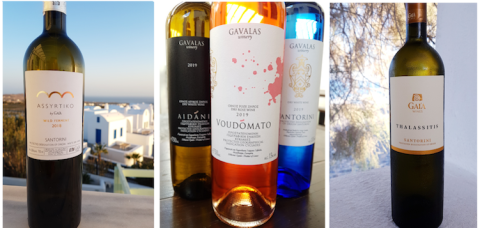
Over the course of my visit it became clear that while Santorini’s winemakers are happy with the wine style that dominates the island’s wines (fresh, white Assyrtiko), they are not content to sit on their laurels. Experiments and diversity are very much on the radar. Yiannis Paraskevopoulos, owner-winemaker of Gaia Wines, perhaps embodies this spirit most obviously. Yiannis is equal parts communicator, charmer, winemaker and scientist. The latter led him to a particularly fascinating experiment with ageing bottled Assyrtiko under the sea – his Gaia Thalassitis Submerged (see Assyrtiko as rare as a mermaid). I tasted the result with him. Five years in an oxygen-protected environment creates an obviously reductive wine, with the tell-tale aroma of struck matches, and tighter structure than the equivalent wine when matured in the winery. The wine was still entirely fresh and zingy in my hotel fridge four days later. Quite different to the Submerged, and possibly my favourite wine of the 100-odd I tried during the visit, is Gaia’s Wild Ferment Assyrtiko. Several wineries produce a wild-ferment Assyrtiko, invariably the island’s lushest, deepest-flavoured examples.
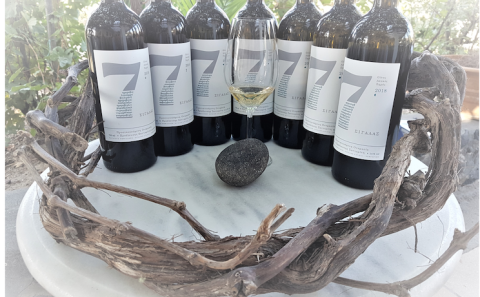
Experimentation with oaking regimes is also leading to some richer, more luxurious styles here, in which Estate Argyros are leading the charge with their new Monsignori and Evdemon cuvées. Argyros’s winery-based R&D is mirrored by vineyard/terroir-based experimentation over at Sigalas. Sigalas now produces seven single-site Assyrtikos to showcase the distinct terroir of Santorini’s seven key wine-growing villages. The seven appear in the ‘Wheels within a wheel’ image below. Sigalas also pioneered the idea of sailing Monemvasia (Malvasia) grapes over from neighbouring Paros, for a 50/50 Assyrtiko/Monemvasia blend named AM. This provides a more-accessible alternative to pure Assyrtiko, which tends be overbearingly acidic in its youth. The team at Gavalas have now cleverly cottoned on to this idea and have just started making a similar blend named Posta.
Early birds
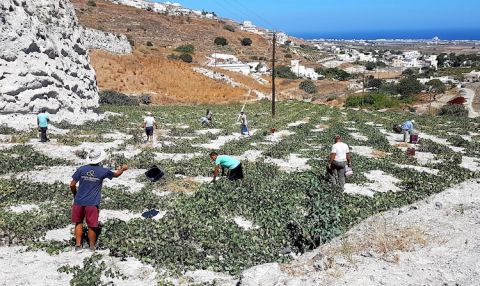
Harvest arrives very early on Santorini, thanks to all that dry, sunny weather. A few years ago, harvest started as early as 24 July. My visit being in early September, I was lucky to see the very last grapes coming in (mostly for Vinsanto), as shown in the photograph above.
At Gaia’s beachside winery, Yiannis Paraskevopoulos surprised me by pouring a tank sample of his 2020 vintage Assyrtiko, which had already completed fermentation. The next day, at Gavalas, we tried a barrel sample of Athiri that was already beginning to settle. That barrel was an experiment (continuing the experimentation theme) in boosting texture and flavour by including a proportion of sun-dried Athiri grapes. And on that note …
Dry, dry, dry
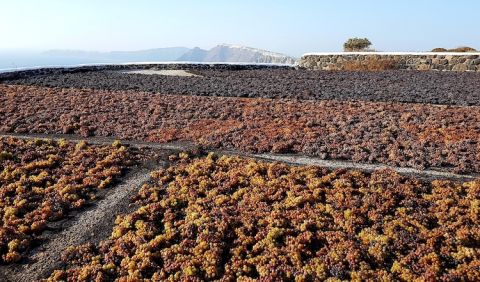
Santorini wines are almost entirely dry-farmed, meaning zero irrigation. Once the dry-farmed grapes have survived the extremely dry growing season, some are left on the vine to dry and ripen a little further. They are harvested, laid gently on the ground (on mats) and subjected to a final drying. The grapes shown above are at various stages of the drying process on top of Venetsanos’s cliffside winery (the white streak just visible in the background is the cliff-top town of Fira). The result of all this is the intensely flavourful, sweet Vinsanto wines of which Santorinians are so proud. Dry, dry, dry becomes sweet, sweet, sweet.
Food required
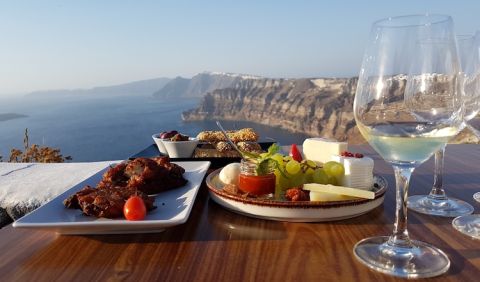
One thing that became clear through nine Assyrtiko-dominated winery visits over four days, is that Santorini Assyrtiko really is best with food. Abundant flavour, citric concentration, low pH, high acid and high alcohol are precisely what make this wine so special, but they also leave it begging for food accompaniment. The photo above is from level two of Venetsanos’s cliffside winery, where they entertain guests with excellent food and stunning views over the bay and towards Fira (just visible in the distance). Delicious Santorini tomato fritters were a revelation to me on this trip, as was the variety of cheeses produced in the Aegean; the plate shown above had six distinct varieties brought in from six nearby islands.
Wheels within a wheel
Circles emerged as a theme during my visit. Santorini itself consists of one small island in the middle of a large (if slightly broken) circle of land – all that remains of a massive volcano that erupted in the 17th century BC. Then there’s the kouloura – the circular, basket-like shape into which the island’s vines are trained, offering more protection from hot, dusty, drying winds than any vertical trellis could. And finally there’s the concentric circle on Gaia Wine’s logo, which may look like a kouloura but in fact represents an ammonite fossil – symbolising the link between sea and land which is so prominent on Santorini. The photo above shows Sigalas’s complete set of seven single-vineyard Assyrtikos and a rounded volcanic pebble, all within an old kouloura.
Santorini summed up
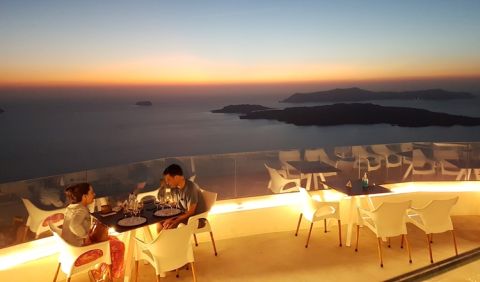
This final picture sums up the atmosphere on Santorini right now. The sunsets are as stunning as ever, the tourism just as polished, the smiles just as bright. But that empty table is a concern. The island’s economy depends heavily on both wine and tourism, and the locals depend on that economy. Some people I spoke to reported a drop in visitor revenue of 80% compared with last year. Despite this, many are adopting a positive attitude to the current situation, using the free time created by the lack of tourists to reflect on the island’s longer-term future, and finding ways to make it less entirely dependent on the tourist dollar. As wine-lovers, we can all do a little to help by spreading the word about Santorini’s amazing wines and buying a few bottles. Maybe revisit this article with a glass of Santorini in your hand.