
19 May 2016 Today's article in our Throwback Thursday series reveals how much research has been done into the aromas and flavours of Sauvignon Blanc in the last seven years. See today's article, NZ Sauvignon Blanc – more variety, less sugar, please, for the latest findings on this topic.
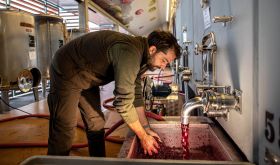
6 October 2008 A tasting in London of a selection of Saint Clair’s Pioneer Block Sauvignon Blanc and Pinot Noir with winemaker Matt Thomson (International Wine Challenge white winemaker of the year 2008, pictured above) highlighted several critical factors concerning vineyard site selection in Marlborough, New Zealand, and picking dates and styles of Sauvignon Blanc.
Matt was at pains to point out that he was expressing personal views but he speaks from more than 15 years’ experience in Marlborough and in other parts of the world, and the tasting itself confirmed much of what he proposed.
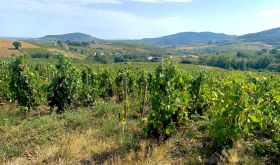
As one of the few wine-growing regions in the world that is both cool and dry, Marlborough has a huge advantage. Better still, the sites that are less good for the region’s hallmark Sauvignon Blanc (which does so well on the gravelly river terraces) tend to be better suited to Pinot Noir (which likes more clay), though there are still many vines planted on the wrong sites – which partly explains why the quality and reputation of Marlborough Pinot Noir tends to lag behind that of Central Otago. In the early days of Marlborough Sauvignon, some of the less good sites were masked by the lower yields (and therefore more concentrated flavours) of vines planted on their own roots. Once grafting on to rootstocks became the norm, due to the prevalence of phylloxera, and yields harder to control, it became clear that some plantings were not in the best spots and required very severe vigour control to achieve concentrated fruit flavours.
There is currently a debate in New Zealand over whether the Marlborough region should have some regulated definition but it seems that those on the ground (and especially those with vineyards near the possible outer boundaries!) would prefer not to have a European-style straitjacket, believing instead that the region has its own natural geographical boundaries: by the sea to the east, by the effective frost boundary to the west, and by hills to the north and south. What is needed, some say, is a greater awareness and promotion of the differences within the region – so that sommeliers and drinkers don’t get bored with a very one-dimensional style and so that people don’t assume all Marlborough Sauvignon is the same and therefore see no reason to choose any bottle other than what retailers refer to as COD (cheapest on display). Good in theory but I recall some recent consumer research that showed very little regional awareness among consumers, even of Marlborough as the home of Sauvignon within New Zealand.
Another slightly more technical debate, but with significant sensory implications, is to do with the groups of flavour compounds in the grapes known as methoxypyrazines and thiols. The former, found especially in Sauvignon Blanc and Cabernet Sauvignon, lead to more herbaceous flavours such as those described as ‘grassy’ or ‘green’ or, more specifically, ‘capsicum’, ‘green gooseberries’ and ‘blackcurrant leaf’, although there are many other wine descriptions associated with these compounds. In extreme form, they just make a wine taste tart and unripe. (As an aside: if you have never smelt a blackcurrant leaf, take the next available opportunity to do so; it is wonderfully distinctive and thereafter always recognisable.)
Thiols are harder to talk about in terms of their contribution to wine flavour because there are many variations on the theme and they are in that group of sulphur compounds that can be both positive and negative in wine, depending on their exact identity, concentration and also on the style of the wine. (See, for example, the Oxford Companion entry on mercaptans for more detail.) Thiols are intrinsic to the debate about ‘reductive characteristics’ in wine and winemaking (aromas and flavours that range from ‘mineral’ to ‘rotten eggs’ through ‘struck match’, ‘cabbage’ and ‘rubber’ and so on) and much has been written about sulphur-like aromas in wine but here I am referring to their occurrence in the grape at harvest.
I asked Matt about the development of methoxypyrazines and thiols in Sauvignon Blanc grapes during the harvest. He explained: 'The methoxypyrazine levels decrease and the thiol levels increase during the ripening process. I find that the thiol levels can accumulate when the grapes are given additional hang-time. This is only true though when the plant has access to plenty of potassium and nitrogen and isn’t stressed by drought or any kind of mineral deficiency. Methoxypyrazine levels decrease fast with fruit exposure, and for some reason thiol accumulation is dependent on having a good ratio of leaves in the fruit zone.' In relation to flavours: 'I associate the blackcurrant leaf with methoxypyrazine and blackcurrant with thiol. I suspect the blackcurrant leaf is really interplay between both. Crushed herbs I think to be methoxypyrazine derived.'
Having said all this, when Matt and his colleagues go down the vineyard rows to taste the grapes in order to decide when to pick, they don’t have an instrument to measure the relative contribution of these two flavour groups. 'We tend to look for overall intensity of flavour in each block. The intensity of [undesirable and thiol-derived] sweaty character seems to depend on the particular site and I’m still trying to understand the reasons for that. Usually the thiols include blackcurrant, passionfruit and grapefruit as well. Some sites, even at very ripe sugar levels, retain quite a bit of methoxypyrazine. I think as long as you have a spectrum of thiols the wine is a success. I think the stalky grassy flavours are pretty hard work, especially in the absence of a thiol lift. I do like the blackcurrant leaf note and the crushed herb aromas.'
While I am not a fan of the most pungent styles of Sauvignon Blanc, I don’t think intensity and pungency are the same thing. You can have the former without the extremes of the latter. With vines in better balance thanks to suitable sites and appropriate viticultural practices (balanced yields, correct exposure because Sauvignon suffers under too much direct sunlight, and optimum leaf to fruit ratio), intensity is more likely, and vineyard expression a great possibility, if harvesting dates are well chosen. That's why I found Matt's tasting of the individual block wines (on which I will report) so interesting.
Many growers and producers in New Zealand and around the world choose to pick their Sauvignon Blanc grapes at different times in order to get a range of flavours in the wine – typically picking some early to get higher levels of the greener methoxypyrazine flavours and some later to get the riper passionfruit and green fig flavours. Thomson disagrees with this approach, even though he accepts that the terrain of the gravel beds means that you do get ripeness variation even within rows and there is always some element of compromise. 'I think intentionally harvesting a block at a less than optimum date is a compromise in flavour intensity from the start. I think understanding each block is important too. There appear to be some blocks that are not capable of reaching high thiol levels and if you wait and try to get them you can lose any flavour. That’s said if you harvest too early you get just stalk and acid with no weight.'
There were clear differences among the Saint Clair Pioneer Block Sauvignon Blanc and Pinot Noir wines I tasted. Since the clones, rootstocks and winemaking were largely consistent for each variety, the distinctions were indeed due to the vineyard site. The tasting also included a short vertical tasting of the Wairau Reserve Sauvignon Blanc, sparking a debate about the ageability of this variety in an unoaked style (conclusion: a few years could add interest and complexity, but much longer and the flavours deteriorated). Look out for my tasting notes.