For a country with only slightly more vineyard than, say, Slovenia, New Zealand has had an extraordinary impact on the world of wine because of its pungent Sauvignon Blanc and now Pinot Noir.
It seems almost churlish therefore to complain about such a high achiever but there is surely one major underperforming asset in New Zealand’s vineyards: Chardonnay. Until five years ago when it was overtaken by Sauvignon Blanc, Chardonnay was the single most planted grape variety in the country. It has only just been knocked into third place by New Zealand growers’ current enthusiasm for planting Pinot Noir, now that New Zealand has so definitively proved itself a source of satisfyingly fruity alternatives to red burgundy.
There is every sign that the next big thing in New Zealand grapes will be Pinot Gris, the pale-skinned variant on Pinot Noir that produces perfumed, full-bodied white wines, and that Chardonnay will continue to be overlooked in New Zealand, despite its ubiquity. In terms of attention in the media, general wine discussion and technical workshops, the C-word hardly seems to feature.
This seems a shame since New Zealand’s big geographical advantage, being far from the equator, means that the country can produce wines with refreshing, natural acidity – an attribute that many a Chardonnay producer in warmer climes would kill for. Instead, winemakers in most of Australia and California, for example, have routinely to add acidity and many of them have been scouting out newer, cooler regions to plant and develop. New Zealand’s latitudes already seem ideally suited to the variety.
The typical New Zealand Chardonnay does indeed show prominent acidity but too rarely is this accompanied by really interesting flavour. Many examples seem a bit like Sauvignon Blancs without the Sauvignon flavour. Yes, they are racy, pure and refreshing but that’s about it. All too few have any really intriguing character, or convincing potential to develop interest after a few years in bottle. And if they do taste of something, as often as not it is of the winemaking techniques they have been subjected to, especially malolactic fermentation and lees stirring, rather than of the grapes themselves or the vineyard where they were grown.
There are some glorious exceptions of course. In the North Island Master of Wine Michael Brajkovich at Kumeu River on the outskirts of Auckland has long managed to produce reliably rewarding Chardonnays, perhaps partly thanks to his early travels around Europe. Kumeu River, Maté’s Vineyard made from a special vineyard planted by his late father is a gold standard among New Zealand Chardonnays and has a proven track record of ageing gracefully. Even the regular 2004 Kumeu River Chardonnay bottling is nowhere near its peak.
Much of New Zealand’s Chardonnay is planted on the east coast of the North Island. The Millton Vineyard in Gisborne have blazed a trail with their biodynamic Chardonnay and some Hawkes Bay examples can offer very much more subtlety than the norm. Morton Estate has earned a fine reputation within New Zealand for its Morton Estate, Coniglio bottling of Chardonnay but it has seen the light of day only in the 2000 and 2002 vintages and is rarely exported. Te Mata Elston has in the past shown some Burgundian character but today there is more obvious depth of flavour to be found in Les Beaux Cailloux Chardonnay from the relative newcomer Craggy Range.
In the south of the North Island in Martinborough, wine producers’ focus, as in so many other New Zealand wine regions, is on Pinot Noir but Dr Neil McCallum of Dry River takes his Chardonnay more seriously than most.
In the South Island the Finns of Neudorf in Nelson have consistently made some of the country’s most subtle, long-lived Chardonnays alongside their admirable Pinots, particularly their outstanding Moutere bottling. Chardonnays grown by Fromm in Marlborough, particularly that from the Clayvin Vineyard, also show much more depth of flavour than their peers. Still in Marlborough, Dog Point is a much newer label with no shortage of ambition in this respect.
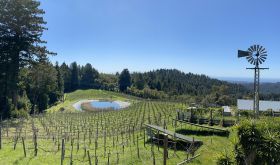
On my last visit to New Zealand the most exciting Chardonnays I tasted however were in Waipara, the rapidly developing wine region on grazing land around Christchurch well south of Marlborough. Mountford, Pegasus Bay and Danny Schuster can field some bottlings with potential but the single most promising producer was Bell Hill, sited on a tiny reclaimed limestone quarry planted with great difficulty by Marcel Giesen of the eponymous family firm and Sherwyn Veldhuizen. Using Burgundy as their model they have one of New Zealand’s most densely planted, steepest vineyards and to realize their goal of recreating Burgundy in the Weka Pass district of the South Island have been prepared to live in the most basic conditions without modern comforts in order to develop this unusual site, blessed with the limestone so crucial to fine burgundy.
One of the major brakes on development at Bell Hill has been their determination to trial different clones of Chardonnay and certainly the answer to the apparent conundrum of New Zealand’s less-than-exciting Chardonnay performance lies in the clones that have so far predominated.
Historically the most common clones of Chardonnay planted in New Zealand have been the Mendoza clone and clone 15, both of which are easy to grow but tend to produce large quantities of rather obvious, simple, early-maturing fruit, often characterised by slight bitterness from the grape skins. The most obvious way of imbuing wines made from these clones with some interest has been to concentrate on flavour-adding winemaking techniques such as lees stirring.
The good news however is that those (relatively few) growers who are putting new Chardonnay plants into the ground, are choosing more interesting Burgundian, so-called Dijon clones – a development that is mirrored elsewhere in the world, not least in Oregon, another source of fine Pinot Noir whose Chardonnays have conspicuously lagged behind in reputation.
According to New Zealand Wine’s impressively detailed statistics at www.nzwine.com, Mendoza and Clone 15 now comprise only about 60 per cent of all Chardonnay planted with the proportion of Dijon clones steadily growing every year, so we can presumably expect the country’s Chardonnays to become more interesting in the years to come. Not that I am suggesting the only decent Chardonnay is a carbon copy of white burgundy – merely wishing to encourage New Zealand Chardonnay growers to be just a bit more ambitious in developing their country’s own ways with this potentially versatile grape.
For the moment, if there is a shortage of really serious New Zealand Chardonnay, there are many well-made, relatively simple wines that can offer rewarding, easy drinking – particularly from Marlborough, the Sauvignon Blanc heartland in the north of the South Island. Cloudy Bay, whose Sauvignon Blanc is so famous, makes a Chardonnay that has considerably more finesse than many. Michelle Richardson is trying admirably hard with Marlborough Chardonnay for her new label. St Clair’s Reserve Chardonnays have consistently done well in competitions, and Muddy Water and Gravitas Chardonnays have more depth than most.
All in all, Chardonnay may not be New Zealand’s strongest suit so far but is surely an exciting prospect.