In Australia the (very early) 2025 vintage is already underway, while in the northern hemisphere this year’s crop of wine grapes won’t ripen until at least July. This contrast between the hemispheres has proved extremely convenient for winemakers anxious to cram as much experience as possible into their lives and bios, for jobbing cellar rats, and for next-generation European wine producers keen to expand their horizons.
It has also encouraged some established wine producers to set up an enterprise in the other hemisphere. Torres in Spain was the first to branch out in this way; the family’s Chilean operation dates from 1979. Since then there have been many others – mainly with northern-hemisphere roots, as in Bourgeois of Sancerre’s New Zealand adventure, Chapoutier of the Rhône’s in Australia and Paul Hobbs of California’s long-standing projects in Argentina. It can work the other way round, too. Australia’s giant Treasury Wine Estates now has considerable holdings in California, and is dabbling in joint ventures in Europe. (The latest, just released on to a bemused market, Grange La Chapelle 2021, an Australian-aged blend of Hermitage La Chapelle and South Australian Shiraz priced at a cool €2,600 a bottle, about 10 times more than Hermitage La Chapelle 2021 itself.)
The operation devised by Julien Schaal, a 43-year-old who laughs a lot, is rather different from any of these. Julien Schaal Wines is definitively bi-hemispherical but he owns not a single vine. And it involves importing a distinctly un-European wine business model into his native France.
He was born just outside Strasbourg, not into a wine family, but early on set his sights on becoming a sommelier. Just two months working on the French Riviera was enough to shatter his dreams. He’d been hoping for the satisfaction of recommending obscure wines to appreciative customers but instead was simply required to supply as many big names as possible to a largely Russian clientele.
This propelled him to wine school in Beaune learning how to sell and then make wine (he strikes me as unusually good at both). In Burgundy he was the only student without a family wine domaine to inherit and an obvious place to gain practical experience. Fortunately his teacher recommended him as an intern to a friend at Domaine du Vieux Télégraphe in Châteauneuf-du-Pape in the southern Rhône. Less fortunately this was in 2002 when the vintage was so bad that no Vieux Télégraphe was made and the owners, the Brunier family, were forced to create a second wine, Télégramme.
The following January, through a friendly cooper in Burgundy, he was introduced to the South African producer Bouchard Finlayson and intended to go there for just three months to help with the harvest. But once there, he fell in love with the South African wine scene. ‘There’s something very easy about the relationships between wine people there’, he told me when I visited him in Alsace last November. He immediately made lots of friends there – Craig Harris, Klein Constantia’s viticulturist, is godfather to his son, for instance.
Back in Europe for the northern-hemisphere 2003 harvest, Schaal was sent to Lebanon for six months by the Bruniers, who had just invested in the wine operation Massaya there. ‘It was the trip of my life', he says now. ‘A hard one but something you need to do in your twenties. We were buying grapes from the Bekaa Valley close to the Syrian border and used to go to Damascus for fun on a Saturday night.’
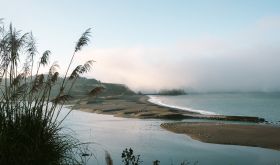
But after this adventure, South Africa beckoned once more and he returned there to a proper job rather than an internship, at Bouchard Finlayson in the Hemel-en-Aarde Valley inland from Hermanus. Gordon Newton Johnson from the winery overlooking Bouchard Finlayson became a particular friend and, over a meal at the local steakhouse, made the 23-year-old Schaal an irresistible offer: a job plus space in the Newton Johnson winery to make his own wine. In 2005 Schaal spent his entire savings of €5,000 on his first intake of grapes. ‘It was a fabulous opportunity’, he says now. ’I still think I’ve been very lucky’.
He must have some skill, too, for Julien Schaal’s Mountain Vineyards Pinot Noir 2023 from Walker Bay has just won the South African wine equivalent of an Olympic gold, Pinot Noir of the Year in this year’s Platter’s Guide, the South African wine bible.
Since 2010, with a short break at a friend’s winery that he now describes as ‘not Germanic enough for me’, he’s been making the increasingly admired Julien Schaal wines at the hugely respected Paul Clüver winery in nearby Elgin. According to Paul Clüver Junior, Schaal has ‘brought an exciting dimension to winemaking in South Africa. One of the things I’ve always loved about Julien is his calm, solution-driven approach to challenges, best reflected in his signature phrase: “It is not a problem”. It’s this mindset that makes his wines, and his presence in the industry, truly exceptional.’
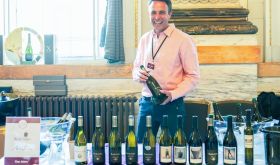
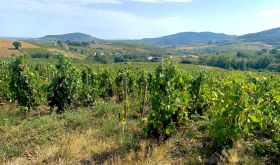
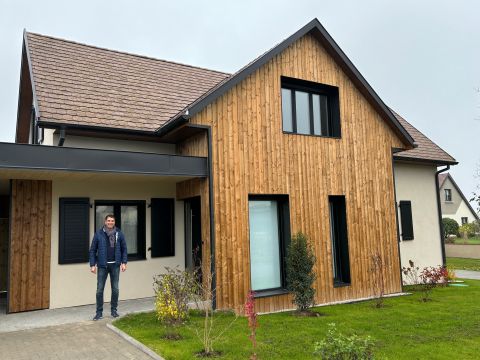
He met his oenologist wife Sophie, pictured above with him, when she was a French intern chez Clüver and since 2021 she has made her own Sophie Schaal South African wines. The couple live, however, with their young daughter, not in South Africa but in the tiny Alsace village of Hunawihr, in a beautifully designed modern house at the foot of the Clos Ste-Hune vineyard (seen through the window in the second image below), whose bone-dry Riesling has been made world-famous by the local Trimbach wine-producing family, whose origins date back to 1626.
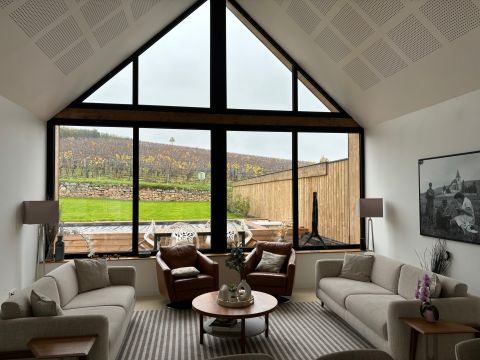
Schaal is keenly aware of the many differences between the French and the South African wine cultures. ‘In France, the fact that you’ve made wine for 100 years is an advantage but South African consumers are always looking for something new.’
An undaunted novice, he decided to try something different in his homeland. ‘I saw that the South African system of buying in grapes [rather than owning vines] works’, explained Schaal, ‘and thought that I’d love to do the same thing in France even though the entry ticket is much more expensive’.
Grape prices in Alsace are two or three times higher than those in South Africa. There are major meteorological differences, too. ‘When the South African guys complain about difficult harvests, I say “you should come to Europe to experience a difficult vintage”.’
While Schaal’s South African wines are made from the Burgundy grapes Chardonnay and Pinot Noir, in Alsace he specialises in dry Rieslings made from grapes bought from a range of top-notch grand-cru vineyards. He initially worked with a friendly neighbour, Olivier Biecher, but from 2013 has gone his own way, determined to concentrate on top quality. His Alsace wines, about 25,000 bottles a year, all labelled by soil type, are now so highly regarded that they have to be allocated.
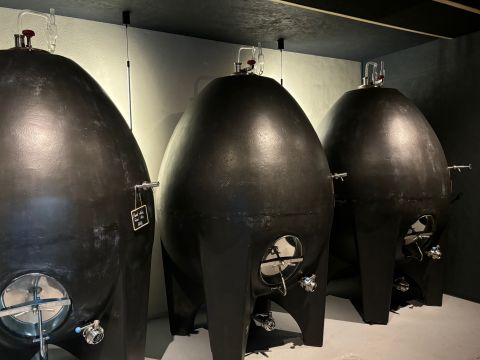
The Schaals have just built themselves an immaculate little winery next to their house, complete with fashionable concrete eggs shipped from South Africa – so much less expensively than had they bought them in Europe, as is everything else. According to Schaal, ‘South African grapes are extremely inexpensive and I probably pay way too much for my grapes because the growers know I’m French. I worry that grape prices are too low in South Africa and that people will pull out vineyards – apples are more profitable. But at least Walker Bay grapes are 10 times more expensive than Swartland’s so that helps to keep vines in the ground there.’
Outside Europe, and especially in California, the model of creating a ‘boutique’ wine label by buying in grapes may be reasonably common, but it is much less so in France (although it has been growing recently in Burgundy because of today’s stratospheric land prices there). During my visit Schaal could think of only one other Alsace wine producer, Jintaro Yura, in a similar grape-buying position to himself. But he subsequently sent this list of ‘a few true gems that showcase an exciting, fresh approach to Alsace wine. Despite the current challenges, there are huge opportunities for Alsace.
‘Countries don’t necessarily want an Alsace wine to begin with. But I convince them. I even export to Spain, Portugal and Italy. You have to work at it and you need to like the process of selling and, most importantly, travelling.’
The Schaal family has just arrived at their rented seaside apartment in Somerset West for the 2025 harvest, shuttling between wineries, with his proud parents in grandparental role.
Julien Schaal recommends
- Yura: Jintaro Yura, a Japanese winemaker who started his own winery in Alsace
- Achillée: Pierre and Jean Dietrich, who left a co-operative to start their own successful winery
- Terres d’Étoiles: Christophe Mittnacht, who recently set up his own winery after parting ways with his cousin
- La Grange de l’Oncle Charles: a new producer building from scratch
- Domaine Exeterra: Florence Kachelhoffer, a young vigneronne who started her own winery after working for Marcel Deiss
See 30 enthusiastic tasting notes on Julien Schaal's Alsace Grand Cru Rieslings, which are available in the US. The 2022 and 2023 vintages of Volcanique from the Rangen Grand Cru are also available in the UK.