Dom Pérignon or Krug? The ultimate first-world problem. But the rivalry between these two famous prestige champagnes from LVMH, the luxury brand owner par excellence, is fun to observe, even if you’d never dream of spending £150 on a bottle of champagne. Each has a new winemaker charged with maintaining their marked differences.
Dom Pérignon has always been an in-house brand, the top-of-the-line creation of Moët & Chandon, named after the monk who is supposed to have ‘invented’ champagne, and now based in his abbey, the Abbaye d’Hautvillers pictured above, as an entity quite separate from the dominant champagne house.
Dom Pérignon is a champagne that is all about image rather than detail. Perish the thought that any LVMH employee would divulge quite how many millions of bottles are made of it. The marvel is how delicious it is despite the volume – downright gulpable the minute each vintage-dated cuvée is launched, and yet it lasts so well that late-release versions (known as P2 and P3) are now available too. You really can smell its distinctive aroma of lemon-mousse concentrate from across a room.
Just don’t try to push the winemaking team for much information. As a fellow champagne-loving Master of Wine observed to me recently in an email conversation about the two wines, ‘I suspect that you, like me, always enjoyed hearing Richard G dodge winemaking questions!’
Richard G is Richard Geoffroy, who retired in 2018 as the man in charge of Dom P, which involved not just overseeing the crucial blending of the base still wines but an exhausting schedule of travelling the world to present the eventual sparkling results.

His place has been taken by Vincent Chaperon, 44 and pictured moodily above, who worked with him on Dom Pérignon for 13 years and may be one of the few people in the world to be relieved that the pandemic has brought travel to a halt. He spoke to me via Zoom from an empty chamber in the Abbaye d’Hautvillers about the brand new vintage, 2010, of Dom Pérignon. Stepping into Geoffroy’s shoes means being responsible for wine production throughout the vast Moët & Chandon champagne empire, a massively demanding new role even without the travelling. ‘Coronavirus arrived at just the right time for me', he said, clearly relieved to have time to take stock.
But what he really wanted to talk about was 2010 in Champagne. It’s not one of the region’s most celebrated vintages, with rampant rot in many vineyards colouring the general perception of it. But Chaperon is convinced ‘it’s one of the forgotten vintages of Champagne'. He was in a much lowlier position in 2010 and was given the job of overseeing picking strategy, being constantly in the vineyard checking the vines. He remembers in particular the weekend of 4 and 5 September dodging in out of vineyards (so often that he never bothered to lock his car; his laptop was stolen).
At that stage the rot that would particularly badly affect Pinot Noir vines was not too widespread but he intuited, through continuous observation and partly from earlier reports from the south of France, that the risk was much higher than the general perception in the Champagne region at that time and instructed the vineyard team to inspect the vines daily, involving much more vigilance. As a result they were able to map the incidence of rot in detail and to decide exactly which plots were not worth picking, rejecting about 15% of the potential crop. ‘Lots of people missed the 2010 vintage', he claims, ‘but picking is like a sport. You have to be in the zone.’
What led to the rot, according to a detailed study by the CIVC, the Champagne producers’ generic body, at the end of 2010, was stress during the particularly dry early summer. It didn’t affect vines on water-retaining chalk nearly as much as the rest, which tended to result in thin, fragile grape skins, prime targets for botrytis. Heavy, though inconsistent, rainfall on 15 August meant there was huge variation in the health of grapes, with those in top sites on chalk the best positioned to withstand rot.
He claims that in 2010 the Chardonnay was ‘the best for 40 years'. The potential alcohols of the Pinots were about 10.6% with some musts up to 11.2%, Chardonnays about 0.2% more, together with acidities that were the highest of the decade apart from 2008.
I have no way of knowing how accurate his account is, but the 2010 is certainly a success, and I am convinced he is as perfect and on-message an ambassador for Dom Pérignon as Geoffroy was. Chapeau Chaperon!
(Chaperon, incidentally, nurses the same ambition as Geoffroy had: to make 10 straight vintages of Dom P in a row. I asked him sceptically whether he would be telling me in a year’s time just how much better the 2011 was than everyone thought. He grimaced and shook his head. ‘In 2011 the problem was blocked maturity in the Chardonnay. So for the first time we had to send our pickers back to northern France and then bring them back 10 days later. But it wasn’t really worth it. The grapes just concentrated a little bit but didn’t really ripen.’)
Krug, which was absorbed into the LVMH stable only in 1999, is quite a different kettle of fish. A much more intellectual wine that is aimed at geeky connoisseurs, it has always been represented by an actual Krug, sixth generation Olivier currently, who darts around the world spreading the gospel of Krugisme and sharing winemaking detail to an eye-watering extent. Presenting the latest version of their principal wine, the 168th edition of Grande Cuvée, from his office on Zoom, Olivier Krug lamented, ‘this is the first time in 30 years that I haven’t had a plane ticket on my desk. It’s a bit depressing.’
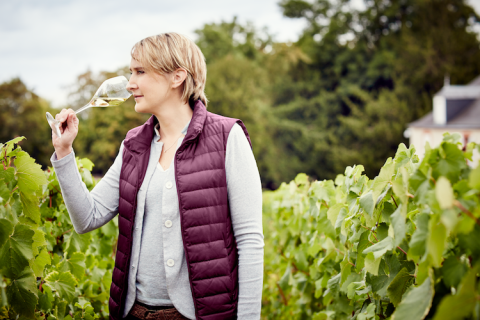
Krug’s new chef de cave, Julie Cavil, 46 and pictured above, presented even more technical background to the complex blend of the 168th edition, and recounted how she was recruited to this famous champagne house. (She had originally worked in a Paris ad agency but got the wine bug.) ‘It was 2006 and it was my seventh interview with Olivier’s uncle Rémi Krug [his tireless predecessor as the family’s chief salesman]. Finally Rémi came into the room with a bottle of champagne, so I thought now at last we were going to celebrate my appointment. But no. What he said was, “OK, Julie. Make me dream about this champagne.”’
Like Chaperon, she started off in the vineyards. Her first assignment was to oversee the harvest in the Krug’s walled vineyard Clos de Mesnil, whose Chardonnay is bottled separately and sells for about £1,000 a bottle.
But, although Krug sell a vintage-dated Brut, one always gets the impression chez Krug that what they are really interested in is their non-vintage Grande Cuvée, which is so much more complicated to make, involving multiple tastings of hundreds of possible ingredients. From 2006 Cavil worked closely with Krug’s chef de cave Eric Lebel: ‘he was on the stage and I was backstage’. She admits to being nervous when she was first allowed to take part in the all-important tasting committee. But she must have shown some ability since from the beginning of this year she has taken over from Eric and has been put in charge of creating Krug’s champagnes. Tasting generally takes five months and she had just got down to deciding on the final blend for the 175th edition of Grande Cuvée when the house was locked down.
She did have 4,000 tasting notes on her specially designed Krug app (when this was excitedly described to me during a visit in 2016 I sensed they were none too keen to share it with the Dom Pérignon team) and managed to complete the task in double quick time, helped by five others, socially distanced in three different rooms. ‘I’ll have lots of tales to tell when the 175th is released in eight or ten years’ time', she says.
I once drove past Château de Saran, Moët’s hospitality centre, with Olivier Krug. ‘I’ve never been there', this employee of Moët’s holding company told me with some pride.
LVMH’s champagne houses
- Moët & Chandon: The Impérial Brut non-vintage blend has improved enormously in recent years.
- Dom Pérignon: Incredible consistency of quality considering the quantity. Reductive style that yields wines that are very easy to like on release.
- Krug: Complex wines with a strong influence of oak and oxygen and real insider appeal. They celebrate the variation between different releases.
- Veuve Clicquot: Another recent change of winemaker and wines I find quite chunky. Very possessive about their particular shade of orange.
- Ruinart: The Blanc de Blancs in a clear flask is particularly popular.
- Mercier: Moët’s value brand.