See also tasting notes on more than 150 Slovenian wines, some outstanding.
Slovenia’s is possibly the most unusual wine culture in the world, certainly in Europe. During a brief visit there last November I tasted some of the most distinctively delicious wines to have come my way for several years, and some of the worst.
Let’s get the bad ones out of the way first. Slovenia still seems to have too many wine producers who think that high acidity, severe tannins and a lack of fruit are positive qualities in red wines – particularly those made from the Bordeaux grape varieties Cabernet and Merlot, although it is also easy to display these qualities in the western Slovenian grape variety variously called Teran and Refošk, a relative of Italy’s Refosco. The second, softening, so-called malolactic fermentation that is now practically de rigueur for red wines throughout the rest of the world still seems to be a novelty in certain Slovenian quarters.
That said, producers such as Santomas in Slovenian Istria (closely allied to the Languedoc’s admirable Château de la Négly) seem to have got the hang of it, even if their glamorous reds have such réclame in their native land that the prices look unsettlingly high outside it.
Slovenia can also produce some worthy examples of the red burgundy grape Pinot Noir such as the Movia Modri Pinot 2002 Brda that was so outstanding at a Pinotfest in Bruges last year (more luscious than the current 2003). In Slovenia I was also impressed by the Modri Pinot 2004 made by Tilia, one of the most cosmopolitan of Slovenian producers. I was even offered a Tilia white at Spago, the haunt of Hollywood’s big hitters, last November. Tilia is based in Vipava inland from Brda, Slovenia’s westernmost wine area right on the border with Friuli. While Brda is influenced by the Adriatic, which can often be seen in the distance, Vipava is significantly cooler. Matjaž Lemut of Tilia, who has worked in both Switzerland and the Napa Valley, explained to me “our grandfathers and fathers tried to bring Bordeaux to the Vipava valley but now their sons are bringing Burgundy”.
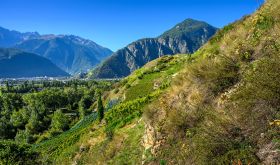
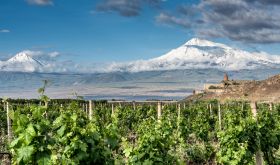
But it is the white wines that are by far Slovenia’s most original gift to the world of wine. Of the wine regions of this small country in the far north of the old Yugoslavia the most fashionable is Primorska on or near the west coast. It encompasses subregions Vipava, Istra (Slovenian Istria) and Brda, an extension of Friuli’s Collio that also means ‘hill’, as well it might to judge from the precipitous landscape. “This is heroic viticulture,” the manager of one of the most successful Brda wine co-operatives observed as we wound round a series of mountainside vineyards. “I don’t understand how the Italians across the border on much flatter land get all the EU subsidies. Instead of trying to help us, our Slovenian bureaucrats spend most of their time counting exactly what volume of wine we have in stock – and they don’t even understand that it expands in summer.”
Most of the wineries I visited were on the dramatic slopes of Brda, whose oaks were used to build Venice and whose restaurants today are liberally plundered by Italian visitors at the weekends. The region most like it is Burgundy, in that most producers own their own small plots of vines (often partly on what is now Italian soil) and tend them themselves as well as making, nay hand-crafting, the wine. As Slovenian wine writer Robert Gorjak, who was my guide, put it, “they are artisans rather than businessmen.”
But what differentiates them from Burgundians are the vine varieties they grow – Rebula (Italy’s Ribolla Gialla) is most common although Sivi Pinot (Pinot Grigio) has been catching up – and their unusual creativity in winemaking methods. I have never seen such a variety of different sizes and provenances of casks for both fermenting and ageing wine. Acacia and mulberry woods were traditionally used here (as acacia seems to be, increasingly, in Austria) and the more artisanal producers seem to play with a cocktail of different oaks and other woods, fashioned into vessels of widely varying capacities – not to mention some exceptional techniques.
Aleš Kristančič of Movia in Brda takes this to the extreme of using tiny cube-like tanks in order to play with temperatures and ambient yeasts and specially made Austrian barrels with metal valves on the top to allow some white wines to be made, like Beaujolais, from whole berries. Some wines are kept on the lees for six years. No sulphur is added. This is extreme winemaking. “It’s full moon so the wines are very calm,” he told me while leading me through positively operatic cellars beneath his house, which serves as an informal clubhouse for the region’s innovative young winemakers.
In general the white wines that predominate here are very different from their aromatic, sleek if predictable varietal counterparts across the border in Friuli. Blends are common. Malolactic fermentation is pretty much de rigueur, making the wines rather richer and fatter, more burgundian in that they build in the mouth, and bottle, but the real point of difference for some producers is their unusual fondness for keeping their baby wines in contact with the grape skins.
Two extreme Friuli producers with strong Slovenian connections, Gravner and Radikon, could be said to have encouraged this tendency, which, if done well, results in thoroughly thrilling, intense, very long lived wines but can add a downright uncomfortable sour apple-skin note to whites if done badly. This unusual technique sorts out the skilful vine-growers from the rest as it can only work if the grapes are perfectly healthy.
Slovenia’s inland wine regions Posavje and, much more important, Podravje are also better known for whites than reds. Indeed many British readers over 50 will have drunk some Podravje white in their time, shipped in bulk to the London docks stuffed full of sugar and sulphur and bottled to order as Lutomer Riesling, subsequently renamed, according to geopolitical correctness, Ljutomer Laški Rizling. Laški Rizling (known in Austria as Welschriesling) with Šipon (known in Hungary as Furmint) and Chardonnay are the most common grape varieties of Podravje.
Although I have not visited Podravje for 30 years, I had the chance last November to taste a wide range of the better wines made there and was particularly impressed by the sweet whites, mainly made from either Laški Rizling or Renski Rizling (the Riesling of Germany). Some of the best wines I tasted are listed below. They are a rum lot but well worth ageing and drinking with food.
Some Slovenian finds
SUBSTANTIAL DRY WHITES
Klinec, Verduc Riserva 2003 Brda, Bela quela 2003 Brda and Chardonnay 1997 Brda
Movia, Veliko Belo 2003 Brda, Rebula 2005 Brda and Lunar 2007 Brda
Ščurek, Stara Brajda Belo 2006 Brda
Simčič, Sivi Pinot 2006 Brda, Chardonnay Selekcija 2003 Brda and Chardonnay 1999 Brda
Batič, Zarja 2006 Vipava
Mansus, Vizija 2003 Vipava
Sutor, Sauvignon 2006 Vipava, Chardonnay 2002 Vipava and Primus Sauvignon 2000
REDS
Rojac, Stari d’Or Rdeče 2004 Slovenska Istra
Santomas, Grand Cuvee Certeze 2004 Slovenska Istra
Ščurek, Stara Brajda rdeče 2005 Brda
Edi Simčič, Duet Lex 2003 Brda, Kolos 2003 Brda and Edijev Izbor 2002 Brda
Tilia, Modri Pinot 2004 Vipava
SWEET WHITES
Ptujska Klet, Renski Rizling 2006, Štajerska Slovenija
Crnko, Laški Rizling Icewine 2005, Maribor
Šturm, Chardonnay Suhi Jagodni Izbor 2005, Bela Krajina
Zurst Prepovedan Saden Traminer 2005 Bela Krajina [confirmation of this name to come]
PRA-VinO, Laški Rizling Ice wine2005, Ljutomer Ormož and Šipon Ice wine 2004, Ljutomer Ormož
See full tasting notes, scores and suggested drinking dates for more than 150 Slovenian wines, some outstanding.