
It has just been announced that the US Alcohol and Tobacco Tax and Trade Bureau, better known as the TTB, has published a rule establishing California’s newest American Viticultural Area, the West Sonoma Coast AVA. Home to some of the coolest vineyard sites in California, and the source of many of the state’s finest Pinot Noirs, the West Sonoma Coast AVA has been a grassroots effort many years in the making.
‘This is extremely exciting and rewarding’, says Chantal Forthun, a board member of the West Sonoma Coast Vintners association, and winemaker at Flowers Vineyards and Winery. ‘I’m ready for the world to recognise the West Sonoma Coast. A lot of people who really care about where they’ve been growing and making wine came together and worked really hard to get here.’
In truth, those who pay attention to California Pinot Noir have long recognised the unique qualities of Sonoma’s coastal terroirs, despite the fact that the region’s existing AVAs did not.
Transcending politics
‘AVAs are supposed to bring clarity and understanding to consumers, and to help consumers make more informed decisions’, says Carroll Kemp, one of the founders of West Sonoma Coast Vintners, and co-proprietor of Alma Fria Wines.
For Kemp and countless others, the Sonoma Coast AVA, established in 1987, has never made any sense at all. Despite having ‘coast’ in its name, the bulk of the nearly 500,000-acre (202,000-ha) AVA sits far inland, well outside any real maritime influence and with a staggering variation in mesoclimates and geology.
‘The Sonoma Coast AVA is so over-broad, by any standard of viticulture and winemaking it obfuscates rather than clarifies’, says Kemp.
As with many American wine regions, the AVA’s boundaries were a function of politics as much as anything else. The primary proponent of the Sonoma Coast AVA’s creation was Brice Cutrer Jones, the man behind the immensely popular Sonoma-Cutrer brand, whose efforts to include his 1,000 acres (405 ha) of vineyards within the AVA were regretfully and entirely successful.
‘It’s so upsetting to me that we can never overcome the fact that when someone reads “Sonoma Coast” on a label they will feel the wine was grown near the ocean’, says Forthun, expressing the longstanding frustration that many pioneers of truly coastal viticulture have felt while watching wines grown only a couple of miles from Napa County get labelled as coastal.
‘We started the West Sonoma Coast Vintners association because we realised that if we didn’t take control of our own destiny, it was going to be written about, named and defined by others’, says Kemp.
Coastal consensus
The origins of the West Sonoma Coast AVA petition began with a failed attempt to create an entirely different AVA around the town of Occidental, where a number of top Pinot Noir vineyards are situated. Not long after Kemp and a few other producers submitted that petition in 2010, the TTB changed its rules for AVA boundaries (for the better, most people agree). Moving forward, AVAs can be nested entirely within other AVAs but their boundary lines cannot cross. The absence of this rule has historically resulted in some pretty messy overlaps in northern California, and around 2011 the TTB apparently decided enough was enough. So the proposed Occidental AVA, which had significant overlaps with the existing Russian River Valley AVA, was doomed.
‘The TTB told us we could either rework our boundaries or petition to change the boundaries of the Russian River Valley’, says Kemp. The group decided neither approach was likely to succeed. By that time, their initial band of producers had grown into the West Sonoma Coast Vintners association, and the organisation reoriented around creating the West Sonoma Coast petition.
Other than one cranky wine producer who fought the proposal almost every step of the way, the effort to define the AVA proceeded, remarkably, without incident or drama, even when the group faced a major hiccup in the form of a competing (and overlapping) petition to establish the Petaluma Gap AVA.
‘Like rational, wonderful friends, we sat down and talked with them’, says Kemp. ‘They wanted their AVA to go all the way to the coast since their petition was based on coastal wind and fog coming through the gap.’ So in a single meeting, the two groups decided that the southern border of the Western Sonoma Coast would be the northern coastal border of the proposed Petaluma Gap AVA, and everyone was happy.
‘It’s a sign of people working together co-operatively in the age of dissent with remarkably little dissent’, says Kemp. ‘It’s pretty amazing. One of the qualities of West Sonoma Coast is that it’s not driven by corporate interests; it’s driven by people.’
A slice of coastal heaven
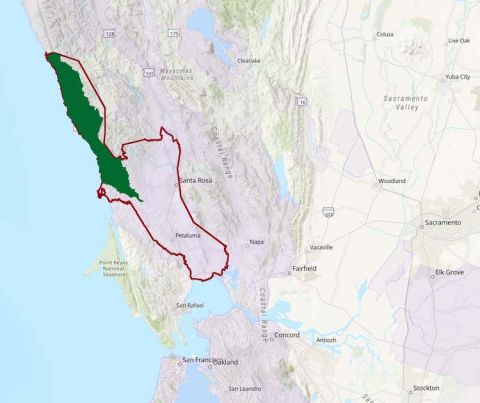
The new West Sonoma Coast AVA, shown in green above within the red outline of the existing Sonoma Coast AVA, extends south from the Mendocino County border (encompassing the recently established Fort Ross-Seaview AVA) to the northern banks of Salmon Creek, which empties into the Pacific Ocean just north of the town of Bodega Bay. From there the border runs south and east to contain a wedge of land not included in either the Petaluma Gap AVA or the existing Russian River Valley AVA.
The eastern edge of the AVA (that isn’t dictated by other existing AVA borders) was set based on a study of how far east the true marine influence of the Pacific extends. The group selected a line of transition between the coastal conifer zone that is populated with redwood forests and rhododendrons, and the more oak-based savannahs that correlate with warmer temperatures and less coastal fog influence.
Unfortunately, the extent of the existing Russian River Valley AVA and the TTB’s new approach to borders means that several areas surrounding the towns of Freestone and Occidental cannot be included in the AVA, despite very clear climatic and stylistic evidence that they belong. But that’s a small disappointment in the face of the recognition this region has long deserved.
A brilliant future awaits
No one knows exactly how many acres of vineyards or how many wineries make their home in the new West Sonoma Coast AVA. The petition submitted to the TTB indicates, ‘The proposed AVA covers approximately 141,846 acres [57,403 ha] and includes at least 1,028 acres [416 ha] of planted and productive vineyards across at least 47 vineyards’, but there are almost certainly more.
The West Sonoma Coast Vintners association currently has 27 members among whose ranks the better-known names include Hirsch, Flowers, Peay, Red Car and Freeman, all of whose wineries sit within the newly created AVA. Many others have vineyards in the region but wineries that sit just outside its borders. Still more wineries, most of which are small and independent, own or lease a vineyard in the region.
Land is expensive, hard to find, and not easy to plant in this rugged coastal landscape that is still heavily populated with multi-generational farms and ranches. While the creation of the AVA should bring well-deserved recognition, the geography thankfully precludes large-scale and swift expansion of vineyards and wineries. For a flavour of this remote region, see Jasmine Hirsch takes the lead.
On a decidedly personal note, I was born within the borders of this new AVA, a fact you may take as a grain of salt when reading my unabashed adoration for the region and its wines. In my opinion some of California’s most profound Pinot Noirs, Chardonnays and Syrahs are being made on the chilly ridgetops facing the Pacific Ocean. And now these exceptional, acid-driven, characterful wines have a wine region with a name they are finally proud to bear.