There have been some significant new developments in the saga of the Australian ‘Albariño’ that isn’t.
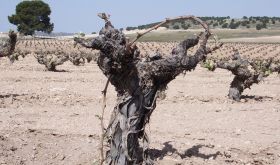
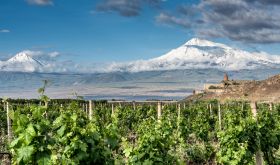
Firstly, New Zealand’s leading vine nursery has now done a DNA analysis on its Albariño material and has announced with some relief that its cuttings really are the Galician white wine grape and not, as in the case of the vines distributed as Albariño in Australia, the Savagnin of Jura (pictured here by specialist wine photographer Mick Rock of Cephas). But secondly, as highlighted in members’ forum after some excellent sleuthing by Spanish wine writer Victor de la Serna, the mix-up started in Spain, not Australia and has considerable potential global consequences.
Australian viticultural consultant Richard Smart has forwarded the following communications from Spain, lest there be any doubt. Here’s what Felix Cabello Sáenz de Santa María, head of the largest vine variety collection in Spain just outside Madrid, wrote recently about the Albariño/Savagnin confusion:
‘This mistake has the origin in our collection, since many years ago Savagnin Blanc and Albariño were confused in some Spanish areas and a wrong sample collected in Orense in 1951 was taken to our collection with the name of Albariño but it was Savagnin. The two true samples known as Albariño were taken to our collection in 1975 from the Fefiñanes winery in Cambados (Pontevedra), and from Misión Bilógica de Galicia (CSIC) in 1977. So all samples sent from our collection between 1955 and 1984 were Savagnin Blanc. This is the origin of the wrong samples of Albariño in the collections of Jerez de la Frontera (Andalucia, Spain) and Vassal (near Montpellier, France). This has been published by Santiago et al in 2007 in the Spanish Journal of Agricultural Research where these two varieties and Caiño Blanco were studied by ampelography and molecular analysis coming to the conclusion that they are three different varieties.
‘It is very probable that Australian Albariño was taken from the French collection and the mistake spread later. Some legends tell that Albariño came from Germany to Galicia through the pilgrim’s route to Santiago de Compostela. This is not true. What we have seen is that Savagnin Blanc has been grown in Galicia, León and Asturias for hundreds of years. We have even found wild vines (River Cares) more than 100 years old that are descendants of Savagnin Blanc.’
And here is what Carmen Martínez Rodríguez of the Misión Biológica de Galicia (CSIC) in Pontevedra, Galicia, the native region of Albariño, writes:
‘I have been informed about the problem that there is with the Albariño vegetal material in Australia.
‘I have been working with the Albariño cultivar since I started my thesis in 1986, so I can say I know this cultivar very well. There is a big confusion regarding this cultivar and this is due to an error of accession in the collection of the Encín, and this error was passed on to the collection of Vassal (France) and to the one of the Rancho de la Merced (Jerez de la Frontera).
‘One of the plants that they had in collection labelled as Albariño was in fact Savagnin Blanc and whenever they have a request of Albariño material, they used to take it from that mislabelled stock. As I have already said, in 1986 I started my studies on the Albariño and I went to visit the Vassal collection (Boursiquot invited me), and that is when I realised that there must be a mistake because for me it was clear that the “Albariño” they have actually was not like the Albariño I know from Galicia.
‘Later I visited the collection of the Encín and I also verified that the accession they have as Albariño was not either the real Albariño. (In 1989 or 1990, I cannot remember exactly, people in charge of the collection were informed about this problem).
‘There is also confusion with this cultivar in the collection from El Rancho de la Merced (Jerez de la Forntera). In conclusion, this is a mistake that just involved one plant (one stock) in one collection but it has been spread to other collections and even to some new vineyards in different countries, because the green material to make these new vineyards was taken from those collections.
‘Albariño is known as a very old cultivar in Galicia (northwest of Spain). Its cultivation is well-known and nowadays it is also widely planted in this region. We have found many old Albariño plants (around 200 or 300 years old) that are still producing and well conserved (I have photographs of some of them). This fact proves the antiquity of its cultivation and its native character.
‘We have just found Savagnin plants in some precise areas around Galicia. However, these plants are always isolated and are never very ancient (this cultivar was introduced in this region at the beginning of the twentieth century) so we consider the presence of this cultivar just as something anecdotal.
‘Although Albariño and Savagnin are very alike in many aspects, they are clearly different from the point of view of the ampelography (for example, the shape of the leaf and the cluster). What I would like to do is to go to Australia to see the vineyards and the plants personally in situ, but for the moment I can try to solve your problem from here looking at my computer. Do you think you would be able to send to me photographs of at least five leaves (selected from nodes 8 or 9 from a fertile shoot of the year). With these photos I could try to determine if they are from Savagnin or from Albariño. Also, I would like to have a look at five clusters (at least), taken from the first node of fertile shoots.
‘As I told you, all my research experience has evolved around the Albariño cultivar. For this reason I have many articles and several books about different aspects connected to this cultivar. Some of these publications are in English and others in Spanish. In some of them I appear as first author and in others the first author is someone else from my group (Santiago, Boso, Loureiro, Gago, Alonso-Villaverde). If you can read Spanish, I would be delighted to send you two books with photos and drawings (I have done the drawings myself) about the typical ampelographic and agronomic characteristics of Albariño.
‘Now, I can tell you some things about our research work so you would be able to know us better. At the moment I am the person in charge of the viticulture research group in the CSIC (Spanish National Research Council). My group is formed of four more doctors and three technicians. We work in many aspects related to the ancient varieties of grapevine from the north and the north west of Spain (Galicia and Asturias). We have a collection of ancient varieties of grapevines (almost 100 cultivars of Vitis vinifera L.), and many of them are still unknown.
‘We are also studying the natural resistance level to Plasmopara viticola (downy mildew) that shows up in some of these old varieties (among them the Albariño) and in the selection of clones from the old varieties that have shown the greatest commercial interest. In addition, we also collaborate with different public and private enterprises to recover old vineyard zones such as the mountain viticulture of Asturias (Vinos de la Terra de Cangas) or the one in Betanzos in Galicia (Vinos de la Tierra de Betanzos). Although in antiquity they were quite important, for the moment these wine denominations are practically unknown in Spain, but they still preserve small treasures from the point of view of the grapevine biodiversity and culture.’