One morning earlier this month a bearded professor from the University of Aberystwyth in Wales robbed 58 Masters of Wine, MW students and fellow wine lovers of one of their favourite concepts.
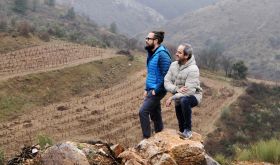
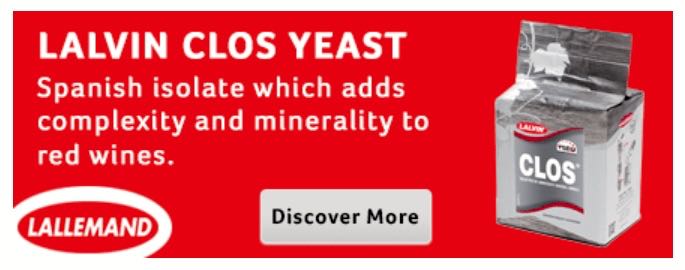
As geologist Alex Maltman explained forcefully, in a reasoned, well-illustrated talk, there can be no direct link between what is below the surface of a vineyard and the flavours found in the resulting wine. This despite the fact that soil type has long been held to be one of the fundaments of the sacred notion of terroir – and today one of most common activities among vine growers the world over is to dig a soil pit in their vineyards to show what type of rocks lurk below. (The one on the right is in Barovo in the south of the Republic of Macedonia but they are proliferating throughout the wine world.) Any wine description worth its salt nowadays refers to the geology of the vineyard and, often, the ‘mineral’ characteristics of the wine. The M-word is widely deployed by both media and marketeers as a positive attribute in a wine (see the ad for a yeast below). Maltman told us that the term is now seeping into other vocabularies, even marijuana description. (His son lives in Holland.)
The words mineral and minerality – for perceived sensations that seem related not to fruit or vegetables or spices or oak but to things like wet stones, struck flint and particularly gaseous whiffs – have invaded wine talk and wine writing over the last 10 years or so. I edited the third edition of The Oxford Companion to Wine, published in 2006, without any mention of minerality, but by last year when the fourth edition came out, it was too prevalent to ignore – even if impossible to define.
As Maltman demonstrated with extracts from books and blogs, many a respected wine writer and producer promotes the myth that vine roots dig deep and absorb minerals from the rocks below, transmitting them in solution up into the grapes and thence into the wine. ‘I’m sorry to spoil the fun', he declared impishly, while giving the impression he really rather enjoyed demolishing this shibboleth.
The confusion comes, as he explained, from ambiguous terminology: mineral nutrients, or nutrient elements, are elements such as phosporous and potassium that are essential to vine nutrition whereas geological minerals are complex, mostly insoluble compounds such as quartz. That confusion is exacerbated by the fact that wines contain traces of 14 dissolved mineral nutrients taken up by the plant that come not from the rocks where the deep roots seek only water, but from the soil and humus on the surface of a vineyard where the elements are available to the vine.
Even if a bedrock is rich in a certain mineral, and it happens to be one of the 14 vine nutrients, it doesn’t mean that all of that mineral is available to the plant. He gave the example of the California wine region Lodi that is rich in potassium (one of the 14) but less than 2% of that is bio-available. Moreover, the plant is selective and takes up only the mineral nutrients it needs, so the chemical composition of grape juice can be very different from that of the soil. And anyway, he demonstrated, these mineral nutrients are present in such tiny quantities in wine that it is highly unlikely that they are tasteable.
He went on to mock us for our use of the term gunflint, a common tasting term for Loire Sauvignon Blancs. ‘So who here specialises in antique firearms, then?’ he asked, before pointing out that flint is silica and therefore inert and completely insoluble so could not possibly vaporise and give off any aroma except when it is struck – difficult underground. Furthermore, fertilisers and nuances of vinification can completely override any natural soil effects on the character of a wine.
Needless to say he is utterly bemused by the many bottlings nowadays that carry the name of a well-known soil type (see below). ‘I’m not saying minerals and geology are not important – just that you can’t taste them directly', is his refrain, although he does admit, ‘it’s always possible that science is missing something.’
This is all very tantalising because those of us who taste thousands of wines a year do perceive various shared characters in wines grown on certain soil types. Schist in particular seems to imbue wines with a refreshing raciness, however potent they are. Wines grown on sand seem softer and looser-textured than those from vineyards rich in clay, for instance. And I cling to the warm graininess I find in the wines grown on the lava-strewn vineyards of Etna.
But perhaps we are kidding ourselves? Maltman will presumably accept our assumptions only if they have been proved in conclusive triple-blind tastings that have yet to be held.
Meanwhile sensory scientists have been trying to get to grips with what wine tasters mean by minerality. Dr Wendy Parr of Lincoln University in New Zealand and Catalan Dr Jordi Ballester based at Dijon University, together with colleagues in Bordeaux, have set up a complex series of experimental tastings (of white wines only) to tease out this conundrum. Does what tasters call minerality correlate, as some have asserted, to reduction in wine, the infamous ‘struck match’ phenomenon? Or is it associated with relatively high acidity? Or perhaps with a lack of strong fruit or varietal character?
Perhaps predictably, despite their best efforts, there was no clear-cut answer (just as, I suspect, there would be no clear-cut answer from an attempt to exactly identify ‘complexity’ or ‘quality’ in wine). But, Dr Parr told us, there was sufficient consistency in how tasters rated the degree of minerality in different wines to suggest that it may well actually exist in the wines, rather than being a concept driven by group expectation.
But what causes these perceptible, if elusive, characteristics if not soil or rock types? Some scientists suggest it could be the microbes and fungi in the soil and atmosphere of individual vineyards including the local yeast populations. A study in California found direct correlations between the microbiome of certain vineyards and the wines produced from them. However, the great majority of wines are made using selected cultured yeast supplied by specialist companies rather than the ambient yeast in a vineyard or winery.
For viticulturist Dr Richard Smart, who was closely involved with the genesis of this attempt to educate the Masters of Wine, minerality is ‘an invented term that has become very popular’. He points out that according to Bordeaux viticulture professor Kees Van Leeuwen, the most important mineral nutrient for wine flavour is nitrogen, an element that is not found in rocks. ‘Does the term add to the pleasure of wine?’ he asked rhetorically, before asking us all to stop using it.
For Wendy Parr, this Canute-like proposal comes too late. ‘The term is widely used, so you can’t ignore it. If we avoided all words for which there was no consensus, our language would be barren.’
ROCKY WINES
13th Street: Sandstone Vineyard Reserve Chardonnay, Ontario, Canada
Bindi: Quartz Chardonnay, Macedon Ranges, Australia
Cave de Tain: Esprit de Granit, St-Joseph, Rhône
Chamonix: Greywacke Pinotage, Franschhoek, South Africa
Michel Chapoutier: Les Granits, St-Joseph, Rhône
Le Clos de Caillou: Les Quartz, Châteauneuf-du-Pape
Crystallum: Clay Shales Chardonnay, Walker Bay, South Africa
Dom de l’Écu: Granite, Gneiss and Orthogneiss, Muscadet, Loire
Glen Carlou: Quartz Stone Chardonnay, Paarl, South Africa
Patrick Javillier: Cuvée Oligocène Bourgogne Blanc, Burgundy
Dr Loosen: Blue and Red Slate Riesling, Mosel, Germany
Mullineux: Schist, Granite and Quartz Chenin Blanc, and Schist, Granite and Iron Syrah, Swartland, South Africa
Dom Vincent Paris: Granit 30 and 60, Cornas, Rhône
Luis Seabra: Xisto Cru, Douro, and Granito Cru, Vinho Verde, Portugal
Torzi Matthews: Schist Rock Shiraz, Eden Valley, Australia
Vine Revival: Terre de Gneiss, Muscadet, Loire