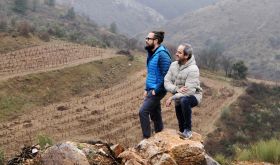
It was not the fame or rarity of the 11 wines shown before and after the discussion between wine scientist Dr Jamie Goode of WineAnorak.com (left in the picture above) and Steve Daniel, a much-admired professional wine buyer for 32 years, now at UK importer Hallgarten Novum.
The topic that attracted so many wine luminaries who could have been tasting Liberty Wines 2018 burgundies or otherwise doing their bit to combat Dry January?
It was the controversial M-word, minerality, a word that, Goode pointed out, has been applied to wine only since the late 1980s. The revered father of modern winemaking Professor Émile Peynaud of Bordeaux never mentioned it, and Professor Ann C Noble of the University of California at Davis ignored the concept in her famous Aroma Wheel created in 1984 to systematise the most common wine descriptors. But this century in particular the words mineral and minerality have been scattered liberally in tasting notes and in producers’ descriptions of their wines, and minerality has come to be seen as a highly desirable quality in modern wine.
Daniel explained that when he started out buying wine for Oddbins in the 1980s, ‘it was a job to find fault-free wine; winemaking was a bit primitive then’. Poorly made wine is much less common nowadays and as tastes in wine evolved globally around the turn of the century from concentration, alcohol and oak to lighter, fresher, more transparent styles, this mineral quality, whatever it is, has become more apparent. Today, Daniel explained, he sees minerality as a particularly positive quality in the wines he buys – although he admitted that he finds the quality generally much more apparent in whites than reds. (Eight of the 11 wines he chose to illustrate the discussion were white.)
Goode was his partner in this exercise partly because his understanding of wine science is considerably deeper than Daniel’s, and indeed than most people’s, but also because Goode is particularly fascinated by the tricky intersection of language and wine. ‘How much does having the language affect our perceptions?’ he asked. A particularly pertinent question in this context. Is it the addition of the words mineral and minerality to the wine lexicon that has encouraged us to look for and admire this particular quality? And what is it anyway?
Like many wine words, it has been used, particularly this century, without much precision, but we wine professionals do tend to agree at least about what it is not. It’s a character that is nothing to do with anything fruity, vegy, oaky, flowery or spicy. It’s a character often associated with a texture, a certain granular quality or what one of our team of tasters, Alistair Cooper MW, calls ‘bitey’. Certainly when Hallgarten Novum canvassed their suppliers as to what their idea of minerality was, one of the younger ones, Juan Pablo Michelini of Zorzal in Argentina, was adamant it was a texture, not an aroma.
Leading Languedoc producer Gérard Bertrand on the other hand (producer of yesterday's wine of the week) expressed a more old-fashioned view to his UK importers, and one that led a few years ago to considerable criticism of the term from geologists such as Professor Alex Maltman of the University of Aberystwyth. At one stage not all that long ago it was commonly believed that vine roots somehow sucked up dissolved mineral elements from the underlying rocks and that thereby these minerals magically appeared in the resulting wines. So, for example, wines actually tasted of limestone, or granite, or volcanic rock types such as basalt. As I have already written here, it was Maltman, himself a hobbyist vine-grower and winemaker, who demolished this literalist theory most vociferously, which certainly led some of us to use the words mineral and minerality much more circumspectly.
But, as Goode pointed out, when we ascribe a leathery quality or cherry flavour to a wine, we don’t actually mean that it contains leather or cherries. And, in a section entitled ‘The Bedeviling Minerality Question’ in their book The Sommelier’s Atlas of Taste, sommelier-turned-winemaker Raj Parr and California food and wine writer Jordan Mackay argue, countering Maltman’s literal criticism, that ‘minerality’s value is not as a scientific term, but as a metaphor. We don’t speak of literal minerals in wine; we speak of a poetic characteristic that reminds us in some way of stones, rocks, metals, and minerals.’
What was interesting about this discussion was how relatively inconclusive it was, although many possible theories were advanced for what is responsible for a quality that might be described as mineral. Daniel associates is with a character ‘beyond fruit’ that prolongs the impact of a wine on the palate. One school of thought associates it with reductive sulphur compounds, the sort of ‘struck match’ aroma associated particularly with the white burgundies of Coche-Dury, Leflaive and Roulot that became particularly fashionable among Chardonnay producers around the world some years ago. Another believes that reductive winemaking in general, in which wine is made with minimal contact with oxygen, results in wines that would be described as mineral. Daniel mused that keeping embryonic wine in contact with the lees of the fermentation process as long as possible might also be a factor.
Goode wondered whether something as basic as acidity isn’t sometimes confused with minerality. It’s certainly true that wines described as mineral tend to seem particularly refreshing and zesty. Another theory is that there is a close relationship between minerality and another quality that seems to be an increasingly fashionable quality in wine: salinity (discussed in this forum thread). I have heard many a revered wine producer all over the world aver that they are actively seeking saltiness in their wines, and there has been some high-powered discussion on Twitter recently about what would happen if salt were added to wine. One of Daniel’s favourite wines (and one of mine too), the Assyrtiko of the volcanic island of Santorini, may well benefit from salt spray carried by the winds that characterise this Greek island.
One thing that Daniel and Goode agreed on was that oak tends to mask minerality, and that the characteristic is very generally more common in Europe than in New World wines. But the two non-European wines included in the 11 shown, both Argentine, suggested that a wine could be imbued with a mineral character by being fermented in concrete, a material once seen as old fashioned compared with easy-to-clean stainless steel but now fashionable once more. Goode suggested that the clay pots and amphorae that have become increasingly popular as wine fermentation vessels could have a similar effect.
Since this mineral character is so desirable, as witness the popularity of this event, could a clever mass-market wine producer make an inexpensive wine that tasted mineral simply via contact with a suitable material? Several internationally experienced winemakers I discussed this with thought this would be worth exploring - see Minerality for the masses for details. Randall Grahm, California winemaker who has just sold his Bonny Doon business, was way ahead of the curve when in 2001 he experimented with suspending various different rock types in his wine. Unfortunately this particular exercise resulted in dangerously high levels of other compounds but the US authorities asked that he cease and desist but I’m sure this is not the end of the road.
Though perhaps by the time the results of a serious, well-organised trial are available, the spotlight of fashion will have moved on from mysterious minerality.
See also this video of the event.
Some recommended mineral wines
With just some of their stockists
Whites
Verum, Las Tinadas Airén 2018 Vino de la Tierra Castilla
Just €9 originally from this La Mancha bodega but it should be much more
Idaia, Dafnes Vidiano 2018 Crete
£14–16 Corking Wines, Strictly Wine, Novel Wines, thewhiskyexchange.com
Gaia, Thalassitis Assyrtiko 2018 Santorini – or virtually any Santorini white
£23–£36 TheDrinkShop.com, Noel Young, Corking Wines, Fintry Wines, Hic!, The Soho Wine Supply, Hedonism
Domaine Pinson 2018 Chablis
£120 a dozen in bond Berry Bros & Rudd
Dom Wachau, Achleiten Riesling 2017 Wachau – or virtually any vintage
£25 The Wine Society
Reds
Zorzal, Eggo Tinto de Tiza Malbec 2017 Tupungato
£15.15–£19.99 Hic! (online)
Dom Joël Remy, Les Lavières 2018 Savigny-lès-Beaune
£170 a dozen in bond Lea & Sandeman
Jean-François Quénard, Les 2 Jean Persan 2018 Savoie
$27.50 Solano Cellars
Concha y Toro, Don Melchor, Puente Alto – most vintages
Just under £100 Penistone Cellars, Hedonism
You can find full tasting notes in our tasting notes database and international stockists from Wine-Searcher.com.