Family strife is everywhere. Once confined to, but the raison d’etre of, literature, it now seems to dominate our tv screens, radio and newsprint – not to mention many more private lives. But there is a family, a British family, in northern Portugal which decisively bucks the trend. Eleven of them either have worked or are working in apparently perfect harmony in one decidedly difficult family business, making premium port.
The Symingtons of Oporto are responsible, via such names as Dow, Graham, Warre, Smith Woodhouse, Quarles Harris and Quinta do Vesuvio, for more than a quarter of all the superior port sold throughout the world, and are doing their best to adjust to a dramatically changed physical and commercial landscape in the Douro Valley upstream of Portugal’s second city. What’s extraordinary about this large family, all descendants of Andrew James Symington who left Scotland for Portugal in 1882 as a 19 year-old and married into a family with port connections, is that they have so neatly divided up responsibilities.
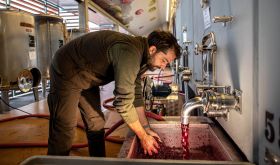
Taciturn but talented Peter is the only member of the third generation left in the business and can hardly believe his luck that just as he’d like to retire from a glorious, 42-vintage port-making career (he was voted Fortified Wine Maker of the Year at the International Wine Challenge in London no fewer than six times) his Rioja-trained son Charles is raring to take over from him, and has already won the same award on his own account. So that’s making the stuff taken care of.
The other five Symingtons currently working for Symington Family Estates are more directly concerned with selling it – as well they might be in these highly competitive times. Paul, Rupert, Dominic and Johnny neatly divide the world up between them. The eldest Paul is responsible for the UK and for marketing. Johnny (the only working Symington to have been born in a decent port vintage, 1960) looks after sales and much of Europe. Dominic looks after the rest of Europe, and Madeira since the Symingtons acquired a major stake in the production of this, Portugal’s ‘other’ fortified wine. And Rupert, who is responsible for the US, just happens to be good with numbers so he’s financial director too. Meanwhile Clare, the lone female Symington in the business (there are scores of both sexes who aren’t) runs a company based in London responsible for allocating and trading in the Symingtons’ stable of vintage ports, the tiny proportion of production that is deemed finest and most age-worthy, produced only in vintages ‘declared’ every three or four years – most recently 2003, 2000 and 1997.
When the Symingtons are about to declare a vintage, or launch a new wine such as their mould-breaking Warre’s Otima 10 year-old tawny port packaged in jazzy, clear half-litres, the whole family assembles in the tasting room next to Peter’s office. And in all other areas according to Paul, “decisions are taken very much on a 'partnership' basis. If we are at each others’ throats, we might as well pack it in. It’s an odd arrangement and doesn’t fit into an MBA specification, but it works.”
This set-up is so unusual that I suspect we would all have heard more about the Symingtons if a) their surname was to be found on their products which, after all, enjoy global distribution, and/or b) any one of the Symingtons were larger-than-life. But perhaps they get on so well because they are all just decent team players without, as Tim Stanley-Clarke their UK ambassador remarks with some exasperation, a single black sheep between them. Good Scottish, and now Portuguese, genes obviously.
Many of the family are British educated. Paul’s family have a house in Fulham. But their base is northern Portugal and an increasing number of them have their own wine farm, or quinta, in the Douro Valley that both supplies the family business with raw material and is very much a second home. “Welcome to Hyannisport” observed Stanley-Clarke as our four-by-four made the near-vertical ascent to Paul’s Quinta das Netas above the Warre winery Quinta de Cavadinha, just below Paul’s father Michael’s Quinta das Andorinhas.
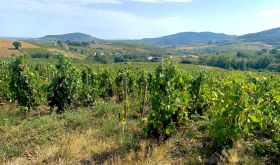
The wild, beautiful and almost silent Douro Valley – for long considered too malarial to be settled by the Portuguese – is where old hands in the port trade work and play. As we zoomed upriver on Paul’s new speedboat, it was not just the dramatic new plantings that were remarked upon. Much-loved picnic places and water-skiing stretches were pointed out, as was the bridge that So-and-So once jumped off, while the new boat of a rival winemaker tied up at the jetty of a neighbouring quinta was sized up. Swallows and Amazons are alive and well in the Douro Valley.
But it isn’t easy to stay afloat in the port business. As Paul points out, the flurry of recent mergers and acquisitions in the global drinks business has seen most port companies involved dropped like hot potatoes. “Only a handful of port companies are profitable. I know of at least three port companies that are currently for sale. The Douro Valley is a struggle.” The owner of the world’s biggest cork supplier, Portuguese of course but no sentimentalist, has just handed on his investment in the Burmester port shipper to the same Spanish bank that had already taken on Calem port. From Paul’s terrace at Quinta das Netas we look across to the house built on top of the hill on the other side of the valley by the old owner of the Royal Oporto business which once shipped vast quantities of cheap ruby to northern Europe. The business is now run by his son who sees the future firmly in unfortified dry wines labelled Douro rather than port.
Which brings us to the future, and the Symingtons’ big rivals, the extended Robertson and Guimaraens families who run The Fladgate Partnership (Taylor, Fonseca and now Croft and Delaforce too). With the Robertsons’ son-in-law in charge and the late, and definitively larger than life, Bruce Guimaraens’ son David (owner of that new boat) as winemaker, they are truly a family business too. One can imagine each camp poring over the latest set of AC Nielsen stats and any major article about port looking for their respective gains and losses. But what distinguishes The Fladgate Partnership is its, or at least its managing director’s, refusal to engage in the dry wine business.
After many years of doubt, the Symingtons have jumped feet first into this dynamic new area with Chryseia, a joint venture with Bruno Prats who once owned Ch Cos d’Estournel in Bordeaux. “We get a lot of pleasure out of making, drinking and serving our table wines”, maintains Peter Symington, whose son has even shown competence in making the ultimate Douro novelty, white wine.
Another somewhat arcane point of difference between the two port dynasties involves their new equipment designed to replicate the foot-treading of grapes that has been fundamental to top quality port production but is increasingly threatened by the labour shortage in these, the depths of rural Portugal. The Symingtons’ great gift to technology is the robotic lagar, a computer-operated hunk of stainless steel and silicon that replaces granite and flesh.
But with soaring production costs both companies will have to work hard if the unique wine that is port is to thrive. Douro economics are such that only premium ports are worth making. Signs are that the next generation of Symingtons will be looking for openings. Paul’s son Robert – Eton, Edinburgh and now Grenoble – has already immersed himself in the purple sticky stuff by working a vintage at Graham’s Quinta dos Malvedos. The only specialisation which is not currently occupied by a Symington is viticulturist, a post currently ably filled by Adelaide-trained Miles Edlmann. I suggest young Symingtons should henceforth be encouraged to garden.
SOME SYMINGTON TRIUMPHS
Dow 1966, 1955, 1927, 1908
Warre Otima tawny, LBV 1992, 1963, 1945. 1924
Graham 2000, 1970
Smith Woodhouse 1977