
I have been thinking recently about a topic of importance to every restaurant in the world that is fundamental to the restaurant’s well-being and, ultimately, its long-term success, especially in this internet-driven era: the restaurant’s name.
It is a topic that any thoughtful restaurateur puts a lot of time and effort into. Before opening, the restaurateur is convinced that the name has to be correct. It has to project the right tone. It has to be relatively easy to remember. It must not be too long and it must not have any negative connotations. And nowadays it has to be a name that will lead those who search online to the right, not an entirely inappropriate, website. In the past, the name also had to fulfil one other criterion: when most of the reservations were made by phone, the name had to be easy to pronounce for the receptionist, standing by the front door, answering what you hoped would be a busy phone line. The internet, and online bookings, have changed all that.
I have first-hand experience of the restaurateur’s anguish choosing the appropriate name. In the autumn of 1980, already an importer of California wines, I decided to open a restaurant that would serve only wines made in the US. I asked Tom Brent, a close friend, to find suitable premises and we both fell in love with the building that had traded as L’Escargot Bienvenu at 48 Greek Street in London’s Soho since 1926.
But this name seemed to us completely wrong and we began to think of alternatives. We got nowhere until one Friday evening I was back at my parent’s home in Cheshire. It was dinnertime and my late mother came into the dining room where I was sitting with my late father, pushing her pride and joy, a hostess trolley. As she did so, I can still recall her saying, ‘Why don’t you just shorten the name, Nick, from L’Escargot Bienvenu to L’Escargot?’
What a piece of brilliance! This name was short, it kept the links to the previous restaurant, which was still known to numerous customers, and it was both easy to pronounce and original. I did not realise at that stage that it would also allow Brent to design a carpet that had snails along its borders joined by dotted ‘snail trails’, nor that it would allow us to hand out chocolate snails with the coffee!
Geography is often what inspires names. Our son named two of his restaurants simply after the street that they are located on: Portland is on Great Portland Street, Clipstone is round the corner on Clipstone Street. Simple, easy to pronounce, and therefore relatively easy to remember.
When in 1985, at the age of 27, Danny Meyer opened his first restaurant he had no hesitation in naming it Union Square Cafe. The restaurant was at 21 E 16th Street, a stone’s throw from the Union Square Greenmarket, whose seasonally changing produce was to inspire his chefs and therefore his restaurant’s menu. Thirty years later, when negotiations over a renewal of the lease with the landlord broke down, Meyer faced an enormous challenge. They could either move the restaurant – and Meyer had drawn a circle of four blocks in every direction around the square – or they would be forced to close. The name had come to dominate the location, and the restaurant’s success over the intervening 30 years had made the whole area more popular and had forced rents up considerably. Fortunately, after looking at more than 25 different locations, Union Square Cafe continues to prosper at its new location on E 19th Street, still a stone’s throw from the square.
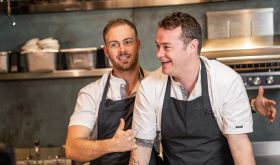
After a decade in London working for others, three New Zealanders, Chris Ammermann, his partner Laura Harper-Hinton and chef Miles Kirby, decided to open their own restaurant. This dream project would be a place where they could roast their own coffee; it would be a modern day cafe/bar/restaurant, a brasserie for the 21st century; and above all, it would communicate a New Zealand laid-back attitude combined with consummate skills in the kitchen and an awareness of the customer’s dignity. All it needed was a name.
Whoever came up with the name Caravan (still a matter of dispute between Miles and Laura) is to be congratulated. It works to reflect the travels that brought three New Zealanders halfway across the world and it is a name that allows the chefs to incorporate the world’s repertoire of ingredients and flavours. ‘And, most importantly, it avoids us having to use the word fusion!’ Ammermann added when we spoke. It is also a name that is easily translated. When the Cadogan Estate awarded the company the lease on their King’s Road site, they insisted on a name that would distinguish it from the other branches of Caravan. Vardo, under which the site now trades, is the name the Romany people call their caravans.
Brut may be a word that is invariably applied to a style of champagne but this is a word that immediately appealed to Eduardo Martínez Gil when he first saw the former garage in the small village of Llubí in Mallorca. Part of its appeal lay in Gil’s profession before he turned to cooking – he had spent many years working in advertising as a creative director and as a result was forming and establishing an ideal restaurant in his mind.
He added when we spoke, ‘Numerous excellent products have come out of a garage. So I had no excuse not to try. Another thing that attracted me is that in a garage you're not afraid to experiment or to get dirty. New challenges always come to a garage, there is always something to solve, there is always something half done. It never gets all collected. And you are absolutely always forced to find a solution, which leads you to learn. But the Beatles, Apple, Disney, Harley Davidson and many other great ideas of this century have begun their lives in a garage.’ The letters BRUT are written in large letters just to the right of the restaurant’s front door.
A restaurant’s name can also convey something far more personal. When chef Angie Mar, born in Seattle, Washington, the daughter of second-generation immigrants from China, left The Beatrice Inn in New York, she too had definite plans. What she eventually opened was a high-risk gamble: a restaurant serving extremely sophisticated French food of a style I have not seen for decades – think mousseline, ballotine, pithivier and millefeuille – with ingredients such as Dover sole and foie gras. The name Mar chose for her restaurant is French, of course, but is entirely personal. Les Trois Chevaux (The Three Horses) was the phrase her mother used when referring to Mar and her two brothers.
But of course, the naming policy that seems to have lasted the longest is also potentially the most dangerous, and that is the practice of naming the restaurant after an individual.
Certainly, I don’t believe that in 1930 when Jean-Baptiste Troisgros put his name on the sign outside his restaurant directly opposite the railway station in Roanne in eastern France, he realised he was establishing a name that has so far lasted 92 years and survived a move into the village of Ouches, 15 kilometres away.
And all three of London’s oldest restaurants have the same origins in serving shellfish and fish: Josef Sheekey began in the 1890s; Bill Bentley opened Bentley’s in 1916; while John Scott served his first oysters, albeit not in their current Mayfair location, as long ago as 1851. Way back in 1798 Thomas Rule first served oysters in the restaurant that still bears his name. And who would have thought that the famous architect Nicholas Hawksmoor, the greatest exponent of English Baroque architecture in the early 18th century, would lend his name to a group of such successful steak restaurants in the UK and, now, the US?
Ultimately, once open and established, restaurant names become accepted. They become part of our everyday vocabulary – but a poorly chosen name can slow down that process.