
See my tasting notes on 40 wines from Beaujolais 2010 and see also Beaujolais facts and figures. Purple pagers also discuss Beaujolais 2010 on the forum here and here.
I recently enjoyed a dinner in Paris with the best-known wine writers in each of Australia and New Zealand. It was all very jolly even if, as you may imagine, study of the Aux Lyonnais wine list took up rather more time than it would for most parties of six.
I was rather shocked, however, by the blank looks I got when I suggested we try Laurent Gauthier's Côte de Py 2009 Morgon before tackling a more 'serious' red. There were mutterings about not having tried Beaujolais for years but, one of them mused, wasn't 2009 supposed to be a particularly good year? They did, I think, enjoy the silky texture, wonderfully fluid fruit and mineral whiff of the Côte de Py, but reserved their real enthusiasm for the (much more expensive and revered) Jamet 2007 Côte Rôtie.
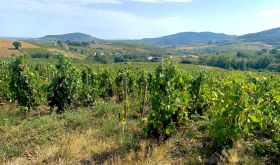
Admittedly, Australia and New Zealand are a very long way from the blue hills of Beaujolais north of Lyons, but you would think that Parisian wine lists at least would have a fair spread of the new, improved wines of this famous region. However, close study the next day of the 900-bin list at Sur Mesure, the topline restaurant of the spanking new Mandarin Oriental hotel in the rue St Honoré, revealed one lone Beaujolais.
The region really has well and truly lost the massive cachet and popularity it used to enjoy. As I wrote a year ago, the unusually ripe, concentrated 2009 vintage that was offered for sale last year (precocious Beaujolais Nouveau put on the market within weeks of being picked being a minority interest nowadays) seemed to stand a good chance of putting Beaujolais back on the map. But it would seem that it will take more than a single unusually toothsome vintage.
I was therefore particularly interested the other day when presented with an opportunity to taste a wide range of 2010 Beaujolais. Was the quality sufficient to nurture the fragile seed of interest planted a year ago? (The 2008s had been a little on the lean side – not useful for a wine that is characteristically high in acidity and light on body.)
I'm delighted to report that the 2010 Beaujolais are in generally showing beautifully – even if the vintage is very different in character from the big, beefy, relatively tannic 2009s. Many of the 2009s, especially those from the crus (in approximately ascending order of body Chiroubles, St-Amour, Fleurie, Régnié, Brouilly, Côte de Brouilly, Juliénas, Chénas, Morgon and Moulin-à-Vent) were so atypical that they are even now still youthful and may well still be better candidates for the cellar than the table. I fear many of the 2009 Beaujolais have been drunk long before reaching their peak, so alluringly rich were they.
The 2010s are much more typical Beaujolais, a bit lighter in body with less obvious tannin but absolutely stuffed full of the unusually succulent fruit of the Gamay grape, in much purer form than used to be the case when so many Beaujolais winemakers depended on speeded-up fermentations and added yeasts that left the wines smelling of pear drops, rubber and bananas.
Devon wine importer and Beaujolais wine producer (Château de Grandmont) Christopher Piper has watched the recent evolution of practices with wines and vines in the region at close quarters. According to him, 'the crisis in Beaujolais which has been rumbling on for the past seven or eight years has not yet gone away but the acceptance that quality is the only way to dig ourselves out of the merde has been regionally prevalent in the past few years. Yields are now seriously controlled. Over-productive vineyards planted in marginal zones have been grubbed up, and the restoration of maltreated soils is well underway.
'We have seen a serious move towards organic viticulture in recent years (like the rest of France) and this once frowned-upon practice is widely appreciated. As vignerons who were brought up during the 1960s and 1970s (with all its madness of mass production and associated chemical warfare) retire, their children have taken over and introduced a new mentality of respect for the land and the desire to make high quality vins de terroir.'
That's certainly what seemed evident in the 40 or so samples of 2010 Beaujolais I have so far had a chance to try. Each had its own strong personality, with those listed below being particularly alluring. The region's 3,000 growers were a little concerned about the vintage – not least because they felt it was bound to be overshadowed by the 2009s but also when, after a hot July, August was cool and slowed down the ripening process. However, particularly fine, dry weather in September meant that they were able to pick notably healthy grapes in late September only when they felt the tannins and pigments were fully ripe – while the cool August helped to retain Gamay's signature freshness.
As for this coming vintage, as everywhere in France, the growing season is exceptionally precocious and picking is expected to start as early as 24 August. It looks as though the 2011s will probably be for early drinking.
In very general terms, the 2010s are already delicious and in many cases should probably ideally be drunk before the 2009s (although in practice this advice may well be rather too late).
Roy Richards of Richards Walford, which imports the wines of several topnotch Beaujolais producers into the UK, describes the 2010 Beaujolais as: 'superb, almost as if the commercial success of 2009 has put the wind of confidence in their sails and made them believe that there is reward for quality and virtue. Yields are low and the wines are concentrated with evident acidity. I believe with top growers that this is the superior vintage, whilst being aware that cynics will conclude that this is because it is the vintage one has to sell.'
Certainly Beaujolais, and especially its crus, deserve much more attention than they are currently accorded. As so many of the world's wine drinkers are now seeking fresher, fruitier, livelier wines, unmarked by heavy oaking, these wines are an obvious choice. They can be enjoyed young, with a wide range of foods and, importantly, on their own. These are the quintessential reds to serve as aperitifs, lightly chilled – and most cost only around £8-15 a bottle.
But at the moment we seem a long way from the 1970s and 1980s when Beaujolais was famous and the late, great cricket commentator John Arlott would regularly entertain visitors in his converted inn in Arlesford, Hampshire, with a clutch of different examples dredged up from his cellar via a dangerously rickety staircase.
See full tasting notes and see wine-searcher.com for stockists and prices.
TOOTHSOME 2010 BEAUJOLAIS
Dom Lagneau, Vieilles Vignes, Régnié and Côte de Brouilly
Dom Manoir du Carra, Juliénas
Bulliats, Vieilles Vignes, Régnié
Dom de la Chaponne, La Forge, Chiroubles
Coquard, Empreinte d'Amour, St-Amour
Clos de la Roilette, Fleurie
Laurent Gauthier, Grands Cras Vieilles Vignes, Morgon
Ch de Grandmont, La Corcellette, Morgon
Dom des Marrans, Fleurie
Ch de Pierreux, Brouilly
Ch de Pizay, Morgon
What's so good about Beaujolais 2010
• 5 min read

This is a longer version of an article also published in the Financial Times.


Wählen Sie Ihre Mitgliedschaft

For the dad who loves wine
Start your membership this Father’s Day with 20% off a full year. Expert reviews, honest writing, no guesswork. Or, gift a membership and save 20%.
Enter code DAD20 at checkout. Offer ends 22 June.
Mitglied
$135
/Jahr
Ideal für Weinliebhaber
- Zugang zu 295,233 Weinbewertungen und 16,093 Artikeln
- Zugang zu The Oxford Companion to Wine und The World Atlas of Wine
- Access askJancis, our AI wine assistant


Inner Circle
$249
/Jahr
Ideal für Sammler
Everything in “Member”, plus:
- Early access to the latest wine reviews, 48 hours in advance
- Early access to the latest articles, 48 hours in advance
Professional
$299
/Jahr
Für Weinprofis (Einzelnutzer)
- Zugang zu 295,233 Weinbewertungen und 16,093 Artikeln
- Zugang zu The Oxford Companion to Wine und The World Atlas of Wine
- Access askJancis, our AI wine assistant
- Frühzeitiger Zugang zu den neuesten Weinbewertungen und Artikeln, 48 Stunden im Voraus
- Gewerbliche Nutzung von bis zu 25 Weinbewertungen und -punkten für Marketingzwecke
Gewerblich
$399
/Jahr
Für Unternehmen in der Weinbranche
Everything in “Professional”, plus:
- Gewerbliche Nutzung von bis zu 250 Weinbewertungen und -punkten für Marketingzwecke
- Access to submit wines for review
- Offer memberships to your employees and manage them from a single place
- API access available for an additional fee
More Gratis für alle

Gratis für alle
Carefully cultivated wildness in the Home Counties. And an unmissable wine list. Farm to fish to fork to frying pan...
Gratis für alle
Jancis makes a suggestion. A version of this article is also published by the Financial Times. See also South Africa’s...

Gratis für alle
Pauline Vicard asks, can wine still justify its cultural relevance? The answer to this question, rather than economics, may become...

Gratis für alle
Jancis is put in her place, by the hybrid grapes of the Emerald Isle. A shorter version of this article...
More from JancisRobinson.com

Insider-Informationen
The wines of this Portuguese region are emerging from the shadows of their history. Above, Azenhas do Mar in Colares...

Getränke außer Wein
An exploration of the transparency of Japanese whisky – and how that sensibility is influencing whiskey-making back in Scotland. Above...
Verkostungsberichte
Rosés for every occasion, from poolside pinks to robust BBQ-ready versions. We at JancisRobinson.com view the world through rose-tinted spectacles...
Weine der Woche
A reference Chablis, albeit in a riper style, available from $39.95, £31.95 . Prompted by our recent forum discussion about...
Verkostungsberichte
The many Cape Chenins and Chenin blends shown at a big South African tasting in London in May reviewed. Tertius...

Unverblümte Meinungen
Chris Howard asks, if there’s such a thing as volcanic wine, can there be oceanic wine? Above, seals on the...
Verkostungsberichte
Bien Boire (‘drinking well’) en Beaujolais is more fun than Bordeaux’s primeurs and offers plenty of excellent wines, reports Natasha...
Verkostungsberichte
Pleasant surprises from a torrid year. Above, Alessandro Campatelli, director and oenologist (and now owner) at Riecine, made a 2022...