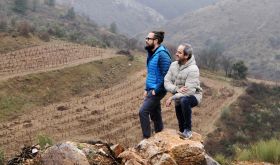
Giovanna Morganti of the tiny Le Boncie estate outside the village of Castelnuovo Berardenga makes one of the finest, subtlest, Chianti Classicos. Except it is not labelled Chianti Classico because the official tasting panel rejected it every year from 2006 to 2011 as tasting 'atypical', so she sells it simply as IGT Toscana.
In the tasters’ opinion, the problem with her hauntingly fresh Tuscan red was that it was made exclusively from the local grape variety Sangiovese and contained none of the then-fashionable international varieties Cabernet and Merlot. It was also obviously aged in large, neutral oak botti rather than modish, small French oak barriques. Added to that, her wine contained too little sulphur, according to the Consorzio that administers Chianti Classico.
She has been vindicated. Thanks to the global trend towards local authenticity, Morganti’s pure Sangiovese style is now much more widely accepted as being what Chianti Classico should taste like, and her wines would probably pass muster with the Consorzio’s tasting panel today – but she’s damned if she will dance to their tune.
'I don’t want to belong. I like being on the outside. I don’t believe in the Consorzio. It’s now run by very young people, who are educated to a certain extent but without going beyond – there’s too much emphasis on marketing. What’s missing at the moment in the Consorzio is finding a common identity between small and big producers, and establishing a link again with agriculture rather than marketing, however sophisticated that marketing is.'
Morganti is far from being the only producer making wines that are further ahead of the curve than those who judge them. She and her peers find themselves, therefore, in the vinous equivalent of a Salon des Refusés.
In an isolated spot overlooked by the rugged Baronnies provençales hills, Michèle Aubéry-Laurent and her son Maxime-François Laurent (pictured above right, with one of her paintings) make arguably the most compelling wine at Domaine Gramenon in the far north of the vast Côtes du Rhône region. They make a superb Grenache, La Papesse, from their parcel of old vines in the commune of Vinsobres, which has its own appellation.
But the tasting committee that decides these things has never allowed them to sell it as a Vinsobres. Instead, it has to be labelled as mere Côtes du Rhône, a wine you can buy for a couple of euros a bottle in any French supermarket. 'They say it’s not typical', sighed the vivacious Aubéry when I visited there last month, 'but typical is machine-picked, with added cultured not local yeast, all to make cheap wines for the supermarkets. And they tend to favour the Syrah grape which is not indigenous to the region.'
Hundreds of less conservative French producers are abandoning the hallowed but tightly regulated Appellation Contrôlée system, in favour of the much less restrictive Vin de France designation, to give themselves the sort of flexibility that non-European wine producers take for granted. (See Arise, lowly Vin de France.)
The same thing is happening in Spain. The excellent but mature and complex As Bateas Galician white from Albariño grapes, for example, has to be sold simply as Vino Blanco. For the local tasting panel, it does not meet the approved youthful style for their Denominación de Origen designation, Spain’s Appellation Contrôlée equivalent.
There is an argument that the tasters who decide whether a wine qualifies for a certain appellation need to be better educated – and exposed to what’s happening in the great wide world of wine rather than being limited by and to the traditions of their particular corner of it.
I suspect that was why Willi Klinger, the dynamic head of the Austrian Wine Marketing Board, asked me – with my global viewpoint – to address last year’s annual conference of Austrian wine producers. The theme was 'Should tastings still define quality wine status?' and he encouraged me specifically to address natural wines and increasing consumer resistance to additives in wine, particularly sulphur. Tastes in wine have been evolving much faster than the regulations and accepted standards for Europe’s wines with a geographical appellation.
At the end of last month, I discovered how a group of wine producers in Baden, in south-west Germany, are reacting to what they see as overbearing restrictions. To qualify as Qualitätswein, their wines have to be accepted as typical of their geographical provenance and winemaking traditions.
Yet so many wine producers here want to explore non-conventional grapes and winemaking methods that a substantial proportion of the most interesting Baden wine is now sold as Landwein. Theoretically, Landwein has lower status than Qualitätswein but, judging by last month’s Landweinmarkt in the town of Müllheim, south of Freiburg, it’s in considerable demand.
Hanspeter Ziereisen, a woodworker and asparagus farmer turned winemaker, has become a bit of a ringleader; his wife Edel is the major organiser of the Landweinmarkt. The event was inspired by Ziereisen’s frustration at being excluded from official wine events, despite making wine that he feels is better than many conventional competitors.
Edel told me that her husband slumped into a three-month depression when his 2004 Steingrüble Gutedel – treated to a long, slow, enriching fermentation with indigenous not added cultured yeast – was first rejected as a Qualitätswein because it was judged too unlike its more neutral counterparts.
The Ziereisens then asked their distributors about the likely impact of their wines losing the Qualitätswein designation and found that they were all perfectly happy to sell them as Landwein.
A total of 22 producers from all over Baden participated in the Landweinmarkt. Many of the most interesting wines were Spätburgunder (Pinot Noir), Grauburgunder (Pinot Gris), Chardonnay and the convincing local speciality Gutedel (Chasselas), but there was also Riesling, Sauvignon Blanc, Syrah and the hybrids Cabernet Blanc and Souvignier – by no means all sanctioned by local rules for Qualitätswein. Too few of them are exported so far, but they are far from inferior.
RECOMMENDED BADEN LANDWEIN PINOTS
These wines should be of serious interest to those looking for better-priced alternatives to red Burgundy. For tasting notes see The beards of Baden,
Brenneisen, Chätsch and Molassefels Pinot Noir 2016
Enderle & Moll, Buntsandstein Ida and Muschelkalk Pinot Noir 2016
UK importer Newcomer Wines, US importers Vom Boden and Fass Selections
Max Geitlinger Spätburgunder and Maximal Pinot Noir 2016
Greiner, Steinkreuz Spätburgunder 2017
Michael S Kintz Spätburgunder 2015
Hanspeter Ziereisen, Jaspis, Rhini and Schulen Spätburgunder 2016 and Jaspis Alte Reben Spätburgunder 2014
UK importer Howard Ripley, US importer Skurnik Wines