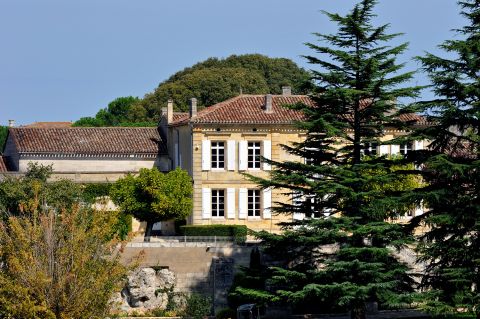
Just before the 2020 en primeur campaign, this 6.24-ha (15.4-acre) estate on prime limestone plateau terroir, a Premier Grand Cru Classé B property, was put up for sale in accordance with the wishes of the majority of the 30 members on the family board. However, Joséphine wanted to keep it in the family and fought hard to do so, backed financially by the Clarins family who believed in her vision for the property. Growing up at her family estate of Château de Musset in Lalande-de-Pomerol, Joséphine went on to study wine production and commerce in both Bordeaux and Burgundy before travelling and making wine in Napa, in Hawke’s Bay in New Zealand, and in Mexico, returning to Bordeaux in 2016. Her first role in Bordeaux was as technical director of Château du Taillan in the Haut-Médoc and from here she moved to Group Bernard Magrez at Château Les Grands Chênes, before taking up her current role at Château Beauséjour. Last year she was crowned one of France’s 50 best winemakers.
Victoria Where were you raised?
I grew up in Lalande-de-Pomerol because my father was estate manager of two wineries, one in Lalande-de-Pomerol and the other in Puisseguin. As a lawyer, my mother was not in the wine business, but I grew up inside the world of wine learning from my father about the different steps of the growing season and winemaking process. I watched my father and could see his devotion to viticulture, and how much hard work went into it. I remember my father working weekends and even during the night and because of this, and my love of studying, I decided I wanted to be a vet rather than a winemaker.
Tell us a bit about your grandparents and their role in your wine journey?
My grandparents on both sides taught me a lot. On my father’s side they were estate managers of Beauséjour and on my mother’s side they owned a small vineyard in the south of France. Both sides taught me different things: on my father’s side it was all about technique. On my mother’s side it was more about tasting the wine, the feelings that arise and intuition.
What are your memories of Beauséjour as a child?
In France, or especially in Bordeaux, it’s traditional to have a ceremonial lunch on Sundays with wine. I have this memory of my grandfather opening and pouring Beauséjour around the table. He would speak for at least 15 minutes about the smell and qualities of the wine, which was hard when you couldn’t drink it as it was sitting in front of you. The speech was the same year on year!
Do you recall a key moment when your love of wine began?
I don’t recall a time that I woke up and decided I wanted to become a winemaker; it came little by little. After studying at veterinary school, I went to engineering school which I enjoyed as I learnt a lot about chemistry, plants and a bit about viticulture. I found this side of it interesting, and it showed me how when working in wine, no day will be the same. From this point on my goal was to be in the wine business. I joined winemaker school and after finishing decided I was too young to start work straight away. Instead, I went to Burgundy and joined the International School of Trade and Marketing in Wine. But I preferred the technical side, so I went back to that.
I went to Napa Valley for an internship while I was in winemaker school for about eight months and then went back to Burgundy. I studied there for a year then went to Vosne-Romanée for a year. I started to miss working abroad as I loved my experience in Napa and had the opportunity to go to New Zealand where I stayed for five or six months. I then came back to Bordeaux and went to Mexico for a few months. I returned to Bordeaux in 2015. I was considering going to Burgundy as I enjoyed my experience there. However, I was offered a full-time job in Bordeaux, so I decided to stay.
Interestingly, I was working with bordeaux varieties through the entirety of my travels [apart from Burgundy]. In Hawke’s Bay it was Cabernet, Merlot and a small amount of Malbec as well as Syrah. In Mexico it was Merlot and Cabernet, although it was a lot hotter than Bordeaux. I came to understand lots about wine from my travels: first about varietal expression and how it is so dependent on the terroir, and technique. In Burgundy I was learning more about extraction and oak selection than in Napa or Hawke’s Bay.
My main learning stemmed from my exposure to the incredible wines that were being produced outside of France. In Bordeaux particularly we have great terroir, and we are famous for our wine. But there are still plenty of people who need to understand that great wines are being made elsewhere, too. Winemakers abroad have learnt a lot about technique and combinations between rootstocks and varieties. This makes it now very hard to tell the difference between bordeaux wines and foreign wines in a blind tasting. Instead of being intimidated by this I feel we should see it as a challenge for us to stay competitive and to improve our techniques and styles. I think this all proves the importance of travelling to understand wine in different regions. My father was so surprised when he came to Napa and impressed by the quality of wine, particularly as he’s part of the generation that believed France to be superior to all other wine regions.
On top of this I realised that the charm of bordeaux is the effect the vintage has on the wine. Because we can’t use irrigation or techniques that can perhaps be used in other areas to reduce the effect of the vintage, you still have good and bad vintages, which is not so obvious in the rest of the world.
What was your first job in Bordeaux?
At the beginning I didn’t want to work in Beauséjour because I wanted to learn as much as I could in Bordeaux and felt I couldn’t do that within a family business. I wanted to find a job on the right bank but I didn’t get very far because of my connection with Beauséjour so I went to the left bank.
I was then lucky to find an opportunity with Armelle Cruse from Château du Taillan because she needed someone to do the technical parts. I really enjoyed my experience there as they produce white wine as well, so I stayed for three and a half years. That experience taught me a lot about decision-making as when you have less money available, your decisions must be managed carefully. From then on in my career, my priorities were considered with more care. In 2017 it was quite difficult because of the frost – we lost 90% of the crop – then in 2018 we had a lot of mid-year disease pressure. However, it produced a nice vintage. In 2019 we had a heatwave at the end of the season. I learnt a lot from that as well. It was at this point that I was hired by Bernard Magrez.
At what stage did you realise you had to try to keep Beauséjour in the family when so many other family members wanted to sell?
I always knew I was going to be back there, but I wanted my own experiences beforehand so that I felt legitimate. I planned to be part of the company in my forties. However when my family started to discuss selling the property I realised I would never have access to this kind of terroir again which made me really sad, so I started looking for a solution to keep it.
So how is it now with the financial backing of Prisca Courtin-Clarins?
It’s great. I’m really lucky to have found this family. Prisca’s partnership is perfect because she is very business-savvy so it’s always interesting seeing her vision for Beauséjour for the next five, 10 or 20 years. It also works well because she trusts me, so all the technical aspects are left to me. This trust does mean I put a lot of pressure on myself because I don’t want to disappoint her. If I ever need her advice, I just call her. We work together very well, we’re really a perfect dynamic duo! She also asks a lot of questions about the process in return. I find it so interesting, but I can’t explain a lot of the process that is due to Bordeaux tradition!
How have your family responded to this success?
At the beginning they were surprised as I’d kept the partnership completely secret until April 2021. They are proud of me and happy because they weren’t losing the property. They visit often, particularly my father who’s here every two or three days, which can occasionally be too much! He’s happy because the door is always open for him which I felt was important and he gives me a lot of advice because he’s so familiar with the property. Sometimes we’ll disagree but he knows that today I’m the boss. He may get a bit upset if I don’t listen to him and will leave me to it, but he always comes back the next day.
What have you learned from closely observing your 6.24 ha of vines at Beauséjour over the last three years?
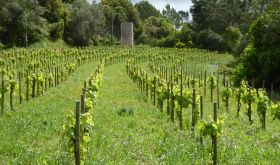
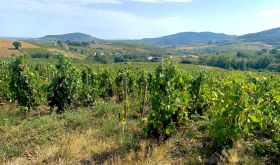
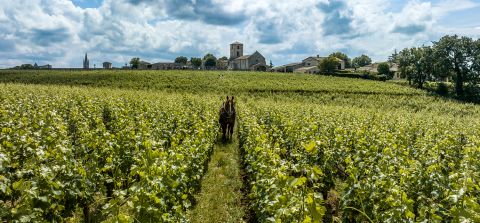
Even though it’s quite a small vineyard, we have very specific parts. You have the limestone plateau, you have the slope and you have the bottom of the slope. Over the past three years I’ve observed a lot about these areas because there are different expressions of each terroir, the different rootstock, the vigour of the vine. Little by little you begin to manage your vineyard more precisely. But what’s important is each vintage has been different so we’re learning new things as we go along.
For example, in 2022 we harvested most of the vineyard at the same time as the Merlot but at different points for the 2023 as the maturities were different.
That’s why it’s so interesting to work in wine because every year it’s totally different. Especially now with global warming, we’re experiencing a lot of extremes. Sometimes you have frost, sometimes you have heatwaves. When people ask me, particularly during en primeur, which vintage I would compare to the 2023, I can’t do it because they are all so different. We’ve had to adapt our management of the vineyard from how my father managed it in his generation because he had a method that worked then, whereas I have to observe, go outside and change with the seasons and the climate.
How would you describe the Beauséjour ethos?
I think Prisca’s and my goals are the same. We want to make Beauséjour one of the iconic wines. I would be very happy if it’s a wine that collectors seek out or if people say that they just want to taste it once in their life. I think Prisca and I are aware that we have a lot of work to do but I’m sure we’ll be there one day.
What wine is in your fridge right now?
That’s a good question because for the past month I’ve been having my own small wine cellar built in my house and last night I started to put all the bottles in it. I started opening boxes and it was like Christmas! I came across a wine from Domaine François Mikulski in Meursault, so I put it in my fridge for a lunch this week.
This interview has been edited for length and clarity. You can read the full text at Bordeaux Index. Members of JancisRobinson.com can also access 50+ tasting notes for the wines of Ch Beauséjour (Duffau-Lagarrosse) in our database.