The 51st publication in our series of entries into our wine writing competition comes from one of our youngest entrants.
Just in case the name Sophie isn’t clear, I am a woman, bearing the grand old age of 25, using any spare pennies to explore the finest food and wine establishments to be found in London, where I live. By day, I work at Berry Bros as Deputy Content Editor, looking after any and all copy requirements, including the blog (for which I commission, edit or write all content).
THE RISE OF RIDGE

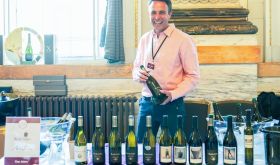
It was just two months after news of Paul Draper’s retirement had hit the wire that I visited Ridge, pictured above, on my very first stop on a Grand Tour of Northern California. Once I had established how to drive an automatic and how not to freak out about being on the wrong side of the road, I hit the highway from San Francisco out to Santa Cruz Mountains, just a short hour from the city, then on up a terrifying dirt track. Hairpin bend after hairpin bend led me up 2,400 feet to Ridge’s Monte Bello site, each corner offering a jaw-dropping glimpse of the view to be had if I could peel my eyes away from the road.
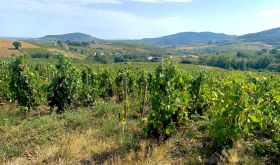
Perched atop the mountain, Monte Bello is uniquely beautiful. Leaving the city’s fog far behind, rising up from the heat of the valley, the air is refreshingly cool and the sun beats down on the vineyards, where the grapes (in mid August) were just in the midst of veraison. The building, while today bearing the hallmarks of a swish and modern operation, still feels like the 'homestead', a sense of rustic history that one can’t create.
Overlooking Silicon Valley, it is unsurprising that technology plays an important role here (as Alder Yarrow describes in The Silicon Valley effect on wine). It’s rare to see such a perfect balance struck between the science and art of wine, particularly at a time when the wine world is so overrun with examples of the extremes. Tiny producers experiment sometimes violently under the guise of natural, averse to advancements; and at the other end of the spectrum, mass-market wines are constructed according to recipe, correcting any possible variation to produce inane and characterless wine. Bang-slap in the middle, the pivot between these two approaches, lies Ridge Vineyards.
Of course the balance is in the blood, the forefathers a mixture of the two. The three musketeers who bought the site in the 1960s (Dave Bennion, Charlie Rosen, and Hew Crane), rescuing Monte Bello from its brief history as a hippy commune, were scientists at Stanford; while Paul Draper (whom they hired as Chief Winemaker in 1969) was a philosophy grad with just a stint of winemaking in Chile behind him, learning much of his craft from books on the job.
Eric Baugher, who has taken over production at Monte Bello (John Olney is responsible for Lytton Springs), studied biochemistry and molecular biology. Originally joining the team in Ridge back in 1994 as a chemist, his first big project was the eradication of Brettanomyces from the cellars. Today he is still clearly passionate about the science behind wine. On site they have a laboratory filled with the latest gadgetry. As Eric walks me around the room, he’s clearly excited by the analytical possibilities on hand, talking animatedly about his newest piece of kit that uses a laser to take a reading of a grape sample in just two minutes.
These readings, however, are never allowed to dictate how the wines are blended. In the vineyard, it’s really a way of keeping in touch with the vine’s progress, understanding its physiological ripeness and (importantly in recent years) water status; in the winery the focus is on stability and quality – ensuring that these are wines consumers can enjoy around the world and for decades to come. Eric deems it the responsible way to handle their 'risky winemaking', but when it comes to blending, that’s 'pure art'.
Their dedication to the technology that will support the Ridge philosophy doesn’t come cheap. Pointing to what looks to the untrained eye like a fairly average pump, Eric says: 'These are not standard pumps that you can go to any supplier and buy, we had them custom-built. I did that in 1997; $17,000 a piece.' I was stunned at how anything that looks quite so un-littered with diamonds could cost so much. Eric explains that these pumps draw wine out of barrel at the same rate as a gravity siphon. 'It’s a pretty cool type of pump.' For the price tag, you’d hope so.
In a particularly un-Silicon Valley way, there is little sense of information being proprietary, and a genuine wish to further the entire industry’s cause, undertaking research projects with UC Davis and Texas A&M, including a quest for the solution to Pierce’s disease.
While fads and fashions have swayed the style of California’s top properties, Ridge (like Au Bon Climat, Calera and a handful of others) has stayed true to a restrained, elegant style of winemaking – without sacrificing their distinctly New World character.
A large part of this is the increasingly rare use of American oak. For me it seems to be a true statement of terroir to embrace native oak in the way that Ridge does. Even more fascinating is the study of American oak that it has undertaken. Eric has found that Kentucky oak has the most 'synergy' with their terroir, although they also use Appalachian and Missouri oak. I taste 2015 Monte Bello first in Appalachian oak, showing lush fruit, while Missouri is much smokier, spicier and a little more angular. The wine from a lone Taransaud barrel has an enchanting nose, but it feels dry, almost staid on the palate. 'Our problem is that it makes the wine taste too much like Bordeaux, not to say that that’s a bad thing, but we’re in the New World. We want to use our own, local oak and make a wine that stands out on its own.'
For many, Paul Draper is Ridge, and news of his retirement (although to be expected at the age of 80) was devastating. Visiting Monte Bello, it’s clear that this fabled producer is the work of much more than one man. While Draper is undoubtedly responsible for building Ridge into what it is today, for seeing its potential back in 1969 and staying true to an often-unfashionable philosophy, his legacy is just the beginning.
THE BROC WAY

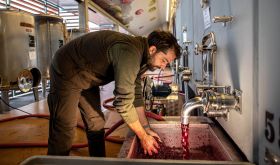
'We’re kind of preparing for harvest during harvest', Chris Brockway (pictured above) cheerfully shouts from behind his goggles as he power-hoses a prized Stockinger barrel. Pouncing on his eponymous winery, Broc Cellars, on a Tuesday morning, it’s all go, with the 2016 fruit about to start coming in, much earlier than anticipated. As he continues with the cleaning, his partner Bridget shows us around the ex-ink factory that they have turned into their cellar, winery and tasting room.
Tucked away on Berkeley’s residential side-streets, a short walk from the hallowed halls of the original Kermit Lynch shop, it’s not where you expect to find a winery, particularly not two wineries (with Donkey & Goat lying just the other side of the car park).
Advances in technology have led to a flurry of urban wineries opening – Donkey & Goat was certainly at the forefront, opening in 2004, with Broc Cellars not far behind in 2006; Brooklyn’s experimental Red Hook popped up in 2008 and it’s even reached the other side of the pond, with Roberson (also Broc’s UK importer) inspired to open London Cru in 2013. With refrigerated trucks, transporting fruit long distances no longer risks spoilage – and London Cru put this to the test, importing fruit from around Europe to make serious wine in Fulham.
With California’s wine country on their doorstep, Broc have little need to look too far for fruit. But in recent years, they have found themselves concentrating on sites a little closer to home. As they become increasingly involved in their vineyards (with an underlying ambition to own land), their focus has shifted to vineyards within a two-hour radius of the winery and particularly the Green Valley, which Bridget tells me has 'some of the oldest vines that you can find, still dry-farmed, own-rooted, and just some really down-to-earth farmers, who aren’t charging Napa prices'.
Undeniably natural in their approach, Broc also insist on using organic fruit, acknowledging that the ideal of biodynamics is too much to ask of many growers. Many of the sites aren’t certified, mostly for cost reasons, but they like to stay involved throughout the year, checking up on the vines and the growers. It can be difficult with some of the older growers, Chris suggests, who 'just spray chemicals ‘cos… it’s March 15th'.
Reassuringly, their natural approach is not in the least bit dogmatic, allowing themselves the use of sulphur at bottling on most of their wines. As Bridget tells me, 'Chris doesn’t see that as not being full natural, he’s like – hey, back in whatever days, that was the traditional way.’ And they’re enjoyably unserious about wine, totally lacking the pretence that a Napa estate might lend them.
Some ideas seem more off-the-wall than others. I curiously eye up a pair of open-top tanks that are like nothing I’ve ever seen in a winery and Bridget laughs, telling me that they are old (thoroughly cleaned, I’m assured) sewer pipes that someone down the street wanted them to try and they now use for their Nero d’Avola. They make their pet-nat in an off-the-cuff, low-cost, charmingly un-mysterious way; riddling the bottles by shaking them periodically with a forklift, and as to disgorgement, Chris says, 'Usually people have a machine – we have a bottle opener and a box of dry ice.' In my mind there’s a childish glee about their methodology – I imagine them watching the frozen neck of lees melting in the sun out back, eagerly awaiting the explosion as it bursts out, as a group of kids might enjoy popping a Mento into a bottle of coke and seeing the results.
That’s certainly not to belittle what Broc is doing. There is so much fun in the brand and it is producing truly delicious, refreshingly low-alcohol, pretty, juicy wines that are utterly drinkable – varying from totally gluggable to more refined examples.
At the more quaffable end of the spectrum lies one of my favourites, a wine that reclaims California’s history with a shameless reality: their white Zinfandel. 'I didn’t exactly decide to do it', Chris ventures. 'It just kind of started happening.' Two sections of the Zinfandel vineyards that they use (the majority of the fruit going into their fabled Vine Starr Zin) were extremely exposed, so they started picking it earlier and making a rosé that was surprisingly tasty. Even when made by Chris Brockway, it’s not always the easiest sell, but as he himself says, 'we’re still small enough we can have fun, don’t worry about it too much'.
Their determination to make wines that are accessible in price ('If [Chris] could make everything [sell for] 20 bucks, he would.'), hasn’t made it easy to get to this point, particularly with no outside investors helping them along the way. 'It’s not easy to do it, you have to be very poor and withdrawn in your account for a while', Bridget says – luckily now with a smile. 'It’s really exciting to see people really liking the wines and ordering them.'
Happy with the number of vineyards and growers he works with, Chris says, 'Now we’re kind of playing around within the vineyards rather than bringing on new vineyards. One of the problems that we’ve started is everybody’s now always asking what’s new? And I say, well I still have the Zinfandel that I’ve been making since 2006 …' While it has been easy to live off new creations over the past decade, it seems an appropriate time to 'settle down' into the wines they make (and for Chris and Bridget to finally move out of their apartment in the city). 'We want to try to grow more of the heritage vine styles – the Carignan, the Zinfandel, the Valdiguié, Grenache Gris and Chenin and kind of make that more of our core wines.'
It isn’t all quiet on the winemaking front though, with an entirely separate and new project underway. Brea is a joint venture with Tim Elenteny of TE Imports. The wines will be made at Broc Cellars, but they are making just three wines, from the state’s most planted grapes, entirely naturally: Pinot Noir, Chardonnay and Cabernet Sauvignon. A new challenge, particularly from their vinous clique, as Bridget says, because 'Cab, Pinot and Chard have such a negative connotation here in the natural wine world.'
Chris Brockway is clearly just one of a number of exciting producers embodying California’s now not-so-new wave (Idlewild, Matthiasson, Ryme and Tatomer to name just a few), experimenting with less fashionable grape varieties and producing restrained styles of wine that people actually want to drink. It wasn’t so long ago, Chris tells me, that even in San Francisco, '[he] was accused of making wines that weren’t Californian'. Luckily that’s changed and Broc Cellars is being rightly recognised for the quality of wine it’s producing.
Most importantly for me is the sense that Broc doesn’t take itself too seriously, producing proper wines – just with a sense of humour. 'We’re having fun, I might not say that in a couple of weeks, but it’s true', Chris smiles, looking at all that is yet to be done to prepare for the coming vintage. Provided that sense of playful exploration continues, the wines will undoubtedly maintain their place in California’s scene, producing elegant wines with just a whisper of anti-establishment.